Showing posts with label students. Show all posts

Friday, January 10, 2025

POLL: College Students Respect The Murderer More Than The Insurance Executive


The charts above are from the Generation Lab Poll -- done between December 19th and 23rd of a nationwide sample of 1,026 college students, and has a 3.4 point margin of error.

Sunday, February 12, 2023

21% Of Black Students Experience Discrimination


The charts above are from the Gallup Poll -- done between October 26th and November 7th of 2022 among 1,106 Black college students. No margin of error given. 

Tuesday, May 10, 2022

Will Biden Reduce Or Eliminate Student Loan Debt?

The exorbitant rise in the cost of a college education, combined with stagnant wage growth for most Americans, has created a crisis of debt for many students. There is currently about $1.7 trillion of loan debt for students. This is keeping them from buying the things their parents were able to buy at the same point in their lives, and that is a drag on the country's economy.

Many want President Biden to eliminate, or significantly reduce this loan debt. And currently he is considering doing that. Here, from Vox.com, are his three options:


Monday, February 14, 2022

Right-Wing Evangelicals Are Going To Hate This Study


The following post is part of an article by Michael Stone at Patheos.com:

New research shows children raised by same-sex couples do better in school than children raised by opposite-sex couples.

The Washington Post reports:

"Children of same-sex couples perform better in school than kids raised by a mom and a dad, according to new research from several European economists. 

The researchers found that children raised by same-sex couples had higher test scores in elementary and secondary school and were about 7 percent more likely to graduate from high school than children raised by different-sex couples."


Pink News notes that researchers who wrote the paper titled “School Outcomes of Children Raised by Same-Sex Couples: Evidence from Administrative Panel Data,” report the following:


"Our findings indicate that children particularly benefit from same-sex couples compared to opposite-sex couples if the couple is cohabiting rather than married…

Further, we also find that children from same-sex couples continue to outperform children from opposite-sex couples in secondary education. Our results suggest that children from same-sex couples are 6.7 percent more likely to graduate than children from opposite-sex couples."


The study was conducted by economists Deni Mazrekaj, Kristof de Witte, and Sofie Cabus of Belgian university KU Leuven, and “used government data tracking all children born in the Netherlands since 1995.”

The original research was presented at the American Economic Association conference in Atlanta in January.

Wednesday, February 02, 2022

The Way To Get Students To Read A Book


The following post is from Robert Reich:

When I was a young teenager near the middle of the last century, I asked the high school librarian if I could borrow J.D. Salinger’s The Catcher in the Rye. Why did I want to read it? she asked. I lied and told her my parents told me it was excellent literature.

The real reason I wanted to read The Catcher in the Rye was it had been banned from the library. I knew the librarian kept one copy behind her desk, and I was determined to get it. She reluctantly handed it to me. I read it voraciously. 

There’s no better way to get a teenager to read a book than to ban it.

Which is why it was so clever of the McMinn County, Tennessee, school board to vote to remove Maus from its eighth grade curriculum. Maus is a Pulitzer-winning graphic novel by Art Spiegelman that conveys the horrors of the Holocaust in cartoon form. The board cited “objectionable language” and nudity.

Before the board made its decision, teenagers in McMinn County probably weren’t particularly eager to read about the Holocaust, even in the form of a graphic novel. But now that Maus has been banned for objectionable language and nudity, I bet they’re wildly trading whatever threadbare copies they can get their hands on. 

Since it was banned, half the teenagers in America seem to have bought Maus (or insisted their parents do). Two weeks ago, the book wasn’t even in the top 1,000 of Amazon’s bestseller list. Now it’s number 1.

Way to go, McMinn County school board! Get teenagers all over America excited to read about the Holocaust!

Even the McMinn County school board has been outdone by the Matanuska-Susitna school board in Palmer, Alaska, which clearly had a more serious problem on its hands than getting teenagers excited to read about the Holocaust. It couldn’t even get them to read the great novels of American literature. 

So the Matanuska-Susitna school board voted 5 to 2 to ban Invisible Man by Ralph Ellison, Catch-22 by Joseph Heller, The Things They Carried by Tim O’Brien, I Know Why the Caged Bird Sings by Maya Angelou, and The Great Gatsby by F. Scott Fitzgerald.

Brilliant! I bet nearly every teenager in Palmer, Alaska is now deep into these books. They’re probably having intense discussions about them online late at night, away from their parents and other snooping adults. “Why do you think Ellison called himself ‘invisible?’” “How did Angelou come up with those amazing metaphors?” “Why did Daisy Buchanan reject Jay Gatsby?” “Wait! Shhh! Gotta go! My parents are right outside my room! Call back in 20 minutes!”

The Great Gatsby was required reading when I went to high school. I admit I never read it. Had it been banned, I probably would have devoured it. 

Beginning last fall, at least 16 school districts in a half-dozen states have demanded school libraries ban Out of Darkness. It’s a young adult novel about a love affair between two teenagers, a Mexican American girl and Black boy, set against the backdrop of the 1937 natural gas explosion at a New London, Texas plant that claimed nearly 300 lives. The book received lots of favorable reviews and literary rewards, but only a handful of teenagers read before it was banned. Now, it’s hot.

It’s the cleverest marketing strategy I’ve ever seen. Publishers must be clamoring to have school districts ban their books. (Why haven’t my books been banned, dammit?)

An influential group called “No Left Turn” is partly responsible. Just take a look at their website of books “used to spread radical and racist ideologies to students.” You can bet teenagers across America are now lining up to read them.

Wednesday, October 20, 2021

Authoritarian Right Is Using School Children As Pawns


School board meeting are becoming chaotic and violent. And board members, school officials, and teachers are being threatened and attacked. This is the new tactic by right-wingers who don't want real history (or real science) taught, and don't want school children protected from COVID-19 by masks or vaccines. In short, they are using school children as pawns to achieve their authoritarian dream.

Here is part of how Ruth Ben-Ghiat describes it at CNN.com:

The authoritarian-style party discipline Trump imposed during his time in office remains in place. Lawmakers who criticize Trump, like Liz Cheney, are viewed as disloyal and ostracized by the GOP establishment. And questioning the leader cult can be downright dangerous. . . .

Now this authoritarian culture, which sees those who hold different views as enemies, has reached the personal and local levels. Schools, and school boards, are the latest front of a Republican crusade to "take back America" through violent verbiage. For instance, Steve Lynch, the Republican nominee for Northampton County executive in Pennsylvania, advocates the use of intimidation at school board meetings to deal with parents who support mask mandates. "I'm going in with 20 strong men....I'm going to give [the school board] an option: They can leave or they can be removed," he declared. . . .

Centering the anti-mask and anti-vaccine fight on schools may seem an illogical move by Republicans: What parent wouldn't want to keep their children safe by complying with best public health practices? Yet right-wing propaganda has effectively convinced many parents that masks are "muzzles" of freedom and vaccine mandates tyrannical, spawning new waves of activists imbued with an intolerant "us vs. them" mentality little in keeping with democratic models of civic life.

This translates into public bullying of parents who want to protect their children from Covid-19. In Los Angeles, anti-vaccine mandate protesters harassed parents at school drop-off. They claimedthat masking is child abuse and subjecting children to vaccines a form of "rape." In Grand Rapids, Michigan, "Moms for America" activists pressured parents to pull their children out of schools that mandate face coverings. "We have had enough of the forced mandates, knee-jerk reactions, and government overreach," said the group's founder, Kimberly Fletcher. "We will not co-parent with the government."

Here the supposed advocates of education "freedom" show their hand. Arguments like those repeated by Fletcher have little to do with child welfare. But they have everything to do with right-wing efforts to discredit the Biden administration by depicting it as bringing socialist tyranny to America, and by labeling Democrats as degenerates who exploit children (the latter belief is also a central tenet of QAnon conspiracy theories).

Concern for children in this context is just a smoke screen for right-wing activists with far greater ambitions. Calls by Fletcher and many others for a mass exodus from public schools, with the excuse of opposing vaccine and mask mandates, align with the ideal of divesting from the civic space of democracy altogether. They also further the cause of privatizing American education -- a pet project of Trump's Education Secretary Betsy DeVos.

Moreover, the idea of "parental rights" in schools, advocated by anti-vaccine militants and their White Christian Evangelical allies, also becomes another way to justify censorship of ideas you don't like, such as the centrality of slavery in America's development and the costs of institutionalized racism.

It's not surprising that former Secretary of State Mike Pompeo wants the private realm to take control of public school curricula. "I think parents should decide what their children are taught in schools," he tweeted, his stance also reinforcing the right's disdain for expertise.

Nor is it unexpected that Glenn Youngkin, who is running for Virginia governor against Democrat Terry McAuliffe, cites parental rights, along with opposition to critical race theory and "transgender ideology," as part of his ideals for school reform. If Youngkin truly cared about public schools, his campaign wouldn't be pushing for parents to pull their kids out of them; and if he truly cared about child health and safety, he wouldn't be opposing mask and vaccine mandates.

When illiberal forces are on the march, the education system is always in their sights. The brutal rejection by activist parents of differences of opinion, and the spread of practices of harassment meant to frighten others into silence, models the kind of authoritarian culture the right is trying to install, town by town, school board by school board.

Thursday, January 28, 2021

Senator Warren Calls For Forgiving Student Loan Debt

The following is the letter from Senator Elizabeth Warren (D-Massachusetts) to her supporters regarding student loan debt. She favors forgiving up to $50,000 of that debt. Here is what she had to say

There's been a lot of talk about unity recently.

For me, unity is about doing the work that the American people want done.

It's not about ideology. It's not about helping just the richest Americans or some interest group — unity is about doing things that the American people want to see us do.

And you know one thing that unites Americans? Canceling student loan debt.

It's a hugely popular proposal that would immediately put hundreds and thousands of dollars back in the pockets of millions of Americans, start to close the racial wealth gap, and boost our economy.

And the president can get it done without waiting for Congress.

I'm partnering with Senate Majority Leader Chuck Schumer and Congresswoman Ayanna Pressley to set a bold plan for how Joe Biden can use his executive authority to deliver meaningful relief to struggling Americans and broadly cancel up to $50,000 in student loan debt.

We need to take action because families need relief. Over 40 million Americans are being crushed by over $1.5 trillion in federal student loan debt.


In the middle of an economy that's been badly hit by the pandemic, the student debt crisis acts like an anchor, preventing a swift recovery and restricting opportunity and prosperity for millions of American families.

Canceling student loan debt as soon as possible would mean substantial and immediate relief for tens of millions of Americans, many of whom have suddenly been laid off or are worried that their jobs are next.

And communities of color, which have been hit hardest by the health and economic consequences of the coronavirus pandemic, disproportionately bear the burden of student debt.

Black students are on average nearly 20 percentage points more likely to take out federal student loans. Half of Black borrowers and a third of Latino borrowers default on their loans within 20 years. Canceling student loan debt would increase wealth for Black and Latino families, help them avoid default, and start to close the racial wealth gap.

Economists agree that canceling student loan debt would also help boost our struggling economy through a consumer-driven economic stimulus, greater home-buying rates and housing stability, expanded access to more affordable financial products including car loans and mortgages, higher college completion rates, and greater small business formation. This is a no brainer for our economy.

Look: we all saw what happened in 2008. After the financial crisis, young people were shoved into a weak job market and plunged even deeper into student debt. And today, as workers face layoffs and frozen wages in the wake of the coronavirus pandemic, student loan borrowers who were barely staying afloat are now drowning. When Americans can't fully participate in our economy, we see a ripple effect across our entire economy and a slowdown in economic growth. This affects all of us, including those of us who don't have student loans or have already paid off their student debt.

We can do better than this. And Democrats will.

Elizabeth

Tuesday, August 04, 2020

Parents Less Likely To Favor In-Person Schooling


The charts above are from the Gallup Poll -- done between July 13th and 27th of a national sample of 1,028 parents, with a 6 point margin of error.

As the school year gets nearer, more parents don't want their children exposed to the virus for in-person schooling.

Thursday, July 30, 2020

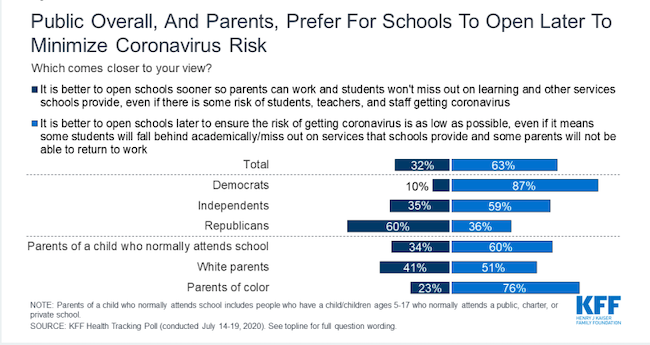
The Public Doesn't Think The U.S. Is Ready To Open Schools


The charts above are from the Kaiser Family Foundation Poll -- done between July 14th and 19th of a national sample of 1,313 adults, with a 3 point margin of error.

Donald Trump and the Republicans want to reopen the schools in the United States, and Trump has even threatened to cut funding for schools that don't reopen. They know that reopening the schools is critical to getting parents back to work -- and they value the economy over the health and lives of American citizens.

But the American public disagrees. They want the virus under control before sending their students back into what could be very dangerous schools. About 60% say we have yet to see the worst from the virus, and 63% say it would be better to delay the school openings. They are worried about the safety of both students and teachers, and they fear students will bring the virus home to their families.

They are right!

Saturday, February 15, 2020

Segregation/Poverty Still Hurting Too Many Black Students


Too many Whites, especially those living in predominately white communities, think we have solved the problem of segregation. Unfortunately that is not true. Too many Black students still attend mostly Black schools, and making it even worse, those schools are in poverty-stricken areas. We need to address this problem if we are going to offer truly equal opportunity to all students.

The charts above are from the Economic Policy Institute, and the post below (from Emma Garcia at the Economic Policy Institute) outlines the problem. Ms. Garcia writes:

Well over six decades after the Supreme Court declared “separate but equal” schools to be unconstitutional in Brown v. Board of Education, schools remain heavily segregated by race and ethnicity.
What are the consequences of this lack of progress in integrating schools for black children?
  • It depresses education outcomes for black students; as shown in this report, it lowers their standardized test scores.
  • It widens performance gaps between white and black students.
  • It reflects and bolsters segregation by economic status, with black students being more likely than white students to attend high-poverty schools.
  • It means that the promise of integration and equal opportunities for all black students remains an ideal rather than a reality.
In contrast, when black students have the opportunity  to attend schools with lower concentrations of poverty and larger shares of white students they perform better, on average, on standardized tests.
Findings on school segregation and student performance come from the National Center for Education Statistics’ National Assessment of Educational Progress (NAEP), the most comprehensive study of education performance in the country. We use the most recently released data to describe school segregation and its consequences for math performance of eighth-graders. These data show that only about one in eight white students (12.9%) attends a school where a majority of students are black, Hispanic, Asian, or American Indian. (We refer to this group collectively as students of color hereafter.) In contrast, nearly seven in 10 black children (69.2%) attend such schools (see Figure A).
As shown in Figure B, black students are also in economically segregated schools. Less than one in three white students (31.3%) attend a high-poverty school, compared with more than seven in 10 black students (72.4%).
The known connection between race/ethnicity and poverty in the United States appears in data on the composition of schools attended by for black children. Figure Cshows that a black child faces a very high probability of ending up in a school where a majority of her peers are both poor and students of color. While less than 1 in 10 white students (8.4%) attend high-poverty schools with a high share of students of color, six in 10 black students (60.0%) do.
In contrast, about a fourth of white students (23.5%) attend schools where most of their peers are white and not poor, while only 3.1 percent of black children attend such schools.
When black children have the opportunity to attend the same schools that white children routinely attend, black children perform markedly better on standardized math tests, which we use here as a measure of education performance.
Figure D shows math scores of black eighth-graders in low-poverty, mostly white schools and in high-poverty schools with a high share of students of color. In high-poverty schools with a high share of students of color, black students scored on average 20 points less on standardized math tests than their counterparts in low-poverty, mostly white schools (255.4 vs. 275.3). In other words, scores are much lower in the type of school that black children are overwhelmingly more likely to attend (high-poverty, mostly students of color) than in the type of school (low-poverty, mostly white) that only 3.1% of black children have a chance of attending.
Though not shown in the figure, the gap between black and white student test scores is larger in high-poverty schools with a high share of students of color than in low-poverty, mostly white schools. By promoting policies that facilitate a shift away from our current pattern of heavily segregated schools, we would thus help close the gap between black and white students overall.
Unaddressed school segregation is a major longstanding policy failure. It consigns most black children to schools that put them behind academically. The persistent performance gaps between white and black children that challenge the education and career prospects of black children from early on demonstrate that school segregation continues to cast a very long shadow—from well before Brown v. Board of Educationto today, and into the future.

Monday, January 06, 2020

Forgiving Student Debt Would Be Huge Boost To Economy


Student debt has ballooned in the last decade, and now surpasses both auto loan and credit card debt (see the chart above). This is because college costs have risen and many students cannot attend college now without going into debt. The problem is that this enormous debt is holding many graduates back from starting families or buying homes -- and that is hurting the U.S. economy.

Some Democratic presidential candidates (especially Elizabeth Warren and Bernie Sanders) have proposed forgiving part or all of this debt. It's not a bad idea. Doing so could be a big boost for the U.S. economy, and benefit all citizens.

Here is what Chris Arnold has to say about forgiving student debt at NPR.org:

Presidential hopefuls Elizabeth Warren and Bernie Sanders want to tear up your student loans and set you financially free. That's popular among voters – especially those struggling to pay off this debt.
Other Democratic candidates have more modest plans. But economists say the dramatic proposals from Sanders and Warren to free millions of Americans from the burden of student debt could boost the economy in significant ways and help combat income inequality.
Warren would forgive up to $50,000 for most people. Sanders would go further with total loan forgiveness. But with these plans having a price tag north of $1 trillion, such legislation would come with plenty of risks.
The reason debt forgiveness could have a big impact on the overall economy is that a generation of Americans is making major life decisions differently because of student loans.
"Children, it's not about if you want them," says Laura Greenwood in Montpelier, Vt. "It's about can you afford them?"
Greenwood works for the state education agency. She's 30 years old and makes $63,000 a year. "I make probably a better salary than a lot of my peers."
But after paying for college and grad school, Greenwood owes $96,000 in student loans. And she says that's got her and her partner feeling frozen. "Yeah. It's always, we're interested in having kids, but just cost of living and all our other bills and then the student loans, it's just like the final straw." She says it makes starting a family feel impossible.
So if people like Greenwood suddenly had this millstone of debt lifted from their necks, it stands to reason that would unleash pent-up desires and spending that would be good for the economy. A lot more people would have kids, or start businesses, or buy houses.
"In the short term, it would be very positive for the housing market," says Lawrence Yun, the National Association of Realtors chief economist. He says his group's surveys show that student debt has people delaying homeownership by five to seven years.
He's not endorsing any particular plan, but he estimates that broad loan forgiveness would push up the number of home sales quite a bit. "Home sales could be, say, 300,000 higher annually if people were not saddled with large student debt." Yun says that would be "a boost to the housing sector as well as the economy."
The effects would go beyond the housing market. William Foster is a vice president with Moody's, which just did a report on student debt forgiveness. "There've been some estimates that U.S. real GDP could be boosted on average by $86 billion to $108 billion per year," which is "quite a bit," he says. "That's if you had total loan forgiveness." Foster says it wouldn't have to be total forgiveness to see significant results. And he says it could also help address rising income inequality.

Wednesday, October 16, 2019

College Students Overwhelmingly Support Impeachment


This chart reflects the results of the Axios / College Reaction Poll -- done between October 8th and 10th of a national sample of 850 college students, with a 3.3 point margin of error.

While the American public may be split on whether to impeach Donald Trump, college students are not. About 76% of college students support impeachment (a 24 point jump over this same poll last May).

And all political groups have shown a significant increase over May -- the Democrats by 26 points, the Independents by 32 points, and Republicans by 6 points.

Friday, September 20, 2019

College Student Voting Doubled From 2014 to 2018


The chart above is from the Institute for Democracy & Higher Education. It is their report titled National Study of Learning, Voting, and Engagement -- and it is good news for Democrats.

Much has been made in the past about how young voters prefer Democrats, but don't vote in large numbers. This shows that is changing. While only 19.3% of college students voted in 2014, that doubled in 2018 to 40.3%. And the rise in college student voting was across the board -- in both two-year and four-year colleges, and in both private and public colleges.

I'm betting that percentage rises again in 2020!

Wednesday, October 17, 2018

Poll Says Half Of College Students Will Vote This Year


These charts are from the recent College Reaction Poll done between September 20th through 25th of 3,633 current college students. No margin of error was given, but the poll was weighted to reflect the proper gender and racial figures of college students.

It shows that about 77% of college students are registered to vote. About 50% say they will definitely vote and another 36% say they will "maybe" vote. About 49% identify as a Democrat, while only 21% identify as Republican. About 4% say they are Libertarians, 1% identify with Green Party, and 24% say they are Independents.

They were also asked who they might support in the next presidential election. It is normally assumed by many that the vast majority would be Bernie Sanders supporters, but as the chart below shows, that is not true. He currently only has the support of about 27% of college students (one point behind Joe Biden at 28%). Trump is in third with 13%.


Saturday, April 21, 2018

Emma, Jaclyn, Cameron, Alex, And David


Time Magazine has published its list of the 100 most influential people in 2018, and making that list this year are five students from Parkland Florida (Cameron Kasky, Jaclyn Corin, David Hogg, Emma Gonzalez, Alex Wind). One of my favorite people wrote the article for their inclusion on the list.

Barack Obama writes:

America’s response to mass shootings has long followed a predictable pattern. We mourn. Offer thoughts and prayers. Speculate about the motives. And then—even as no developed country endures a homicide rate like ours, a difference explained largely by pervasive accessibility to guns; even as the majority of gun owners support commonsense reforms—the political debate spirals into acrimony and paralysis.
This time, something different is happening. This time, our children are calling us to account.
The Parkland, Fla., students don’t have the kind of lobbyists or big budgets for attack ads that their opponents do. Most of them can’t even vote yet.
But they have the power so often inherent in youth: to see the world anew; to reject the old constraints, outdated conventions and cowardice too often dressed up as wisdom.
The power to insist that America can be better.
Seared by memories of seeing their friends murdered at a place they believed to be safe, these young leaders don’t intimidate easily. They see the NRA and its allies—whether mealymouthed politicians or mendacious commentators peddling conspiracy theories—as mere shills for those who make money selling weapons of war to whoever can pay. They’re as comfortable speaking truth to power as they are dismissive of platitudes and punditry. And they live to mobilize their peers.
Already, they’ve had some success persuading statehouses and some of the biggest gun retailers to change. Now it gets harder. A Republican Congress remains unmoved. NRA scare tactics still sway much of the country. Progress will be slow and frustrating.
But by bearing witness to carnage, by asking tough questions and demanding real answers, the Parkland students are shaking us out of our complacency. The NRA’s favored candidates are starting to fear they might lose. Law-abiding gun owners are starting to speak out. As these young leaders make common cause with African Americans and Latinos—the disproportionate victims of gun violence—and reach voting age, the possibilities of meaningful change will steadily grow.
Our history is defined by the youthful push to make America more just, more compassionate, more equal under the law. This generation—of Parkland, of Dreamers, of Black Lives Matter—embraces that duty. If they make their elders uncomfortable, that’s how it should be. Our kids now show us what we’ve told them America is all about, even if we haven’t always believed it ourselves: that our future isn’t written for us, but by us.

Wednesday, March 14, 2018

College Students See An Erosion Of 1st Amendment Rights


These charts are from the Gallup Poll. The survey was done between November 1st and December 10th (2017) of a random national sample of 3,014 students attending a four-year college in the U.S., and has a margin of error of 2 points. That sample is compared to a similar survey done in 2016.

Those students were asked in both years whether they thought our First Amendment rights (free speech, free press, free assembly, freedom to petition government, and freedom of religion) were secure or not. The charts show the percentage believing those rights were secure.

Note that, except for Republicans, the college students had a drop from 2016 to 2017 in the belief that those rights were secure -- and that drop was evident for all five of the freedoms. In other words, more students saw those rights as eroding in 2017 than saw that in 2016.

This is understandable. We have an occupant of the White House right now that does not respect the First Amendment rights. He has attacked anyone who would speak or demonstrate against him (whether in the press or as an individual or group), and his pandering to christian evangelicals has weakened the religious rights of those in another religion (or without religion).

For Trump, rights are only reserved for those who agree with him.

Saturday, February 24, 2018

"Young Adults With Passion Can Change The World"

(Photo of teens from Marjory Stoneman Douglas High School is from NBC News.)

Dan Rather is exactly right in this comment from his Facebook page:

We can have a debate about gun control. But to all those "adults" who mock or lie about the students of Marjory Stoneman Douglas High (and the waves of sympathetic students across the nation), to all those who rain vitriol down on children's heartbreak and nascent activism, to all those who spread outrageous conspiracy theories meant to dismiss those who demand to be heard, there is no place for you in civil society. 
I know why the reactionary forces who have cynically played the status quo on our gun culture to their political and economic power are fanning the flames of these outrages. They know, as I do, that young adults with passion can change the world. I saw that in Birmingham, Alabama when African American children faced the fire hoses and dogs in the march for racial justice. I saw it in the jungle hell of Vietnam and the streets of America when young soldiers and protesters asked the chilling question: what are we fighting and dying for? I saw it in Europe where waves of youthful activism shattered the Iron Curtain. 
The voice of a child is often a clarion call to action. In their purity lies passion and courage. They are our future. And when they roar, they will be heard and shake the political status quo of our nation.