Showing posts with label GDP. Show all posts

Wednesday, August 04, 2021

Trump Had The Worst GDP Growth Since Hoover


Throughout his campaign and his term in office, Donald Trump bragged about how good a businessman he was, and how his presidency would be the greatest for the economy. It didn't work out that way. It turns out he was as incompetent at directing the economy as he was about everything else. GDP growth, one of the best predictors of how well the economy is doing, was not good during Trump's time in office. In fact, he had the worst GDP growth since Herbert Hoover.

Here is some of how Bloomberg News reports it:

It was the whopping-yet-still-disappointing 6.5% annualized growth number for the second quarter that got most of the attention when the U.S. gross domestic product report came out Thursday. But the data release from the Commerce Department’s Bureau of Economic Analysis also included revisions to GDP and related measures back to 1999, making this an opportune time to take another look at economic growth under Donald Trump and his predecessors.

This is, let’s be clear from the start, not a perfect way of measuring presidential economic performance. There are lots of things that determine economic growth rates other than who is in the White House, and when a president does make a difference the results may be felt long after he’s left Washington. Still, it’s a widely used metric and Trump was downright obsessed with it, so here goes.

OK, maybe that GDP obsession didn’t work out so well for Trump. The chart starts with Dwight Eisenhower because his was the first presidency for which the BEA has full quarterly GDP data. Annual GDP numbers go back to 1929, and if you measure from Herbert Hoover’s first year in office (1929) to the year he left (1933), annualized growth was negative 7.4 percent. So Trump did a lot better than that! But his was the worst GDP performance since then (measured the same way as with Hoover). . . .

All of those top performers except Reagan were Democrats, which has not gone unnoticed by economists. Over the nearly 75 years for which we have reliable quarterly GDP and monthly jobs numbers, the growth of both has been markedly faster during Democratic presidencies than Republican ones. . . .

Trump offered hints of a different economic approach, but the signature legislative accomplishment of his term was another big tax cut and his growth numbers will drag the Republican averages down even further. 

Thursday, February 04, 2021

GOP Presidents Are NOT Best For Economy - Democrats Are


 Republicans like to brag that their policies are best for the economy. There's only one thing wrong with that -- it is NOT true! In both GDP (gross domestic product) growth rate and job growth -- the two economic indicators most mentioned as positive evidence of a good economy -- Democratic administrations were better than Republican administrations.

The two charts above (from The New York Times) show the truth, using figures from the U.S Bureau of Economic Analysis and the U.S. Bureau of Labor Statistics. Note that concerning GDP growth, the highest growth rate was among Democratic presidents (with top four growth rates happening under Democratic administrations). And with job growth, the top six growth rates were under Democratic administrations.

The one thing Republicans are good at is cutting taxes for the rich, but that doesn't help the economy. It only fattens the bank accounts of the rich. It is Democratic administrations that have initiated policies that help the economy (and most Americans).

Tuesday, October 13, 2020

Democratic Presidents Are Better For Economic Growth


Republicans have been selling Americans a lie for decades now -- that Republican presidents are better for the economy than Democratic presidents. And sadly, many Americans have bought that lie. 

That does not make it true though. In fact, it turns out that Democratic presidents are significantly better for economic growth than Republican presidents -- and that is true of both Gross Domestic Product (GDP) and stock market growth.

This is not just my opinion. The data bears it out. Here's how Business Insider (a conservative publication) reports this:

It's a widely held view that Republican presidents are better for the economy and stock market than Democratic presidents, because of their drive to cut taxes and reduce government spending. But the data says otherwise.

According to an August 21 note from Liberum, a UK-based investment bank, historical stock market returns and gross domestic product data points to a stronger economic expansion under Democratic presidents than under Republican presidents.

The firm looked at data going back to 1947, which is when official GDP calculations were introduced, to analyze who did better. Liberum credited a new president with the economic performance of the first quarter of his first year in office.

According to Liberum, the average annual US GDP growth rate under a Democratic president was 3.6%, compared to 2.6% for a Republican president. And those economic gains trickled down to stock market gains as well.

Liberum found that the stock market, represented by the S&P 500, posted an average annual total return of 10.8% under a Democratic president, compared to just 5.6% for a Republican president, since 1947.

Many would likely argue that the data is skewed to favor a Democratic president because it includes the Great Recession of 2008, and the COVID-19 induced market sell-off of 2020, both of which happened under Republican presidents.

Therefore, Liberum also looked at the historical data from 1947 to 2006, which excludes both the Great Recession and the COVID-19 pandemic.

But the data is more of the same. From 1947 to 2006, the average annual return for stocks under a Democratic president was 10.5%, versus 6.1% under a Republican president.

The difference in economic and stock market gains between a Democratic and Republican president can be explained by "fiscal multipliers," according to Liberum.

While Republicans aim to stimulate the economy via tax cuts and deregulation, Democrats aim to stimulate consumption (and thus the economy) with redistribution policies like increased unemployment benefits, increased child credits, and food stamp support, Liberum noted.

And those policy differences can lead to sizable differences in their economic impact.

If a tax cut introduced by Republicans led to a 1% decrease in tax income for the government, it would boost economic growth by 0.3% to 0.4%. 

Meanwhile, expanding unemployment benefits and other policies often pushed by Democratic presidents "has a fiscal multiplier of 1.2 to 1.7," Liberum found.

In other words, tax cuts would have to be 5x larger than increases in welfare spending to have a similar economic impact.

Friday, July 31, 2020

2nd Quarter GDP Shows Biggest Drop Since Great Depression


From The New York Times:

Economic output fell at its fastest pace on record last spring as the coronavirus pandemic forced businesses across the United States to close their doors and kept millions of Americans shut in their homes for weeks.

Gross domestic product — the broadest measure of goods and services produced — fell 9.5 percent in the second quarter of the year, the Commerce Department said Thursday. On an annualized basis, the standard way of reporting quarterly economic data, G.D.P. fell at a rate of 32.9 percent.

The collapse was unprecedented in its speed and breathtaking in its severity. The only possible comparisons in modern American history came during the Great Depression and the demobilization after World War II, both of which occurred before the advent of modern economic statistics.

Donald Trump and the congressional Republicans would like you to believe the economy is ready to bounce back -- even better than before. That is not true!

This is an economy in deep trouble -- more trouble than most Americans have seen in their lifetimes. And it won't be fixed by reopening businesses and schools. That will just help to spread the Coronavirus, and the economy cannot begin to heal until the virus is brought under control -- which the country is not even close to doing.

We cannot expect the GDP numbers to magically bounce back in the third quarter either. We are already one month into the third quarter, and the virus is still raging across the country. It is likely that the third quarter GDP will look as bad as the second quarter does.

This is going to be an extended recession, and anyone expect the economy to quickly bounce back is living in a dream world. Many small businesses will not recover from the recession, and many workers will be left without jobs even after the virus is controlled. The Bush recession took well over a year for the economy to recover, and even longer for many Americans to recover their own financial position. The Trump Recession could last even longer.

We should remember that the Trump recession didn't have to happen. If Trump had acted quickly and competently once notified of the Coronavirus (like Obama did after learning of Ebola), the economy might not have even had to be shut down. But Trump delayed doing anything for far too long, and then did not do enough. That continues to be the case.

Friday, March 27, 2020

Americans Beginning To Understand We're Facing Recession


The charts above are from the Gallup Poll. It is from surveys done between March 13-16, March 17-19, and March 20-22. The latest poll had a national sample of 3,555 adults, and a margin of error of 3 points. The preceding polls were similar.

It shows the public is finally starting to realize the trouble our economy is in. Between March 13-16 only 38% of the public thought a recession was imminent. Now that figure has risen to 61%.

The truth is that we are already in a recession. A recession is defined as two quarters of negative GDP (Gross Domestic Product) growth. The figures for first quarter GDP will be released after the end of this month, and no economist believes the quarter will show positive growth. And neither will the second quarter (April thru June).

Sadly, there is still one group refusing to believe the economic reality -- Republicans. Only 35% of Republicans think a recession will occur. They get their news from Donald Trump and Fox News, and they evidently believe the lies both are telling them.

Saturday, February 01, 2020

Growth Of Productivity Is Not As Good As Trump Claims


While in Davos a few days ago, Donald Trump claimed:

“The United States is in the midst of an economic boom the likes of which the world has never seen before.”

The charts above (from The New York Times) shows that is a lie. The top chart shows the quarterly growth of Gross Domestic Product (GDP). The second chart shows the yearly growth of GDP.

Note that while there is still positive growth, that growth has slowed -- and for the last three quarters has barley topped 2%. It was also only slightly more than 2% for the entire year of 2019. That is far from "an economic boom the likes of which the world has never seen before".

This is just more proof of the failure of the Trump/GOP tax cuts. They were supposed to provide enormous economic growth and higher wages for workers. They did neither.

Thursday, October 31, 2019

Economy Good? NOT For The Middle & Working Classes


Donald Trump continues to brag about the economy, and the media seems to agree with him. It is a good economy for the top 1% (and maybe even for the top 10%). But the bottom 90% ( the middle and working classes and the poor) are being left behind in this "good economy".

The charts on this page were found at Axios.com, and they paint a rather bleak picture of the economy for most Americans. Note the chart above. It shows that working and middle class wages have risen by about 15% in the last four years. But there's no cause for celebration. Inflation has eaten up more than that -- with housing rising by 26%, medical costs rising by 33%, and college costs rising by 45%. Most people, thanks to rising costs, are doing worse than they were during the Obama administration.

Will the economy do better, and help the middle and working classes? Not likely. The chart below shows the economy is slowing down. While the GDP had some robust growth in the first quarter (slightly over 3%), it dropped sharply in the second quarter (about 2.1%), and again in the third quarter (about 1.9%). Those are not the kind of numbers that make businesses want to raise wages.


Sunday, March 31, 2019

The GDP Growth From The Tax Cuts Is Going Away Now


The only thing Donald Trump has going for him is a fairly good economy (although while the numbers look good, too many people are not benefitting from it). We can argue about whether he is just the beneficiary of a growing Obama economy or deserves some credit for the economy. But one thing is becoming clear now -- the economy is starting to slow, and Trump's tax cuts are not producing the growth they were supposed to produce.

Here's how Nobel Prize-winning economist Paul Krugman puts it in his NY Times column:

So far, Donald Trump has passed only one significant piece of legislation: the 2017 tax cut. It was, to be fair, a pretty big deal: corporations, the principal beneficiaries, have already saved more than $150 billion, and over the course of a decade the tax cut will probably increase the budget deficit by more than $2 trillion.

But the tax cut was supposed to do more than just give stockholders more money — or at least that’s what its proponents claimed. It was also supposed to lead to many years of high economic growth, 3 percent or more at an annual rate.

Independent observers were skeptical, to say the least. They conceded that the tax cut might lead to a brief sugar high, because that’s what big deficits do. But any favorable effects on growth, they argued, would soon fade out. And they always insisted that it would take some time to assess the tax cut’s actual effects.

Nonetheless, when the economy grew pretty fast in the second quarter of last year, Trump and his supporters cried vindication, and ridiculed the critics.

But a bit of time has passed since then. The chart (above) shows the U.S. economy’s growth rate by quarter since the beginning of 2018. The last number isn’t official; but there are a number of independent observers, including both Federal Reserve banks and private financial institutions, who produce “nowcasts” that estimate growth based on early data. At this point all of these nowcasts show slowing growth, and most put the first quarter at around 1.5 percent.

So do the results so far look like the huge, sustained boom the Trump camp promised, or the brief sugar high predicted by the critics? . . .

The Trumpist theory — which was, I’m sorry to say, endorsed by conservative economists who should have known better — was that there was a huge pile of money sitting outside the U.S. that companies would bring back and invest productively if given the incentive of lower tax rates. But that pile of money was an accounting fiction. And the tax cut didn’t give corporations an incentive to build new factories and so on; all it did was induce them to shift their tax-avoidance strategies.

As Brad Setser of the Council on Foreign Relations points out, a casual glance at the data seems to suggest that American companies earn a lot of their profits at their overseas subsidiaries. But a closer look shows that the bulk of these reported profits are in a handful of small countries with low or zero tax rates, like Bermuda, Luxembourg and Ireland. The companies obviously aren’t earning huge profits in these tiny economies; they’re just using accounting gimmicks to assign profits earned elsewhere to subsidiaries that may have a few factories, but sometimes consist of little more than a small office, or even just a post-office box.

These basically phony profits then accumulate on the books of the overseas subsidiaries, rather than the home company. But this doesn’t affect their ability to invest in America: if Apple wants to spend a billion dollars here, it can always borrow the money using the assets of its Irish subsidiary as collateral. In other words, U.S. taxes weren’t having any significant effect in deterring real investment in the U.S. economy.

When Trump cut the tax rate, some companies “brought money home.” But for the most part this had no economic significance. Here’s how it works: Apple Ireland transfers some of its assets to Apple U.S.A. Officially, Apple Ireland has reduced its investment spending, while paying a dividend to U.S. investors. In reality, Apple as an entity has the same total profits and the same total assets it did before; it hasn’t devoted a single additional dollar to purchases of equipment, R&D, or anything else for its U.S. operations.

Not surprisingly, then, the investment boom Trump economists promised has never materialized. Companies didn’t use their tax breaks to invest more; mainly they used them to buy back their own stock. This in turn, put more money in the hands of investors, which gave the economy a temporary boost — although for 2018 as a whole, one of the biggest drivers of faster growth was, believe it or not, higher government spending.

So the theory supposedly behind the Trump tax cut has turned out to be a complete bust. Corporate accountants got to have some fun exploring new frontiers in tax avoidance; the rest of us just ended up saddled with an extra $2 trillion or so in debt.

Now, I’m not deeply worried about that debt. Given low borrowing costs, the costs and risks of federal debt are far less than the usual suspects — again, the same people who cheered on the Trump tax cut — have claimed. But think of all the other things we could have done with $2 trillion — all the infrastructure we could have built and repaired, all the people who could have been given essential health care.

What a colossal, corrupt waste.

Sunday, September 16, 2018

Is The Economy Doing As Well As Trump Claims ?


Donald Trump loves to brag about how well the U.S. economy is doing (and take full credit for it). And if you look at the two main indicators that most view as showing a good economy -- the Stock Market and the Gross Domestic Product (GDP) -- then that would be true.

The problem is though that those indicators only tell us how well the rich are doing. Note on the charts that stock values and GDP are both up in record territory, which means that corporations (and the rich who own and invest in them) are doing very well in the current economy.

Unfortunately, the rest of America is not doing as well. While stock values are way up, the net worth of most Americans is not. It lags far behind what it was before the Bush Recession. And while GDP is way up, the income for the bottom 90% of Americans is not. It barely equals the pre-Bush Recession levels (and is even worse when inflation is figured in).

Obviously, we need to develop better indicators for how well the economy is doing. The current indicators only tell us how well the rich are doing. We need indicators developed that will tell us how well ALL Americans are doing. Of course, that won't happen as long as the Republican control our government, because the rich are the only people they care about. All you have to do is look at their tax reform to know that (which gave 82% of the cuts to the richest people).

We need to change our economic policy to one that is fair for everyone in our society -- not just the rich, as Republican economic policy does. This is why we must flip Congress this year (and then the White House in 2020). We cannot instigate fairer economic policies (and develop indicators to tell us how the whole population is doing), until the Democrats are back in power.

The charts above are from The New York Times.

Monday, June 11, 2018

Is The U.S. Big Enough To Dictate Trade Policy To Others?


Right after World War II, the United States economy was undoubtably the strongest in the world. One reason for that is because the European and Asian countries were devastated by the war and trying to recover. It left the United States in a position to dictate economic policy to the world.

The United States continues to have the biggest economy in the world -- with a gross domestic product of about $20.41 billion. Is that big enough to bully the rest of the world into accepting U.S. trade policy. Donald Trump seems to think it is. He thinks he can put tariffs on other countries, and force them to give in to U.S. economic desires.

He is wrong. While there are a lot of smaller countries that the U.S. can bully, Trump is picking on some economic entities that are now big enough to withstand the pressure and fight back. He is trying to bully China, the European Union, and the G-6 nations (the G-7 without the U.S.).

Those entities do not have tiny economies anymore. China has a GDP of $14.09 billion (and its growing fast). The G-6 countries have a GDP of $19.22 billion (and Trump's performance last weekend has united them). And the European Union has a GDP of $19.67 billion (less than a billion below the United States).

They are big enough to play economic hardball with the United States -- and that is especially true if you combine the G-6 and China, or the European Union and China. Trump has said a trade war would be easy to win, but he's picking on economic entities that are strong and capable of fighting back. They can hurt the U.S. as much (maybe more) than the U.S. can hurt them in a trade war.

Trump is living in the past, but the world has changed. In this modern world, we must get along with our allies and follow policies that are good for all -- not just the United States.

Thursday, May 18, 2017

CRS Says Tax Cuts For Rich Will Not Grow The Economy


Donald Trump has said he will spur enormous growth of the U.S. economy (GDP) and create a massive number of new jobs. Sadly though, his plan to do that will NOT accomplish that goal. His plan is to give the rich (and the corporations) a massive tax cut.

As I have said many times on this blog, tax cuts for the rich do not produce economic growth. In fact, the size of the top tax rate has nothing to do with GDP growth. The only thing a tax cut for the rich will do is to significantly increase the wealth/income gap between the rich and the rest of America (which is already at a pre-Depression 1920's level) -- and that's not good.

I'm not alone in this belief. The nonpartisan Congressional Research Service (CRS) has done a study on taxes and economic growth -- and they concluded that the two are not related. Here is the conclusion from the CRS report:


The top income tax rates have changed considerably since the end of World War II. Throughout the late-1940s and 1950s, the top marginal tax rate was typically above 90%; today it is 35%. Additionally, the top capital gains tax rate was 25% in the 1950s and 1960s, 35% in the 1970s; today it is 15%. The average tax rate faced by the top 0.01% of taxpayers was above 40% until the mid-1980s; today it is below 25%. Tax rates affecting taxpayers at the top of the income distribution are currently at their lowest levels since the end of the second World War.

The results of the analysis suggest that changes over the past 65 years in the top marginal tax rate and the top capital gains tax rate do not appear correlated with economic growth. The reduction in the top tax rates appears to be uncorrelated with saving, investment, and productivity growth. The top tax rates appear to have little or no relation to the size of the economic pie.

However, the top tax rate reductions appear to be associated with the increasing concentration of income at the top of the income distribution. As measured by IRS data, the share of income accruing to the top 0.1% of U.S. families increased from 4.2% in 1945 to 12.3% by 2007 before falling to 9.2% due to the 2007-2009 recession. At the same time, the average tax rate paid by the top 0.1% fell from over 50% in 1945 to about 25% in 2009. Tax policy could have a relation to how the economic pie is sliced—lower top tax rates may be associated with greater income disparities. 

If Trump was serious about spurring economic growth and creating jobs, there is a much simpler solution that would accomplish that -- raise the minimum wage to a livable level. That would not only raise the wages of more than 20% of workers, but would put upward pressure on all worker wages. It would result in a massive amount of new spending, which would grow the economy (GDP) and create many new jobs.

Of course the Republicans won't do that. Trump and the congressional Republicans believe wages are too high. They want to leave the minimum wage at its current inadequate level, or abolish it entirely. They are not serious about creating jobs. They just want to give the rich tax breaks -- and their lie about it producing jobs is an effort to fool the public and allow them to cut taxes for the rich.

Monday, March 20, 2017

How Can We Increase GDP Growth (And Job Creation) ?

(The chart above is from cnsnews.com.)

GDP growth is one of the best signs of how an economy is doing, and a healthy economy grows at about a 3% rate. Unfortunately, the U.S. economy has not seen a 3% growth rate for 10 straight years -- a record period.

How can we boost the GDP and job creation (which can only happen in a healthy economy)? Josh Bivins has studied the problem for the Economic Policy Institute. He dismisses Trump's idea of cutting taxes for corporations, because corporations already are experiencing record after-tax profits, and adding to those after-tax profits will not spur them to invest more in the economy (boosting production and creating jobs). Only one thing can boost GDP and sustain a rising productivity -- an increase in the demand for goods and services.

How can we increase demand and boost GDP? Bivins says we must do three things:
1. Increase public investment (in programs that help Americans)
2. Raise worker wages
3. Keep the interest rate low

His study is rather lengthy, but well worth the time for those interested in economic policy. I post below only the conclusion of his report:

The casualties of the Great Recession and subsequent slow recovery have been many. The most important are obviously those workers and families that have suffered from the loss of jobs and declining wages and incomes. But another casualty of the Great Recession is a deceleration of productivity growth. Given that productivity growth provides the ceiling on how fast potential living standards can rise, it is crucially important to not accept a lower rate of productivity growth if it can be fixed by policy.
And one key driver of slow productivity growth in recent years can be fixed: the remaining shortfall between aggregate demand and the economy’s productive potential. Running the economy far below potential for a long time has led to insufficient investment to sustain rapid productivity growth. One way to close this accumulated investment gap is, of course, to simply have fiscal policymakers boost public investment. And this should indeed be a response.
But another crucial response is to ensure that the labor market and wider economy run hot enough to force businesses to boost investment simply to meet growing demand. When this is done, policymakers also need to keep the recovery strong until real wages begin consistently rising. From a policy perspective this means keeping interest rates low and not prematurely raising them due to misguided fears of inflation. The inflationary impact of a pick-up in real wages is likely to be quite muffled by the faster investment and productivity growth that will follow.
As with all macroeconomic predictions, this one about productivity rising to meet wage growth could be wrong. But the downside risk of being wrong is relatively small; a couple of years of above-target price inflation as wages push up costs. Given the many years of below-target inflation, one hesitates to even call this a “downside” of a policy that has the economy going for growth. The downside risk of reining in demand before we even test the virtuous cycle of rising wages leading to rising productivity growth, however, is enormous. The decline in potential output for 2017 between what was forecast in 2007 and what is estimated now is almost $2 trillion. If half of this—$1 trillion—could be clawed back through a policy that runs the economy hot and leads to higher productivity growth, it will be an extraordinarily consequential policy choice.

Tuesday, September 08, 2015

Democratic Presidents Are Best For Jobs And The Economy

Republicans like to say they are the party that is best for the economy, and brag that they are the best job creators. Neither of those things is true. They may put more money into the pockets of the rich (and the giant corporations), but their policies don't do much for the vast majority of Americans or the economy in general. The charts below, from Politics That Work, exposes the Republican claims as false.

According to Bureau of Labor Statistics data analyzed by California economist Steven Stoft, in the 75 years from Fiscal Year 1940 to Fiscal Year 2014, Democratic Administrations have generated 58 Million private sector jobs. Republican Administrations during that time have generated 26 Million private sector jobs.


Because the U.S. population has grown so much during the last 75 years, it is perhaps clearer to look at job growth as a percentage of population. So, as a percentage of population, since fiscal year 1940, jobs have increased 3% per year under Democrats and 1% a year under Republicans.


This graph plots the GDP growth of every year since 1930. The points in the "All Republican" column represent years in which the GOP controlled the presidency, and held majorities in both the U.S. House and the U.S. Senate. The "All Democratic" column indicates the same for the Democratic Party, and the "Divided" column includes years in which each party controlled at least one of those three institutions. The "X" in each column represents the average for the column.

GDP Growth is highest when Democrats control the White House and both House of Congress... 5.2% annual GDP growth. When the White House and Congress are controlled by different parties, GDP growth averages 2.9%. When Republicans control both the White House and Congress, GDP growth is 1.2%.

Friday, June 06, 2014

Rising GDP Can't Eliminate Poverty In A "Rigged" Economy


“The federal government needs to remember that the best anti-poverty program is economic growth.”

Those are the words of Rep. Paul Ryan (House Budget Committee chairman), but they have become a mantra for right-wing Republicans -- especially those who are elected officials. And to prove their point, they point to the period between 1959 and 1973. During that period, the nation's economy (GDP) grew about 82% per person -- and the poverty rate dropped from 22.4% to about 11.1%.

Those are some pretty impressive numbers. Why then did this magical solution to poverty not continue to work? In the last generation, the economy has grown by about 147%. Shouldn't that mean poverty would currently be at a historical low (if not eliminated)? But that growth hasn't eliminated (or even further lowered the poverty level -- which has bounced between 12% and 15%, and currently rests at 15%.

The answer, of course, is that the Republicans are touting a simplistic solution to a complicated problem -- and they are ignoring the effect of legislation and policy on that poverty problem. For starters, while the rising GDP may have had a small effect on the poverty level between 1959 and 1973, the poverty programs passed in President Johnson's "Great Society" legislation had a much bigger impact on the poverty level. It is President Johnson's "war on poverty" that is primarily responsible for reducing poverty to a level of only 11.1% (and if more money could have been put into those programs, poverty probably could have been reduced even more).

But starting after 1980, the Republicans began to institute their "trickle-down" economic policy -- a policy that hurt unions, reduced regulations on financial and corporate entities, and lowered teas on the rich and the corporations. In the Bush administration, the GOP doubled-down on those policies. The effect was to stagnate worker wages (since rising production was no longer shared with workers), and since inflation continued to rise, many workers fell into poverty (even though they had full-time jobs).

The combination of this refusal to fairly share rising production, combined with rising inflation, the deregulation of Wall Street, the encouraging companies to export American jobs to third world nations, and falling government revenues (due to even more tax cuts for the rich and corporations) combined to throw the nation into a deep recession (which cost millions more in job losses). This resulted in a poverty level of 15% (which has remained constant since 2011) and a record number of Americans needing food stamps.

And the Republicans only solution for this larger level of poverty is to cut those government programs that fight poverty and lower taxes even more for the rich and the corporations. In other words, they want to give the country a bigger dose of the same policies that caused this economic mess -- and they have blocked all attempts by President Obama and the Democrats to return the country to a fairer and more stable economy.

The truth is that while rising GDP can't eliminate poverty, it can have a small but positive effect on poverty reduction. But it can only do that if unions are strong, production is shared with workers, an adequate minimum wage is instituted, and taxes remain at a level to adequately fund the government -- including the full funding of the social programs that have been shown to be effective in fighting poverty. Rising GDP is not, and never has been, a magical solution by itself to eliminate poverty -- especially when, as now, that rising GDP is hoarded by the rich.

In short, a rising GDP can help in fighting poverty -- but not under the "rigged" system instituted by the Republicans (which funnels all of that GDP growth into the picts and bank accounts of the rich).

Friday, May 02, 2014

Obamacare Keeps GDP From Sliding Into Negative Growth

I have written many times about how the Republican-imposed "trickle-down" economics and austerity are holding back the economy and stunting the growth of U.S. Gross Domestic Product (GDP). The GDP is the best indicator of how healthy the economy is, and a normal healthy economy will have around a 3% yearly growth in GDP. The definition of a recession (for economists) is three straight quarters of negative growth.

Last year, the United States economy fell far short of that normal 3% growth, and the first quarter of 2014 shows the economy is barely hanging on. That first quarter growth was a pathetic 0.1% GDP growth (which would translate into a yearly growth of only 0.4%). That means the economy is very close to slipping back into a recession (even though most Americans have yet to recover from the last recession).

And perhaps most embarrassing for the congressional Republicans is what kept that first quarter GDP from being negative -- Obamacare (the program they have voted to repeal more than 50 times). The increase in government spending due to Obamacare added about 1.1% to the GDP growth in the first quarter -- which means that the GDP growth would have been -1.0% with Obamacare (if the Republicans had been successful in repealing it).

The Republicans seem to be doing everything they can to throw this nation back into a recession (which they would then try to blame on the Democrats). They must be voted out of office in the coming election -- so we can return to a sane economic policy that will spur economic growth and create jobs.

Friday, February 07, 2014

Most In U.S. Are Still Feeling The Effects Of Recession

Is the United States currently in a recession? If you ask that question of economists, the answer would be no -- because the technical/textbook definition of a recession is at least three quarters in a row of declining Gross Domestic Product (GDP), and the GDP has actually been climbing a little the last few quarters (even though it has not been climbing enough to indicate a healthy economy).

If you ask that question of the rich or the corporations, they would also say no. That's because they have completely rebounded from the recession -- and both are currently making record-breaking incomes and profits. They may be nervous because of the weak economy, but they are currently doing very well.

But as the chart above shows, most Americans believe we are still in a recession. They don't care about the technical/textbook definition of a recession. They just know that they, their family members, and their friends are still feeling the effects of the last recession. You don't need to tell them that poverty is growing, that millions are still unemployed, that most new jobs being created are minimum wage (or near it) jobs, that the median wage is falling, and that the middle class is shrinking. They are living those facts.

And since a significant majority of Americans have been unable to shake off the effects of the last recession, it should come as no surprise to learn they believe the United States is still in a recession. For them, that is just a fact. The chart below shows the demographic breakdown of those who believe the U.S. is still in a recession (i.e., those still hurting from the last recession):

These charts were made from information in the new NBC News / Marist Poll. The survey was done between January 12th and 14th of a random national sample of 1,200 adults (1,039 registered voters), and had a margin of error of between 2.8 and 3.0 points.

Friday, November 15, 2013

Green Party Says Economic Growth (Both GDP & Jobs) Is Just A "False Positive"

Recent months have seen some growth in both the Gross Domestic Product (GDP) and job creation, and that has some saying the economy is improving. The Green Party disagrees (and I concur). Much of the ballyhooed increase in GDP is just accounting shenanigans, and far too many of the new jobs are either low-wage no-benefit jobs or part-time jobs -- or both. This leaves most Americans still struggling to shake off the effects of the recession. Hear is what the Green Party believes about the economy (as written by Green Party Shadow Cabinet member Jack Rasmus):

A first look at U.S. third quarter 2013 GDP and October Jobs Reports gives the impression that the U.S. economy is mending and might soon begin to recover. But a closer inspection shows that the reports indicate an economy still mired in a ‘stop-go’ trajectory at best and a jobs market able to produce low pay, often contingent service jobs. Moreover, trends within the reports suggest even the already tepid results in the reports will likely wane, once again, in the coming quarter and months. Here’s why.
U.S. 3rd Quarter GDP Report
The official, preliminary GDP numbers for July-September indicate a 2.8% U.S. growth rate. The truth is always in the details, however. And a closer look at the composition and trends within GDP are nowhere near so rosy.
First and most important, no less than 0.71 of that 2.8% is due to what is called inventory accumulation by nonfarm businesses, which rose more than twice as fast as the 0.30 in the second quarter 2013 following a mere 0.06% in the first quarter. In other words, businesses have been accelerating their stocking up of goods in anticipation of a subsequent rise in consumer household spending in the U.S. However, as indicated below, that spending is decelerating rapidly—not rising—and along several fronts.
It would not be the first time in the past few years that businesses falsely anticipated the take off of consumer spending and ramped up prematurely, only to have to contract just as dramatically when spending did not materialize.
In early 2012 a similar scenario occurred. Business inventory accumulation surged, adding significantly to GDP, then collapsed. After gains in inventory spending contributing 0.91 to GDP in the 3rd quarter 2012, last year, the same inventory spending collapsed in the final quarter of 2012, subtracting a full -2.09 from GDP. Fourth quarter 2012 U.S. GDP in turn collapsed to a mere 0.1% growth rate. Thereafter, businesses began once again this past spring in building inventories in anticipation, yet again, a surge in consumer spending to occur this current 4th quarter 2013—once again a ‘surge’ that does not appear will take place.
Another problem with the recent 2.8% GDP 3rd quarter 2013 number is that it reflects a major redefinition of what constitutes GDP that was introduced this past July 2013 by the Bureau of Economic Analysis, the U.S. agency responsible for GDP reporting. In that change and redefinition, the BEA added for the first time business Research & Development costs to the business investment contribution to GDP. In other words, ‘costs’ not ‘output’, as previously has always been the case, now contribute to GDP. This was clearly one way to artificially raise what has been a declining trend in U.S. business investment in the U.S. for the past decade. Applying the redefinition retroactively, this GDP redefinition added no less than $550 billion to 2012 GDP last year. And for the most recent quarter, it added further to U.S. GDP’s 2.8% rate. R&D contribution to U.S. GDP is currently running at more than $280 billion for the year. That ‘redefinition and cost’ compares to an estimate of $292 billion for all software contribution to U.S. GDP this year; and more than the investment contribution for all transport equipment or all industrial equipment to U.S. GDP this year. It is not an insignificant sum, in other words. But it is ‘adding’ artificially to the 2.8% U.S. GDP recent numbers.
Eliminate the excessive .71 contribution of inventories that will almost certainly contract this fourth quarter, and the artificial addition to GDP from R&D ‘costs’, the actual longer term trend in GDP in the 3rd quarter is about 1.8%--not 2.8%. That’s about the longer term average of U.S. GDP growth annually for the past two years. In other words, the economy is growing no faster than it has in the past, a rate that is about half what it should be at this point nearly five years after the end of the recession in 2009.
But the 3rd Quarter GDP numbers are notable as well for other weak trends within the general number. First, it appears that spending on services has nearly come to a halt. After contributing 0.69 and 0.53 to GDP rates in the first and second quarters of 2013, respectively, services spending collapsed to only 0.05% in the 3rd quarter. Other warning signs of questionable consumer spending going forward are also now beginning to appear as well. Consumer confidence has plunged. The largest segment of consumer spending, retail sales, fell 0.1% in September, following one of the worst ‘back to school’ shopping seasons that “ended on a sour note, raising concerns about the holidays”, according to the Wall St. Journal. Imminent cuts of billions of dollars in food stamps recently approved by Congress will take a further toll on consumer spending essentials in the near future, as will the 6-day shorter holiday shopping season for this year. Both wholesale and consumer prices continue to decelerate to 1% or less, also an indicator of soft sales and demand by consumers. In short, it is not likely consumer spending will rebound significantly this fourth quarter, prompting in turn the sharp reduction in business inventory spending noted above.
Added to this will be a continued decline in government spending at the federal level, as the sequestered spending cuts take an even deeper ‘bite’ out of the U.S. economy. Both Defense and Non-defense spending has been reducing GDP every quarter since the beginning of 2013. This will not only continue, but will now accelerate in the 2013-14 fiscal budget year.
Finally, on the manufacturing and construction side of the economy, which represents about 20% of total GDP, recent growth in new residential housing construction will likely decline. The recent U.S. ‘housing recovery’ is now over, with rising interest rates and prices. U.S. homebuilders are beginning to recognize this and are now reducing their output, and thus future contribution to GDP from this sector.
The contribution of manufacturing and exports to U.S. GDP growth longer term is also fading. In the 3rd quarter, net exports added to GDP despite slowing exports because imports declined faster than exports. What was a U.S. brief export sales advantage for a while in 2013 is in decline, as the Eurozone economy takes action to lower its exchange rate and thus boost their exports and as China quickly moves back to an ‘export-driven’ GDP in recent months after having tested the waters, and retreated, from a shift to more internal consumption driven growth. The imminent shift by the U.S. federal reserve bank toward a ‘taper’ monetary policy in coming months will also result in higher U.S. interest rates (further slowing housing and auto sales) and a related rising dollar (further slowing export sales).
The recent 2.8% U.S. GDP for the third quarter is therefore a ‘false positive’ in terms of where the U.S. economy, and economic growth, may be headed this coming 4th quarter and longer term.
U.S. October Jobs Report
Last month’s Jobs report is a reflection of U.S. third quarter GDP. The reported increase of 204,000 jobs in October at first glance appears a positive development. At least that number is needed to start reducing the unemployment rate. However, that rate actually rose last month. The reason is a whopping 700,000 more workers left the labor force. That huge number leaving the labor force is a strong indicator of severe weakness in the U.S. labor markets, not strength. It means hundreds of thousands more in just one month have given up finding work because they can’t.
The composition of the hiring is also disturbing. 44,000 new hires in the retail sector. 53,000 in leisure & hospitality. And 52,000 in business services. The first two are typically overwhelmingly part time employment, as is a good part of the third as well. No doubt concerned with the weak August-September retail sales results, retail has begun hiring part timers even earlier than in previous years. Leisure and hospitality (restaurants, hotels, etc.) have also continued to hire, again typically part time. The hiring of part time, or ‘contingent’, labor is a major trend of this past year—when in the first half of 2013 more than 600,000 of the 900,000 newly hired were in fact ‘contingent’ (part time and temp jobs). That means low paid and service jobs, without benefits as a rule. That also means slow to stagnant income growth from job creation—the most important source of disposable income growth necessary for sustained consumer spending.
While wage increases for the past year are reported as 1.8%, it is important to note that this rate is for full time workers only. It does not reflect the lower pay received by part time workers, which have been the bulk of jobs created over the past year. When adjusted, wages are stagnant at best or falling for production and supervisory workers as a whole, full and part time and temp. It is not surprising, therefore, that median family (aka working class) disposable incomes continue to fall this year, as they have in four preceding consecutive years. That is not a foundation for future consumption increases. To date, consumption spending has risen even tepidly due to the growing use of consumer credit—cards, student loans, and auto and mortgage refinancing loans. Recently, credit card usage has slowed, however. Consumer spending has also been boosted by the wealthiest 10% households, who spend largely on performance of stock and bond markets that have been surging to record levels. Stocks and credit cards are not a basis for true household spending recovery; jobs and real income growth are the key but neither appear will contribute much in coming months.
Finally, contingent job growth—and especially in retail and hospitality both highly dependent on holiday spending—can ‘disappear’ quickly from the economy, and may in fact do so by December should consumer spending come in well below expectations. Meanwhile, the federal government continues to reduce spending and shed jobs, and may even do so at a faster rate early next year should the ‘sequester’ spending cuts not be reversed and Congress take an even deeper bite out of social security and medicare spending in 2014.
To summarize, the 2.8% GDP for the 3rd quarter, and the October 2013 jobs report, are nothing to get excited about. They represent temporary adjustments to an otherwise stagnant at best U.S. economy performance and a jobs creation record barely absorbing new entrants into the labor force and doing so at a sub-standard pay rate.

Wednesday, October 16, 2013

Shutdown Is Hurting The Economy Through Reduced Consumer Spending

Although the rich and the corporations have recovered from the recession (and are making record-breaking profits), most Americans have not -- and the economy as a whole is barely limping along. The last thing that was needed was a government shutdown. Most economists have predicted that shutting down the government would harm the economy by taking government money out of the economy (which would harm the sales of all kinds of businesses, and thus reduce overall GDP).

Now there is evidence that the shutdown's harm to the American economy may be significantly larger than expected. That's because consumers, scared by the possible ramifications of the shutdown, have also reduced their own spending. A new ICSC / Goldman Poll (conducted between October 10th and 13th of 1,025 nationwide adults -- 505 men and 520 women) shows that at least 40% of the general population says they have reduced their spending as a result of the government shutdown.

And that reduced spending spans all income groups. While the lower income groups have reduced their spending the most, even a significant portion of the upper income group (those making more than $100,000 a year) has reduced spending (about 32%).

Making matters even worse, we are very close to entering the holiday season. Many American businesses, especially small businesses, just get by most of the year, and count on the holiday season for their profit. Reduced holiday spending could be disastrous for those businesses. If the shutdown was to end quickly, the spending might go up again and not affect the holiday season. But if the shutdown lasts longer, it could well mean a poor holiday buying season for business. And that could push our barely positive GDP back into negative territory -- perhaps even touching off a new recession (when most Americans are still struggling to cast off the effects of the last recession).

This shutdown has negatively affected the public's view of the Republican Party. And that is well deserved, since their actions in shutting down the government (and threatening to cause a government default) is hurting the economy (and therefore the well-being of many, if not most, Americans). The GOP is playing with fire, and that fire  could burn us all.

Sunday, July 14, 2013

Bernie's Proposal On Tax Fairness


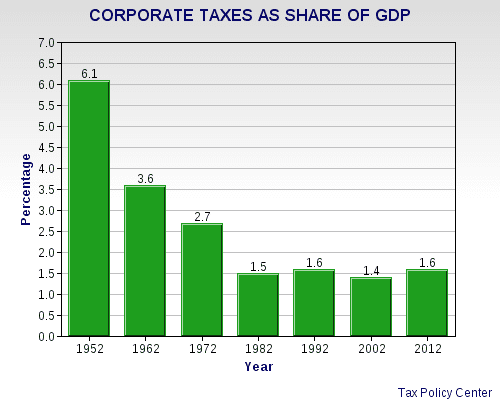
Republicans like to whine about how corporations in the United States are taxed too heavily -- and they like to point to the top tax rate (about 35%) as proof. But what they don't tell you is that very few, if any, corporations pay that rate. In 2011, the average tax paid on corporate profits was only about 12.1% -- far less than most middle class Americans pay on their earned income. And some don't pay any taxes at all (in spite of earning huge profits). They have been able to do this because of tax subsidies and loopholes provided for them by the GOP, and because they hid huge amounts of profits overseas to avoid paying taxes on them.

Note also (in the top chart above) that the taxes paid by American corporations as a percentage of Gross Domestic Product (GDP) has dropped sharply in the last 60 years -- from about 6.1% in 1952 to about 1.6% in 2012. That's a much smaller tax burden for corporations in the U.S. than that paid by corporations in other countries (see bottom chart above).

The truth is that American corporations are not overtaxed -- they are under-taxed. American corporations are currently making record-breaking profits, and their tax burden is lower than it has been in decades. The Republican argument that these corporations need to pay even lower taxes is simply ludicrous. And it is at odds with their stated desire to cut the federal budget -- since the federal budget has already been cut to the bone (except for the military budget) and the bottom 90% of Americans are still hurting from the Bush recession (and can't afford higher taxes).

Senator Bernie Sanders (I-Vermont) has a solution -- a solution that would both promote tax fairness in this country and sharply reduce the federal budget deficit. Here are some of the things Senator Sanders has proposed in his new tax plan:

“Stop large corporations from stashing their profits in the Cayman Islands and other offshore tax havens to avoid paying U.S. taxes.  Legislation already introduced by Sanders would raise more than $590 billion over the next decade.”

“Establish a Wall Street speculation fee to ensure that large financial institutions pay their fair share in taxes.  A speculation fee of 0.03 percent on the sale of credit default swaps, derivatives, options, futures, and large amounts of stock would reduce gambling on Wall Street, encourage the financial sector to invest in the productive economy, and reduce the deficit by $352 billion over 10 years.”

“End tax breaks and subsidies for big oil, gas and coal companies to reduce the deficit by more than $113 billion over the next 10 years.  The five largest oil companies in the United States have made more than $1 trillion in profits over the past decade.  Exxon Mobil is now the most profitable corporation in the world.  Large, profitable fossil fuel companies do not need a tax break.”

“Tax capital gains and dividends the same as work.  Taxing capital gains and dividends the same way that we tax work would raise more than $500 billion over the next decade.  The top marginal income tax for working is 39.6 percent, but the top tax rate on corporate dividends and capital gains is only 20.”

I am not opposed to lowering the tax rate for corporations, and neither is Bernie -- as long as enough subsidies and loopholes are eliminated to insure that corporations actually pay their fair share of taxes. Bernie's plan makes a lot of sense -- which is exactly why it will be killed by the congressional Republicans. The GOP is far more interested in protecting their corporate buddies from paying taxes than they are in reducing the federal budget deficit or putting our economy back on the road to recovery.