
The chart above reflects the results of the American Research Group Poll -- done between July 16th and 20th of a nationwide sample of 1,000 adults, with a 3 point margin of error.

Democrats can show America that they can be better trusted than Republicans to bring prices down and real wages up by pledging 10 things.
1. We’ll eliminate Trump’s across-the-board tariffs. They’re import taxes that are raising the prices of just about everything American consumers buy. We’ll eliminate them where their costs to consumers are far higher than any potential benefits in the form of new jobs.
2. We’ll get energy prices down by ending Trump’s war in Iran and shifting to renewable sources of energy.
Trump’s war has increased gas prices by $1 a gallon over most of the country. It’s accomplished nothing but give Iran bargaining leverage to close the strait — which was open before the war. We’ll bring down energy prices by ending the war and then reduce energy prices by shifting to renewable sources that are cheaper than fossil fuels, such as solar, wind, and biomass.
3. We’ll bust up monopolies. Another major source of high prices is monopolies — especially in high tech, healthcare, food, and finance. We’ll vigorously enforce antitrust (anti-monopoly) laws so that corporations don’t have the power to raise prices. We’ll bust up giant corporations. We’ll bar large firms from merging or acquiring other firms.
4. We’ll fight for stronger unions. Workers need more bargaining power to get higher wages. Part of the answer is stronger unions. Democrats will make it easier for them to start or join them.
5. We’ll raise the national minimum wage to $20 an hour. No one who works full-time should be in poverty. And we’ll raise it even higher for employees of big corporations that pay their top executives more than 200 times the typical worker.
6. We’ll make housing more affordable. We’ll stop private equity firms from buying up large tracts of housing and colluding on prices. We’ll get rid of zoning laws that keep housing prices high. And we’ll raise taxes on big corporations that drive up housing prices where they’re headquartered or have major facilities and use the funds for more affordable housing there.
7. We’ll cut healthcare costs by making Medicare available to everyone. Giving everyone the option of buying into Medicare would bring healthcare costs down because it’s cheaper and more efficient than private for-profit health insurance.
8. We’ll get working families help with childcare and eldercare. Both are essential for working families who must now pay out large portions of their incomes to provide care for family members.
9. We’ll give working families paid family leave. Twelve weeks of unpaid leave has proven useful but not adequate. Every other advanced country provides paid leave; the richest country in the world should too.
10. We’ll raise taxes on the wealthiest to pay for this. Since Reagan, the rich have paid far lower taxes while accumulating a near-record portion of total income and wealth. It’s only fair that they pay more so that the rest of America can afford what Americans need. We’ll raise the top marginal tax rate to 70 percent — what it was before Reagan. We’ll also impose a 0.5 percent tax on wealth in excess of $100 million. We’ll also eliminate the cap on income subject to Social Security taxes, require that the ultra-rich pay annual capital gains taxes on unrealized income, and eliminate the stepped-up basis at death.
These 10 steps are crucial for making America affordable again.

Trump keeps bragging about how well Wall Street is doing, but that doesn't affect most Americans. For them, the economy is not doing well at all. Robert Reich explains:
Job growth slowed considerably last month. Employers added a less-than-expected 57,000 jobs in June, according to Labor Department data out today.
That’s far below the 129,000 jobs added in May and comes amid high anxiety about the state of the American economy.
According to today’s report, average hourly earnings increased by 3.5 percent. But prices are increasing at an annual rate of 4.2 percent.
What do you get when prices are increasing faster than wages? You get people who are becoming poorer. And what do you get when people become poorer? Angry voters.
Trump is constantly talking about the strength of the stock market. This morning he even shared a link to an article called “S&P 500 closes with strongest quarter since 2020.” Yesterday, when asked about the huge profits he’s made off his stock trades, he countered, “Well, you know why I’m profiting? Cause the stock market’s going up. Everybody’s profiting.”
The truth is most Americans aren’t profiting in the stock market. The richest 10 percent own over 90 percent of the value of all shares of stock. The richest 1 percent own over half of the value of all shares of stock.
Trump frequently points to 401(k) accounts as evidence of Americans benefiting from the strong stock market. But only around a third of working-age individuals have any savings at all in 401(k) accounts. About 40 percent of all Americans have no retirement savings whatsoever.
Bottom line: It’s a lousy economy. Anyone who voted for Trump in 2024 should have buyer’s remorse.


Nobel Prize-winning economist compares today's oligarchy with that of the Gilded Age (which led to the Great Depression):
Many people have compared our current era to the Gilded Age. But that analogy is deeply unfair to the Gilded Age. Like the robber barons of yore, today’s oligarchs are immensely wealthy — even wealthier, relative to the economy as a whole, than their predecessors. And extreme wealth corrupts our democracy. But the corruption is deeper and more destructive now than it was then: The mitigating factors that once put some brakes on the harm done by excessive wealth concentration are now mostly gone.
About wealth concentration: The standard source for information on extreme wealth is the Forbes 400 list. Forbes only began compiling that list in its current form in 1982, but it published its first listing of America’s top fortunes in 1918. The chart above compares the wealth of the richest 5 Americans in 1918 with that of the richest 15 in 2025 — 15, not 5, because the total U.S. population more than tripled over that period. I scale their wealth both as a percentage of total wealth and as a share of GDP.
Either way, the concentration of wealth at the very top is much higher now than it ever was during the Gilded Age. And these are numbers from last year, before the SpaceX IPO. The robber barons were pikers compared with today’s oligarchs.
This level of wealth brings with it immense political influence. A New York Times analysis found that 300 billionaires accounted for 19 percent of political contributions in the 2024 election. And since the election the power of money has grown even stronger.
In part this reflects the way great wealth has been used to corrupt the media. Elon Musk bought Twitter, not as a financial investment, but to turn it into the right-wing fever swamp it has now become. Larry Ellison, America’s second-richest man, purchased CBS basically to destroy it as an independent news source and convert it into Fox News 2.0, a goal he is achieving — and he is now on track to do the same to CNN.
On top of this, the presidency is now more or less openly for sale. “Donald Trump,” writes Forbes, “has presided over the most lucrative presidency in history,” adding $4.2 billion to his personal wealth since regaining the White House.
There were many corruption scandals during the Gilded Age, but none on this scale.
What do today’s uberrich do with their political power? Much of what they push for involves their own self-interest. In 2024 Mark Zuckerberg basically used his financial clout to kill bipartisan legislation that would have tried to protect children from psychological harm due to social media and, of course, put some restrictions on Meta. The Koch family has spent decades doing everything it can to prevent action against climate change and keep America burning fossil fuels.
Beyond this, some megabillionaires use their power to push political extremism.
True, Elon Musk is something of an outlier; you have to go some ways down the list to find someone comparably extreme (Peter Thiel is #40.) And he isn’t the first incredibly wealthy man to be deeply bigoted and an avid consumer of conspiracy theories: Henry Ford was a rabid anti-Semite who published and distributed The Protocols of the Elders of Zion, a forgery probably concocted by the Russian secret police.
Still, it’s remarkable that the world’s richest man has passionately embraced the “Great Replacement” theory of a sinister conspiracy to replace whites with nonwhite immigrants.
And it’s equally remarkable that our political system accepts it as a fact of life that such a person should command such power, even leaving on one side the dubious roots of his wealth. Where’s the outrage?
Obviously some Americans are outraged, but the backlash against a highly corrupt, rigged system is far weaker than one might have expected. Why?
I’ll return to this question in later posts, but it’s clear that modern America suffers from a combination of cynicism — “everybody does it” — and fatalism — “that’s just how the world works” — far worse than anything we experienced in the robber baron era.
You can see this moral malaise in the shrugs with which all too many politicians, especially but not only Republicans, greet each new revelation of presidential scandal. You can also see it in the behavior of the ultrawealthy themselves.
Make no mistake: the men on that 1918 Forbes list were, without exception, ruthless businessmen. The term “robber barons,” popularized in the 1930s by the historian Mattew Josephson, was apt. The great fortunes of the late 19th and early 20th centuries were accumulated by men who functionally played the same role as feudal warlords extorting tolls from travelers passing their castles. In particular, John D. Rockefeller, the world’s richest man, in effect controlled an essential economic choke point, a sort of financial Strait of Hormuz, through his monopolization of oil refining.
Yet many of the robber barons also possessed a sense of noblesse oblige, believing that they should deploy some of their riches on behalf of the public good.
Many of the robber barons gave huge sums to philanthropy. These included large donations to cultural institutions, which continue to enrich our society to this day.
Mention Andrew Carnegie or Henry Clay Frick to a modern New Yorker and the first things they think of will probably be Carnegie Hall and the Frick Collection of fine art.
No doubt this was in large part a public relations exercise, but the fact that the robber barons believed that this PR effort was necessary was itself a symptom of a society less cynical than it is today. And the Gilded Age wealthy left a lasting legacy of good deeds to set against the history of their ruthless business practices.
By contrast, today’s oligarchs spend very little on good works, according to Forbes. Musk and Ellison have both given away less than 1 percent of their fortunes.
And Musk in particular is the opposite of a philanthropist. Not only doesn’t he spend any of his own money to help others, he used his power when running DOGE to cut off aid to poor countries, condemning hundreds of thousands of children to avoidable death. And he was gleeful about it:
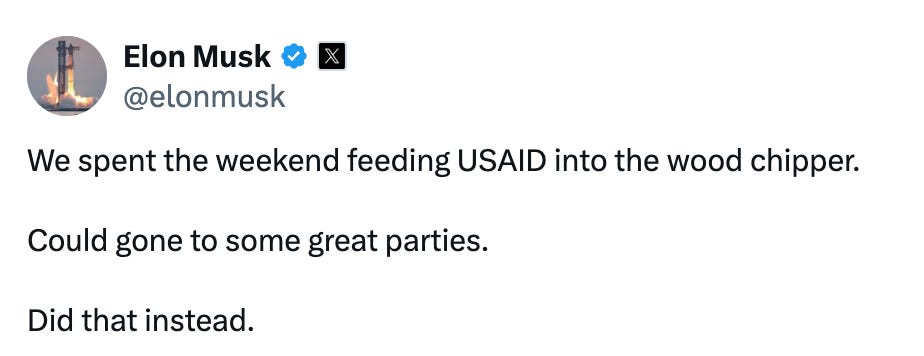
Again, where is the outrage?
So, are we living in a second Gilded Age? If only. We surpassed Gilded Age levels of income and wealth inequality decades ago. We’re now in an era of oligarchy in which the power of great wealth and the abuse of that power by a tiny elite eclipse anything we saw in the late 19th and early 20th century. And the super-wealthy themselves are far more lacking in redemptive qualities than their predecessors.
Meet the new bosses, worse than the old bosses.
