Showing posts with label pledge. Show all posts

Saturday, July 18, 2026

10 Things Democrats Can Pledge To Create An Affordable Economy


From Robert Reich: 

Democrats can show America that they can be better trusted than Republicans to bring prices down and real wages up by pledging 10 things.

Pledge To Make America Affordable Again

1. We’ll eliminate Trump’s across-the-board tariffs. They’re import taxes that are raising the prices of just about everything American consumers buy. We’ll eliminate them where their costs to consumers are far higher than any potential benefits in the form of new jobs.


2. We’ll get energy prices down by ending Trump’s war in Iran and shifting to renewable sources of energy. 

Trump’s war has increased gas prices by $1 a gallon over most of the country. It’s accomplished nothing but give Iran bargaining leverage to close the strait — which was open before the war. We’ll bring down energy prices by ending the war and then reduce energy prices by shifting to renewable sources that are cheaper than fossil fuels, such as solar, wind, and biomass. 


3. We’ll bust up monopolies. Another major source of high prices is monopolies — especially in high tech, healthcare, food, and finance. We’ll vigorously enforce antitrust (anti-monopoly) laws so that corporations don’t have the power to raise prices. We’ll bust up giant corporations. We’ll bar large firms from merging or acquiring other firms.


4. We’ll fight for stronger unions. Workers need more bargaining power to get higher wages. Part of the answer is stronger unions. Democrats will make it easier for them to start or join them.


5. We’ll raise the national minimum wage to $20 an hour. No one who works full-time should be in poverty. And we’ll raise it even higher for employees of big corporations that pay their top executives more than 200 times the typical worker.


6. We’ll make housing more affordable. We’ll stop private equity firms from buying up large tracts of housing and colluding on prices. We’ll get rid of zoning laws that keep housing prices high. And we’ll raise taxes on big corporations that drive up housing prices where they’re headquartered or have major facilities and use the funds for more affordable housing there.


7. We’ll cut healthcare costs by making Medicare available to everyone. Giving everyone the option of buying into Medicare would bring healthcare costs down because it’s cheaper and more efficient than private for-profit health insurance.


8. We’ll get working families help with childcare and eldercare. Both are essential for working families who must now pay out large portions of their incomes to provide care for family members.


9. We’ll give working families paid family leave. Twelve weeks of unpaid leave has proven useful but not adequate. Every other advanced country provides paid leave; the richest country in the world should too.


10. We’ll raise taxes on the wealthiest to pay for this. Since Reagan, the rich have paid far lower taxes while accumulating a near-record portion of total income and wealth. It’s only fair that they pay more so that the rest of America can afford what Americans need. We’ll raise the top marginal tax rate to 70 percent — what it was before Reagan. We’ll also impose a 0.5 percent tax on wealth in excess of $100 million. We’ll also eliminate the cap on income subject to Social Security taxes, require that the ultra-rich pay annual capital gains taxes on unrealized income, and eliminate the stepped-up basis at death.


These 10 steps are crucial for making America affordable again.

Saturday, December 06, 2025

Democratic Candidates Should Run On They 10-Point Affordability Pledge

Robert Reich has come up with a 10-point affordability pledge that he believes Democratic candidates should campaign on. I agree! He writes:

Democrats can show America that they can be better trusted than Republicans to bring prices down and real wages up by promising 10 things.

***

The Democrats’ Pledge to Make America Affordable Again


1. We’ll eliminate Trump’s across-the-board tariffs. They’re import taxes that are raising the prices of just about everything American consumers buy. We’ll eliminate them where their costs to consumers are far higher than any potential benefits in the form of new jobs.


2. We’ll bust up monopolies. Another major source of high prices is monopolies — especially in high tech, health care, food, and finance. We’ll vigorously enforce antitrust (anti-monopoly) laws so that corporations don’t have the power to raise prices. We’ll bust up giant corporations. We’ll bar large firms from merging or acquiring other firms. 


3. We’ll fight for stronger unions. Workers need more bargaining power to get higher wages. Part of the answer is stronger unions. Democrats will make it easier for them to start or join them. 


4. We’ll raise the national minimum wage to $20 an hour. No one who works full-time should be in poverty. And we’ll raise it even higher for employees of big corporations that pay their top executives more than 200 times the typical worker. 


5. We’ll make housing more affordable. We’ll stop private equity firms from buying up large tracts of housing and colluding on prices. We’ll get rid of zoning laws that keep housing prices high. And we’ll raise taxes on big corporations that drive up housing prices where they’re headquartered or have major facilities and use the funds for more affordable housing there. 


6. We’ll cut health care costs by making Medicare available to everyone. Giving everyone the option of buying into Medicare would bring health care costs down because it’s cheaper and more efficient than private for-profit health insurance. 


7. We’ll get working families help with child care and elder care. Both are essential for working families who must now pay out large portions of their incomes to provide care for family members. 


8. We’ll give working families paid family leave. Twelve weeks of unpaid leave has proven useful but not adequate. Every other advanced country provides paid leave; the richest country in the world should too.


9. We’ll provide a universal basic income if adequate-paying jobs are unavailable. Face it: Artificial Intelligence will permanently replace many jobs. No family should be left in the cold. The universal basic income won’t be so high as to make families comfortable, but it will be enough to keep them out of poverty.


10. We’ll raise taxes on the wealthiest to pay for this. Since Reagan, the rich have paid far lower taxes while accumulating a near-record portion of total income and wealth. It’s only fair that they pay more so that the rest of America can afford what Americans need. We’ll raise the top marginal tax rate to 70 percent — what it was before Reagan. We’ll also impose a 0.5 percent tax on wealth in excess of $100 million. We’ll also eliminate the cap on income subject to Social Security taxes, require that the ultra-rich pay annual capital gains taxes on unrealized income, and eliminate the stepped-up basis at death.


These 10 steps are crucial for making America affordable again. We pledge to back every one of them. 


Please share this with any Democrat interested in running for or remaining in office. And ask them to make the pledge.

Sunday, May 12, 2019

Beto Is WRONG - The Nominee Must Support All Democrats

Beto O'Rourke was one of several Democrats I was considering supporting for the 2020 presidential nomination. Unfortunately, that is no longer true. His recent statement in New Hampshire has me upset, and I can no longer consider supporting him.

During a house party in Lebanon (New Hampshire), Beto was asked if he would support every candidate of the Democratic Party. His answer was extremely disappointing. He refused to pledge to support every Democratic candidate, saying:

"I can't take a pledge to support every single Democrat in the country. I need to know about them first, right? Would you want me to make a blanket commitment about people I know nothing about, who I've never met?"

That is unacceptable. The answer to his question is YES, I want you to make a blanket commitment to support every Democrat -- whether you know them or not.

Here's why I want that commitment:

* The presidential nominee is the leader of the party. How can the party's leader refuse to support any candidate of the party?

* Having a Democratic president is not enough. Nothing will be accomplished unless Democrats also control both houses of Congress.

* Every Democrat on the ballot (whether a progressive, liberal, moderate, or conservative) is better than any Republican on the ballot. Even a conservative Democrat will vote with the party much or most of the time. No Republican will do that at all.

Democrats already have a problem with some candidates requiring a purity test for Democratic candidates (Bernie Sanders, Tulsi Gabbard). We don't need our nominee supporting Republicans because they are friends or he doesn't know the Democrat running.

Beto needs to decide -- is he a Democrat or not?

Saturday, March 09, 2019

Bernie Signs Party Pledge (But He's Still Not A Democrat)


Bernie Sanders has spent his political life as an Independent, and he has refused all overtures from the Democratic Party in Vermont. In 2016, he ran in the Democratic presidential primary while continuing to insist that he is not a Democrat.

But the Democratic Party made a little rules change for the 2020 primaries and caucuses. Only members of the party can run. This posed a dilemma for Sanders. He wanted to use the Democratic Party apparatus to run for president, but he also wanted to refuse party membership. What was he to do?

Well, we found out a few days ago. He signed the Democratic Party's candidate pledge (see above) which was sent to all the candidates. BY signing that pledge, he affirmed that he was a member of the Democratic Party and would run and serve as a Democrat.

Should we celebrate Sanders joining the Democratic Party? NO! I don't for even a minute believe Sanders is now a Democrat. All we have to do is look at the other race he's in for 2020 -- re-election as a senator in Vermont. He's not running as a Democrat (which he would be doing if he had actually joined the party), but as an Independent (just like he's always done).

All he has shown is that he's willing to lie to get what he wants (to get on the November ballot as a presidential candidate). Do we really want to replace one liar with another?

Thursday, March 31, 2016

No Party Loyalty Among The GOP Presidential Candidates

(Caricatures of the GOP presidential candidates is by DonkeyHotey.)

If you still harbored any doubts about the growing division in the Republican Party, the recent Republican Town Hall meetings (which involved all three Republican presidential candidates individually) should settle those doubts.

Last September, all the Republican candidates pledged to support the party's eventual nominee (and to not run an independent campaign against that nominee). All of that is out the window now. In the Town Hall interviews, all three Republican candidates refused to say they would support the party's eventual nominee.

This is not a surprise that Trump wouldn't support the nominee (and might even run against that nominee as an independent). When Trump made his pledge, it came with a condition -- that he believe he had been treated fairly by the Republican Party's leaders. Recently, those party leaders have initiated a "Stop Trump" movement, with plans being made to try and snatch the nomination away from him in an open (brokered) convention. It's easy to see why he would feel he's not being treated fairly.

It conceivable that Trump will launch an independent bid for the White House if denied the convention's nomination. That would be disastrous for the GOP, since a recent Rasmussen Poll showed that 24% of Republicans say they would be very likely to vote for Trump if he did. Even if he didn't run as an independent, those voters might vote for a third party (feeling they were cheated), or even worse just stay home on election day -- which would hurt the down-ballot Republican candidates.

It could be just as bad if Trump does get the nomination. There are a lot of Republicans who say they simply could not vote for Trump, and a party with Trump heading the ticket could also hurt down-ballot Republicans. And both Cruz and Kasich refused to say they would support Trump as the nominee of their party. If they can't get on board, why should other Republicans?

I don't think it's an overstatement to say the Republicans have a real electoral mess brewing. The party is seriously divided, and I'm not at all sure that division can be healed by November.

Saturday, September 05, 2015

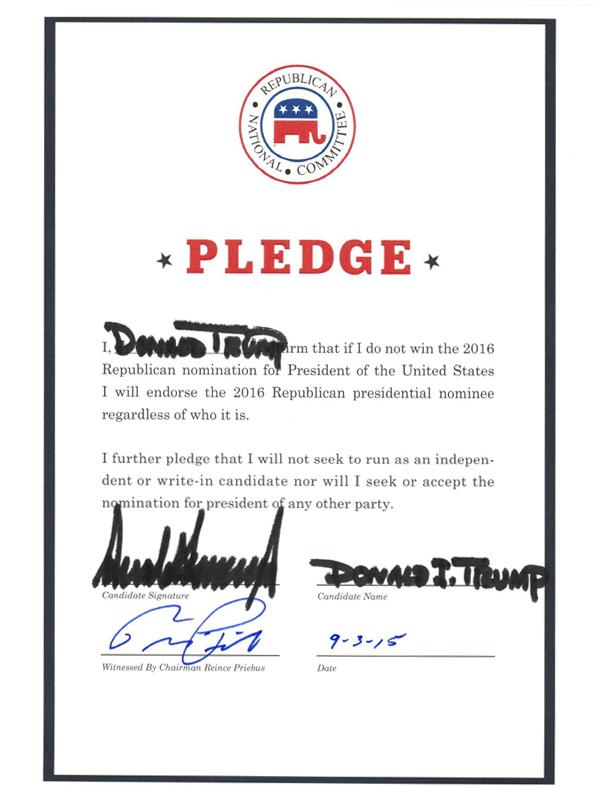
Donald Trump's Pledge To Republicans Is Meaningless

(This caricature of Donald Trump is by DonkeyHotey.)

On Thursday, Donald Trump signed a pledge to support the eventual nominee of the Republican Party, and to not run an independent campaign if he is not the nominee. With his current large lead among Republicans, it was an easy (and politically astute) thing for him to do. But does it mean anything?

I don't think it does. Trump said he signed it because he was being "treated fairly" by the Republican Party. But what happens if he someone rises above him in the polls, and it no longer looks like he could win the GOP nomination? This pledge is not a legally binding contract, and the GOP would have no legal recourse if he changed his mind. All he would have to do is say the party was no longer treating him fairly -- that they had broken the agreement. And I doubt that would hurt him among his supporters.

Would Trump do that? I think he very well could. It's not like he hasn't changed his mind in the past. He has changed many times, and if he thought it would benefit him, he would do it again. And I'm not the only person who thinks Trump break his pledge to the Republican Party. Consider this post by Emily Atkin at Think Progress:

“I will be totally pledging my allegiance to the Republican Party,” Donald Trump said on Thursday, holding up a piece of paper with his signature and the wrong date for all of America to see. 
The moment was one that Republican party establishment figures had been waiting for. With that pledge, Trump entered into a formal agreement with the Republican National Committee that he will not run for president as an independent if he doesn’t win the party’s nomination next year. 
Trump had been threatening to do just that if he wasn’t “treated fairly” by the RNC, and the prospect was a little scary for Republicans. Trump is, after all, polling far ahead of every other GOP candidate. If he dropped out and ran as an independent, he’d surely derail support for the eventual Republican nominee and hand the election to a Democrat.
But now the pledge is signed. There’s even a couple with correct dates on them. So that’s the end of that story, right?
Wrong.
“Pledges like this just don’t mean anything,” said Kyle Kondik, a political analyst at the University of Virginia Center for Politics and managing editor of Sabato’s Crystal Ball. “Anyone who thinks that this will someone preclude a Trump third party run is full of themselves.”
Trump’s pledge, Kondik explained, is not a legally enforceable contract. The Washington Post described it this way: “It’s like the sort of pledge you get your kids to sign that they will do their homework, make their beds and eat their vegetables before they can play with your iPhone. It’s a statement of intention, but not a binding one.”
It’s also not like Trump is well-known for keeping political promises. In fact, Trump’s changed his mind about his policy positions so much that Meet the Press was able to put together a two-minute montage of his flip-flops, titled Trump vs. Trump.
In other words, Kondick said, if there’s any politician that would back out of a non-binding agreement, it’s probably Donald Trump.
“Trump could just say, ‘The party’s betrayed me,'” he said. “There’s any number of excuses he could come up with to run as an independent.”
Whether the pledge will hurt or help him in the polls is a matter of debate. The most recent polling from Monmouth University put Trump way ahead of his challengers, with 30 percent of support nationally. 
Kondick was inclined to believe it might help him temporarily, while National Journal speculated that some supporters may abandon him now that he’s lost a bit of of his anti-establishment cred. 
Either way, the pledge of loyalty does mean at least one thing: that Trump’s continuing to make news. And that may have been his intention all along.

Sunday, October 19, 2014

Don't Say The Pledge


There is a move among some atheist organizations right now to encourage people to refuse to recite the Pledge of Allegiance. I support this move, and I haven't said the pledge in many years now. Why? Does it mean I'm not patriotic? Of course not. Patriotism doesn't depend on reciting a few words.

I cannot bring myself to recite the pledge because of the phrase "one nation under god". For me, that would mean I pledge my support for the United States being a religious (and probably christian) nation -- and I cannot do that. This nation was founded as a secular nation and that's what it should remain -- because only a secular nation can guarantee religious freedom (which includes the freedom to not be religious).

The pledge has not always contained the offensive god phrase. It was written in 1892 by Francis Bellamy. Bellamy was both a Baptist minister and a socialist, but saw no need to include either politics or religion in the pledge. The pledge as he wrote it could be recited by any American -- regardless of their politics or religious views. It was not until 1954 (more than 60 years later) that the god phrase was inserted into the pledge -- turning it into something that millions of attests in America could no longer pledge.

The saddest thing about the current movement to not say the pledge is that many students are being punished by their teachers for refusing to stand and recite the pledge. That is ridiculous -- and it is unconstitutional. No student (or adult) in this country should be punished for exercising their right not to participate in what they consider a religious ritual -- especially in a public (government) school.

I know these teachers (and other christians) don't understand how offensive the word god can be to some people. But they need to ask themselves a question. Could they in good conscience recite the pledge if it contained the phrase "under allah" or "under satan"? I doubt it. I think they would find that far too offensive. They need to understand that the phrase "under god" is just as offensive to many atheists.

Why can't we just go back to the original pledge -- a pledge that anyone can recite without going against their conscience?

Wednesday, September 03, 2014

Should "Under God" Be In The Pledge Of Allegiance ?

(This image of the pledge as it should be is from the blog of Melissa Montoya.)

Last week an elected official violated a citizen's rights and basically trashed the United States Constitution. Winter Garden  (Florida) mayor John Rees demanded a person attending a city council meeting stand for the Pledge of Allegiance, and when that person refused, he ordered the Police Chief to remove that man from the room -- and the Police Chief complied. The mayor said he thought the man's refusal to stand for the pledge showed a lack of respect for American troops fighting overseas.

Of course, that's ridiculous. The gentleman's refusal to stand for the pledge had nothing at all to do with supporting our troops -- or with his love for this country either. The man was exercising his "free speech" and "freedom of religion" rights under the Constitution -- and opposing the idea that when one recites the pledge today, one is not only pledging allegiance to this country but also declaring a belief in god (something no American should be forced to do, since "freedom of religion" also guarantees the right to be free from religion). ACLU spokesman Baylor Johnson hit the nail on the head by saying of the incident:

"People are not required to participate in the Pledge of Allegiance or a sectarian prayer or any kind of compulsory expression just to attend a public meeting."
"The problem with telling people they have to participate in any mandatory expression is that it tells people who might have a religious objection or other deeply held belief that, if they don't go along with what the government tells them to do, they aren't welcome in this community."
This brings up the question -- why must our Pledge of Allegiance contain the divisive phrase "under god"? Why must any person profess a belief in a god to pledge their allegiance to this country? I love my country, but I have not spoken the words of the Pledge of Allegiance for several decades -- because I do not believe in a god, and I have to desire to publicly profess a belief in god. I know that many religionists consider the phrase to be a harmless one, but for me (and millions of other Americans) it would be a lie -- and no one should be forced to lie to profess their love of country.

The pledge has not always had that phrase. The pledge was written in 1892 by Francis Bellamy (a minister and a socialist), and for the next 62 years it was recited in schools and public events without the words "under god" (much like the pledge shown above). It was not until June 16 of 1954 that the pledge was officially changed to include those words (probably as an overreaction to "godless communism").

The intention of the pledge is to bring Americans together in support for their country -- but putting the words "under god" in the pledge actually accomplished just the opposite. It divided the country by making the pledge a profession of belief in god -- something that millions of Americans simply are unwilling to do. Why can't we just remove those two offensive words, and return to a pledge that shows love of country without including religion?

The Seidewitz Group recently conducted a survey for the American Humanist Association on this issue. They surveyed a random national sample of 1,000 adults on May 29 of 2014 (with a margin of error of 3.1 points) -- and they found a large number of Americans would like to see those words removed from the pledge. That includes about 34.3% of the general public (or more than 100 million Americans), and even larger percentages of many demographic groups. The results of the survey are shown in the chart below.

Isn't it time to return to a pledge that everyone who loves this country can recite?