Showing posts with label Justice Alito. Show all posts

Friday, June 14, 2024

Justice Alito Is Afraid His Bias Might Be Hidden (SATIRE)


Alexandra Petri give us more great SATIRE in The Washington Post. This time her target is biased Supreme Court Justice Samuel Alito.

In the hours after Samuel A. Alito Jr. learned that secretly captured recordings of a private conversation were going to be made public, the Supreme Court justice was frantic, close associates say, worrying the tapes would undermine the image he has worked to create of exactly what kind of judge he is. But when publication revealed the comments to be merely an endorsement of the need “to return our country to a place of godliness,” that worry gave way to relief.

“That could have been so much worse,” Alito said in a subsequent interview. “What if I’d said something temperate or reasonable?”

“Any time I open my mouth, there’s always a chance that something might come out that doesn’t sound petty and vindictive,” the justice allowed. “What if I mishear something and accidentally agree that justices must take care to recuse themselves after any whiff of impropriety? It would take me years to recover from that.”

Alito, seemingly shaken by the possibility, then listed a series of far-fetched utterances that could be equally ruinous:

“I would never impose my religion on others.”


“It isn’t the role of the Supreme Court to legislate from the bench.”


“No, I would not accept a seat on a private jet, even if it was already going to the destination and so the seat would be just going to waste otherwise.”


Alito went on: “Why, just thinking about this made me so stressed that Martha-Ann had to read me my Obergefell dissent to calm me down.” Alito beamed. “In it, I complained that ‘those who cling to old beliefs will be able to whisper their thoughts in the recesses of their homes, but if they repeat those views in public, they will risk being labeled as bigots and treated as such by governments, employers and schools’ — something I printed under my name, publicly, and was proud of, and have repeated in speeches to the Federalist Society!”


Alito also worried that footage might surface from a recent party at which he recalled a guest saying Donald Trump was a wonderful man who deserved both unlimited power and to be the next president, during which Alito apparently remained silent.


“But I was nodding!” he insisted. “I was nodding! Don’t worry!”


So far, the justice has been lucky. But Alito urged anyone who might in the future question troublesome private remarks to go and study all his public speeches and published opinions.


“I am who I’ve always been in public,” Alito said. “Not some impartial justice in a black robe who considers himself above politics, but the guy who mouths ‘not true’ during President Barack Obama’s State of the Union address. If you have any doubt of who I am, look to my op-eds in the Wall Street Journal. I’m just a guy who wants the people who read the Wall Street Journal opinions section to know that he is being unjustly maligned by ProPublica. How else could I look Leonard Leo in the eye?


“My public life speaks for itself,” he concluded.


Still, Alito jumped at the chance to solidify his stances on a few more matters on the record. Ethics? “Unnecessary.” Women? “Vessels. They love to fly flags.” Previous precedent? “Absolutely immune, untouchable.”


He noticed the surprise on this reporter’s face and hastened to clarify: “Oh, precedent? I thought you said ‘previous president!’”

Friday, May 31, 2024

Alito And Thomas Should Be Forced To Recuse Themselves


It has become obvious that Justices Alito and Thomas are biased in the cases concerning Donald Trump, but both are refusing to recuse themselves. Maybe it is time to force those recusals. Here is part of what Rep. Jamie Raskin has to say about that in The New York Times:

Many people have gloomily accepted the conventional wisdom that because there is no binding Supreme Court ethics code, there is no way to force Associate Justices Samuel Alito and Clarence Thomas to recuse themselves from the Jan. 6 cases that are before the court.

Justices Alito and Thomas are probably making the same assumption.

But all of them are wrong. . . .

Justices Alito and Thomas face a groundswell of appeals beseeching them not to participate in Trump v. United States, the case that will decide whether Mr. Trump enjoys absolute immunity from criminal prosecution, and Fischer v. United States, which will decide whether Jan. 6 insurrectionists — and Mr. Trump — can be charged under a statute that criminalizes “corruptly” obstructing an official proceeding.

Everyone assumes that nothing can be done about the recusal situation because the highest court in the land has the lowest ethical standards — no binding ethics code or process outside of personal reflection. Each justice decides for him- or herself whether he or she can be impartial. . . .

The U.S. Department of Justice — including the U.S. attorney for the District of Columbia, an appointed U.S. special counsel and the solicitor general, all of whom were involved in different ways in the criminal prosecutions underlying these cases and are opposing Mr. Trump’s constitutional and statutory claims — can petition the other seven justices to require Justices Alito and Thomas to recuse themselves not as a matter of grace but as a matter of law.

The Justice Department and Attorney General Merrick Garland can invoke two powerful textual authorities for this motion: the Constitution of the United States, specifically the due process clause, and the federal statute mandating judicial disqualification for questionable impartiality, 28 U.S.C. Section 455. . . .

The constitutional and statutory standards apply to Supreme Court justices. The Constitution, and the federal laws under it, is the “supreme law of the land,” and the recusal statute explicitly treats Supreme Court justices like other judges: “Any justice, judge or magistrate judge of the United States shall disqualify himself in any proceeding in which his impartiality might reasonably be questioned.” The only justices in the federal judiciary are the ones on the Supreme Court.

This recusal statute, if triggered, is not a friendly suggestion. It is Congress’s command, binding on the justices, just as the due process clause is. The Supreme Court cannot disregard this law just because it directly affects one or two of its justices. Ignoring it would trespass on the constitutional separation of powers because the justices would essentially be saying that they have the power to override a congressional command.

When the arguments are properly before the court, Chief Justice John Roberts and Associate Justices Amy Coney Barrett, Neil Gorsuch, Ketanji Brown Jackson, Elena Kagan, Brett Kavanaugh and Sonia Sotomayor will have both a constitutional obligation and a statutory obligation to enforce recusal standards.

Indeed, there is even a compelling argument based on case law that Chief Justice Roberts and the other, unaffected justices should raise the matter of recusal on their own (or sua sponte). Numerous circuit courts have agreed with the Eighth Circuit that this is the right course of action when members of an appellate court are aware of “overt acts” of a judge reflecting personal bias. Cases like this stand for the idea that appellate jurists who see something should say something instead of placing all the burden on parties in a case who would have to risk angering a judge by bringing up the awkward matter of potential bias and favoritism on the bench.

But even if no member of the court raises the issue of recusal, the urgent need to deal with it persists. Once it is raised, the court would almost surely have to find that the due process clause and Section 455 compel Justices Alito and Thomas to recuse themselves. To arrive at that substantive conclusion, the justices need only read their court’s own recusal decisions. . . .

The federal statute on disqualification, Section 455(b), also makes recusal analysis directly applicable to bias imputed to a spouse’s interest in the case. Ms. Thomas and Mrs. Alito (who, according to Justice Alito, is the one who put up the inverted flag outside their home) meet this standard. A judge must recuse him- or herself when a spouse “is known by the judge to have an interest in a case that could be substantially affected by the outcome of the proceeding.”

Saturday, January 21, 2023

Who Leaked The Dobbs/Roe Decision? Could It Be A Justice?


The Supreme Court has announced that it was not able to find the person who leaked the Roe vs Wade decision. Could that be because the Justices were not examined as thoroughly as other Supreme Court employees? Could the leaker actually have been a Justice?

Robert Reich thinks that may be the case. He writes:

The Supreme Court yesterday announced that an internal investigation failed to identify the person who leaked a draft of the Court’s opinion in Dobbs v. Jackson Women's Health Organization — the opinion that overturned Roe v. Wade, the 1973 decision that had established a constitutional right to abortion.


The Court’s marshal, Gail A. Curley, who oversaw the inquiry, said investigators had conducted 126 formal interviews of 97 employees, all of whom had denied being the source of the leak. (In a one-page statement accompanying the report, Michael Chertoff, a former secretary of the Department of Homeland Security, asserted that Curley’s team had conducted a thorough investigation and he could not “identify any additional useful investigative measures” they should have taken.)


This shouldn’t end the matter. 


A modern Sherlock Holmes might well conclude that the leaker was … Justice Samuel Alito, Jr. 


First, it’s unlikely any of the justices was interviewed. The report said all witnesses were told they could be dismissed if they refused to answer questions. That’s a dead giveaway: Supreme Court justices cannot be dismissed from their jobs.


Second, Alito had a motive for leaking. He wrote the draft in Dobbs and got four other justices to tentatively sign on. He presumably wanted to lock them in. Leaking the draft was a way to do so. 


Third, Alito is already under suspicion for leaking another draft Court opinion that he authored, which marked another triumph for the religious right.


On November 19, the New York Times quoted Christian minister Rob Schenck as claiming that in 2014 Alito divulged the outcome of a Supreme Court case known as Hobby Lobby, which he authored — weeks before the opinion was released to the public. According to Rev. Schenck, Alito’s leak occurred when he and his wife were dining with a couple who were secretly collaborating with Schenck. Hobby Lobbyallowed religious exemptions to the Affordable Care Act’s contraceptive coverage requirement for certain for-profit corporations.


Alito has denied the allegation.


Even if uncontroverted evidence emerges that Alito leaked the Dobbs decision, there’s nothing the Supreme Court could do to discipline him. The Court has no code of conduct or rules of ethics. (Think Clarence Thomas.) Partly for this reason, public trust in the Supreme Court has been plummeting.


The last Congress introduced the Supreme Court Ethics, Recusal, and Transparency Act which would, among other things, require the Court to adopt a binding code of conduct. With Republicans in control of the House, the current Congress is unlikely to do the same. 


But the Court need not await Congress. If Chief Justice John Roberts doesn’t want to be remembered as the Chief who allowed the Court to drown in disrepute, he will take the lead in creating clear ethical rules that all Supreme Court justices will swear to abide.

Sunday, October 02, 2022

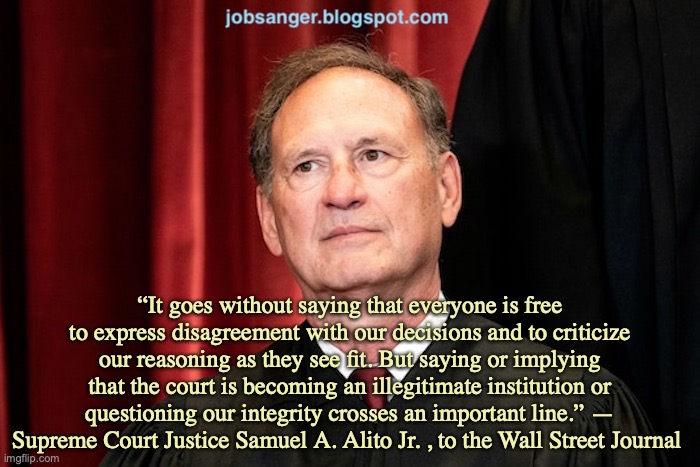
Alito Answers Critics Of Supreme Court (A Satire)


Justice Samuel Alito (one of the most rabid conservatives on the Supreme Court) is upset that many people now think the Court is more interested in playing politics than upholding constitutional law. Washington Post columnist Alexandra Petri (with tongue firmly planed in cheek) decided to help him out by formulating a response by him to the court's critics. Here is her very funny bit of satire:

First off, how dare you. Second of all, how dare you! I am calling up the Wall Street Journal now to say “how dare you” to them a third time! You are crossing a very important line by saying I am crossing an important line.

We all know that speech is not limitless. Some forms of speech are too reckless to be borne. For instance, everyone knows that shouting “Fire!” in a crowded theater is something you should never, ever do, even if I, Samuel Alito, am lighting your crowded theater on fire. Your shouting will cause a panic, and it is beyond the pale. If I am setting fires, I’m sure it is with good reason, and you ought to sit there patiently to find out what the reason is.

What should you do if you think the Supreme Court is becoming too political a body? Hush! That’s what you should do! If we were too political, I would be the first to know, and I know that we aren’t. Too political a body would be one that had Merrick Garland on it.

Have you considered that actually you are the one undermining the legitimacy of the Supreme Court? You and all your impertinent questions! It is certainly not I, anything I am doing, or the way the court is currently composed. The legitimacy of the Supreme Court, as we learned from Marbury v. Madison, is something that is handed down through a system of divine right. John Marshall was presented a set of scales by a mysterious arm that reached up out of the Potomac River, and from that point, nobody was allowed to question anything the court did. (Except, of course, for those decisions that it made with which I personally disagreed and which I gleefully overturned. But that was different.)

No, I won’t explain any further! All I know is that the legitimacy of the Supreme Court is something that ought to be taken on faith, as a matter of dogma — which, coincidentally, is also a pretty great way of making judicial decisions. Yes, I’m sure I have that right. When people talk about the separation of church and state, they just mean California.

Of course, there are some members of the Supreme Court you can disagree with readily, at any time. The minority, for instance. And no such deference is owed to the executive branch, at whom you may mouth your disagreement anytime you see fit.

But to call my court’s integrity into question — the temerity! This kind of horrible disrespect is the sort I will not suffer in silence. All I want is to live my life as I choose, holding sway over the entire nation without pushback or criticism. Yet at every turn my benevolence is met with treachery and complaint. Is this how you treat your unelected magistrate? Nobody shall exert undue control over my judicial body.

This is what I am always warning about: the creeping tyranny of people saying, “Your opinion is ill-considered,” or, “This seems political,” or, “You are free to have those beliefs, but I don’t think, in the United States, you get to impose them on others.” Imagine being any more oppressed than this! You can’t! I certainly can’t!

So stop questioning my authority! You know what it’s called when you question the integrity of the Supreme Court, as a majority of Americansnow do? “Free speech in a free country”? Who said that? Find the heretic, and seize him! Seize him!

Saturday, May 14, 2022