Showing posts with label Roe vs Wade. Show all posts

Saturday, January 21, 2023

Who Leaked The Dobbs/Roe Decision? Could It Be A Justice?


The Supreme Court has announced that it was not able to find the person who leaked the Roe vs Wade decision. Could that be because the Justices were not examined as thoroughly as other Supreme Court employees? Could the leaker actually have been a Justice?

Robert Reich thinks that may be the case. He writes:

The Supreme Court yesterday announced that an internal investigation failed to identify the person who leaked a draft of the Court’s opinion in Dobbs v. Jackson Women's Health Organization — the opinion that overturned Roe v. Wade, the 1973 decision that had established a constitutional right to abortion.


The Court’s marshal, Gail A. Curley, who oversaw the inquiry, said investigators had conducted 126 formal interviews of 97 employees, all of whom had denied being the source of the leak. (In a one-page statement accompanying the report, Michael Chertoff, a former secretary of the Department of Homeland Security, asserted that Curley’s team had conducted a thorough investigation and he could not “identify any additional useful investigative measures” they should have taken.)


This shouldn’t end the matter. 


A modern Sherlock Holmes might well conclude that the leaker was … Justice Samuel Alito, Jr. 


First, it’s unlikely any of the justices was interviewed. The report said all witnesses were told they could be dismissed if they refused to answer questions. That’s a dead giveaway: Supreme Court justices cannot be dismissed from their jobs.


Second, Alito had a motive for leaking. He wrote the draft in Dobbs and got four other justices to tentatively sign on. He presumably wanted to lock them in. Leaking the draft was a way to do so. 


Third, Alito is already under suspicion for leaking another draft Court opinion that he authored, which marked another triumph for the religious right.


On November 19, the New York Times quoted Christian minister Rob Schenck as claiming that in 2014 Alito divulged the outcome of a Supreme Court case known as Hobby Lobby, which he authored — weeks before the opinion was released to the public. According to Rev. Schenck, Alito’s leak occurred when he and his wife were dining with a couple who were secretly collaborating with Schenck. Hobby Lobbyallowed religious exemptions to the Affordable Care Act’s contraceptive coverage requirement for certain for-profit corporations.


Alito has denied the allegation.


Even if uncontroverted evidence emerges that Alito leaked the Dobbs decision, there’s nothing the Supreme Court could do to discipline him. The Court has no code of conduct or rules of ethics. (Think Clarence Thomas.) Partly for this reason, public trust in the Supreme Court has been plummeting.


The last Congress introduced the Supreme Court Ethics, Recusal, and Transparency Act which would, among other things, require the Court to adopt a binding code of conduct. With Republicans in control of the House, the current Congress is unlikely to do the same. 


But the Court need not await Congress. If Chief Justice John Roberts doesn’t want to be remembered as the Chief who allowed the Court to drown in disrepute, he will take the lead in creating clear ethical rules that all Supreme Court justices will swear to abide.

Tuesday, July 05, 2022

The Court's Decision Will Affect Everyone - Even The Rich


This thought-provoking op-ed in The New York Times is by Elizabeth Spiers: 

If there’s one assumption about abortion rights that’s accepted across the ideological spectrum, it’s this: The Supreme Court’s reversal of Roe v. Wade will mostly affect the poor; rich women will still be able to access abortions when they need them.

Liberals make this point to highlight the fact that abortion is yet another locus for rising inequality. “If an extremist Supreme Court overturns Roe, wealthy women will still get safe abortions — by traveling to another state or country,” Senator Elizabeth Warren tweeted in May. “But women of color, those with lower-incomes, and victims of abuse will suffer the most.”

On the right, Supreme Court Justice Brett Kavanaugh and others argue that people who really need an abortion can simply cross state lines to get one — suggesting that pro-choice constituencies are overreacting.


The notion that rich women will be fine, regardless of what the law says, is probably comforting to some. But it is simply not true.


Yes, abortion bans will disproportionately affect poor women and women of color in a country that already has appallingly high maternal mortality rates, no federal paid family leave and little support for parents who struggle to provide for their children financially. As Rebecca Traister pointed out in New York Magazine, this is nothing new: The Hyde Amendment and state restrictions have already made abortion effectively inaccessible to many women without means or mobility.


But we should not lose sight of the reality that the Supreme Court decision has created a crisis for all American women. Even the richest Americans — the one-percenters and the upper middle class — will not escape the effects.

Attenuating the rights of half of the population will have systemic effects akin to climate change. Just as no amount of investment in Mars-bound space colonization, air-conditioned bunkers and private firefighting services will save the rich from terrible outcomes if the planet becomes uninhabitable, the rich cannot avoid the effects of the overturning of Roe. Residents of blue states won’t be exempt. And men who think the ban won’t affect them are mistaken; it will affect women they know and love, and it will change the political economy in which they live and operate.

The persistent myth that the wealthy will be unaffected is predicated upon the vague notion that they’ll be able to access and purchase abortion pills by mail, travel to places where abortion is legal or get an abortion from a local provider willing to break the law.


And sure, it’s easy to imagine a scenario where a red state one-percenter has his daughter or wife airlifted to another state for an abortion — or, potentially, for in vitro fertilization, if it becomes illegal to terminate embryos. We are accustomed to different rules and privileges for the wealthy, and witness these injustices daily. People with more money and privilege conferred by race and class — people who have access to better lawyers — experience our justice system differently. They also get better health care and pay less in taxes as a share of income. We hold the rich to a lower, not higher, standard and tacitly accept that they will get away with cheating various systems.


But the wealthiest are in for some unpleasant surprises when it comes to abortion. The scenarios where a woman needs an abortion include medical emergencies where any delay in treatment can have severe, even fatal consequences — and in those circumstances abortion pills obtained by mail won’t help. One in 50 pregnancies in the United States are ectopic pregnancies, for example, where a fertilized egg implants outside the uterus. The embryo must be removed, and delaying that treatment can result in sepsis, internal bleeding and death. Placental abruptions must be addressed immediately to avoid extensive bleeding, renal failure and even, in some instances, death. Any woman who finds herself in either of these scenarios is not going to be able to pack her bags and go for a long drive. Even for someone with the means, an airlift to a medical facility in another state may not be quick enough to save her. She will need to be treated locally and immediately. Some of the bans going into effect around the country include medical exceptions for these situations, but if there’s any ambiguity about what the law allows, the time it takes a medical professional to consult a lawyer may be the difference between life and death.


Some states are expected to try to ban interstate travel for abortions. Bans in Texas and Oklahoma leave room for that possibility. Planned Parenthood’s Montana branch has reportedly decided that it will no longer provide medication abortions for patients from certain states where bans are in effect or in the works, citing the “rapidly changing” legal landscape. It’s also clear that many Republicans view the Roe reversal as an inroad to a total federal ban. If they gain electoral victories in 2024, this is a very likely outcome, and in that case there will be no blue state abortion clinics to travel to. Even now, the lines and waiting times at abortion clinics in safe haven states are likely to get very long.


Many people also assume the wealthy can always find a local doctor willing to perform an abortion, even in a state where it has become illegal. This seems unlikely. While some providers did flout the law and provide women with abortions before Roe in 1973, the ubiquity of digital surveillance and other mechanisms for violating the privacy of women seeking abortions have made it far more difficult for them to do so privately and safely. Trigger laws are already forcing medical professionals to consult lawyers before they provide care, and laws that criminalize abortion leave health care workers with little incentive to violate them. When faced with the prospect of prosecution or losing a medical license, how many doctors will take this risk, even when money is offered? Meanwhile, anti-choice conservatives are already working to make it harder to access abortion pills.


Some believe abortion bans won’t affect them because they’ll never find themselves in need of an abortion. Conservatives might imagine the typical woman who needs one fits an archetype: poor, single, liberal, promiscuous, anti-family and irresponsible. But most women who get abortions are already mothers (60 percent). Nearly half of abortion seekers live below the poverty line, but a significant portion are not poor. (Women with higher incomes have more access to contraception, but that dynamic might change if the Supreme Court follows through on Justice Clarence Thomas’s suggestion to revisit earlier rulings, including the right to contraception.) Conservative families also include teenagers and young women whose privacy, autonomy and ability to seek medical care, regardless of whether their parents approve, will be severely compromised by abortion bans.


The reality is that women from every demographic need abortions. Well-off conservative women are not immune to contraception failures, gynecological emergencies, miscarriages, incest or rape. Many women find that despite their beliefs, carrying a pregnancy to term is just not something they can go through with, for a range of reasons. Pregnancy itself can be life-threatening for women with certain pre-existing medical conditions, and even for women who don’t have those risks, it is life-altering. The kind of person who might need or want an abortion is, put simply, any person capable of getting pregnant.

Women will die because of this — disproportionately poor and middle-class women, but not just poor and middle-class women. Rich women could just as easily suffer and die too — even those who think they would never need an abortion, or that they would never be denied essential medical care in the United States of America in 2022.


There will be other knock-on effects: Roe is a privacy law, and there are implications for the ruling outside of the issue of abortion. Forced birth will take women out of the workforce in an already tight labor market. Women could be treated like criminals for having miscarriages, which are incredibly common. And women who are pregnant when their partners don’t want them to be will be more at risk for domestic violence and homicide. Individual wealth won’t prevent these outcomes either.


It is of course true that the wealthy are the least vulnerable in the new post-Roe world, and this is not a requiem for them on a tiny violin. But it is important for all parties to understand that everyone is going to participate in this nightmare, whether they realize it now or not. The wealthy unfortunately have an outsized influence on politics, so how much the bans harm them, inconvenience them or enrage them will likely affect the will of politicians to vote for and maintain abortion bans.

The overturning of Roe will affect all of us. And if you are lucky enough to be wealthy, your money probably won’t shield you.

Tuesday, June 28, 2022

Voters Don't Like The Court's Decision On Abortion


The charts above reflect the results of the new NPR / PBS NewsHour / Marist Poll -- done on June 24th and 25th of a nationwide sample of 868 registered voters with a 5.1 point margin of error.

Monday, June 27, 2022

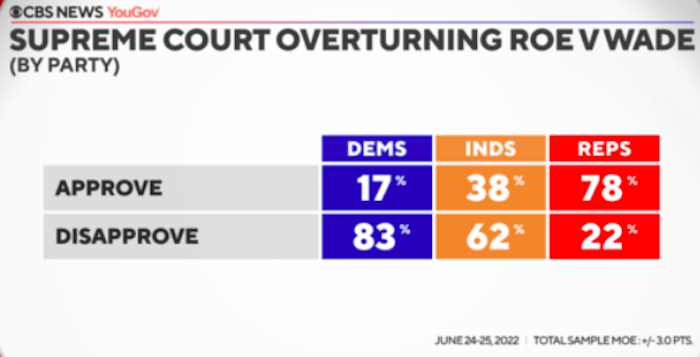
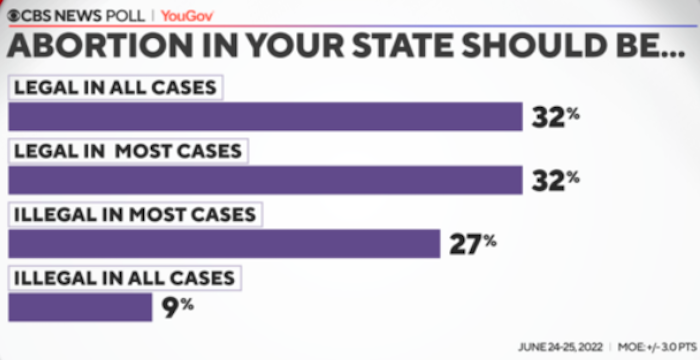
Overturning Roe Vs. Wade Was A Very Unpopular Decision


The charts above are from a new CBS News / YouGov Poll -- done on June 24th and 25th of a nationwide sample of 2,265 adults, with a 3 point margin of error.

Sunday, June 26, 2022

From The Dissenting Opinion On Overturning Roe Vs. Wade


 The following is a small part of the dissenting opinion by Justices Breyer, Sotomayor, and Kagan:

For half a century, Roe v. Wade, 410 U. S. 113 (1973), and Planned Parenthood of Southeastern Pa. v. Casey, 505 U. S. 833 (1992), have protected the liberty and equality of women. Roe held, and Casey reaffirmed, that the Constitu- tion safeguards a woman’s right to decide for herself whether to bear a child. Roe held, and Casey reaffirmed, that in the first stages of pregnancy, the government could not make that choice for women. The government could not control a woman’s body or the course of a woman’s life: It could not determine what the woman’s future would be. See Casey, 505 U. S., at 853; Gonzales v. Carhart, 550 U. S. 124, 171–172 (2007) (Ginsburg, J., dissenting). Respecting a woman as an autonomous being, and granting her full equality, meant giving her substantial choice over this most personal and most consequential of all life decisions. . . .

Now a new and bare ma- jority of this Court—acting at practically the first moment possible—overrules Roe and Casey. It converts a series of dissenting opinions expressing antipathy toward Roe and Casey into a decision greenlighting even total abortion bans. See ante, at 57, 59, 63, and nn. 61–64 (relying on for- mer dissents). It eliminates a 50-year-old constitutional right that safeguards women’s freedom and equal station. It breaches a core rule-of-law principle, designed to promote constancy in the law. In doing all of that, it places in jeop- ardy other rights, from contraception to same-sex intimacy and marriage. And finally, it undermines the Court’s legitimacy. . . .

With sorrow—for this Court, but more, for the many mil- lions of American women who have today lost a fundamen- tal constitutional protection—we dissent.

A Satirical Take On The Terrible Court Decision


The following post is a satirical look at the Supreme Court decision by Alexandra Petri in The Washington Post

I can see how you might be confused! At least, I think that horrid screaming, silent sobbing and rending of garments indicates confusion.

You are looking at the rulings the Supreme Court has been putting out lately and wondering how they are consistent with one another. “This ruling seems like it will result in many more births. Tons of births. More births than a majority of Americans think we ought to be compelled to have, in fact!” you say. “Whereas this ruling seems like it will result in people being killed with guns. Are we excited to protect life, or aren’t we?”

This is simple. Let me draw you a chart: Here is conception, when we have decided life begins. Sacred, exquisite, beautiful life. Life, than which nothing is more precious. Life, a concept popular enough to sell as both a board game and a cereal. Life! Which everyone ought to have!

Here, we have the halcyon period during which nothing is too good for you and you must be saved and protected at all costs. Anything you want, you must have. Someone else’s body, even at risk to her life? You got it! We owe you that much. We have no way of knowing you won’t be Shakespeare, or invent foaming hand soap. Up until the moment of birth, you are a glistening orb of magical potential. You might become a president, or better yet, the man who picks the president by deciding which electoral votes get counted.

And then here is birth, after which you are on your own.

Once you have been born, you are a nuisance, and, possibly, a woman — two categories the Supreme Court generally frowns upon. The born are always asking for things. You want baby formula? Uncontaminatedformula? You want people not to be able to bring guns to your school? You want to be mirandized? Can’t we go back to that lovely place when you were just an exciting concept who might grow up to be a Supreme Court justice?

Are you getting the idea now?

“But surely,” you might say, “people who have been born also have rights we are bound to respect?” Yes, for the moment. But we’re working on it! See how we’ve started chipping away at public safety?

Hopefully we can get the number of rights down even further, if we really work at it. No precedent is safe! Not Griswold! Not Lawrence! Not Obergefell! Down with substantive due process and up with due dates!

Some complain that this will be the first generation born with fewer rights than the one preceding it. But can you blame us for limiting the rights of the born? They are just so irritating!

All the people who sit next to you on public transit and talk too loudly and cough come from the ranks of those who have been born already. All the people who told you that your position on abortion is incorrect. All the women who threatened your precious career. All the people who show up outside your house and yell. Everyone who takes too long at the checkout line in front of you, or who calls you at home from a number labeled Spam Risk, or who leaves unpleasant comments on your online posts. They have all been born, and they are all terrible.

The born demand food and clothes and a roof over their heads. They object to laws passed about their bodies by people who have only the remotest, foggiest notion of what their bodies actually contain. They feel, somehow, that they should be able to make their own decisions, medical and otherwise — even the ones who are capable of conceiving! They, themselves, want to choose, not a bunch of people in robes who have been laboring under a misconception for years and now would like everyone else to, as well. And these born keep insisting they have a right to life, to liberty, to full autonomy. So needy!

Now you understand, surely. There is life — pleasant, luminous, sacred, to be honored and protected at all costs. And then comes the moment of birth, after which all you have is the unpleasant, sticky process of actually living. That hardly seems worth protecting at all.

Saturday, June 25, 2022

Supreme Court Says Women Are NOT Equal To Men


June 24th of 2022 will go down in history as a dark day for the United States. It marks the first time the Supreme Court has taken a right away from American citizens (instead of expanding individual rights).

The overturning of Roe vs. Wade means that women are now second-class citizens in this country. They do not have the right to control their own bodies -- as men do. And the decision promotes a minority religious view -- imposing that religious view of all Americans. Right-wingers will say this is just freedom of religion, but freedom of religion does not mean the right to impose religious views on everyone.

The religious minority would have you believe that a fetus is a person, even though that view doesn't appear anywhere in their Bible (which does NOT ban abortion). They lean on the commandment not to kill -- ignoring the dozens of instances in the Bible where their god says killing is appropriate. The ban on abortion is a made-up belief, and is not supported by their religious book.

This ruling will not end abortions. Women were getting abortions before Roe vs. Wade, and they will continue to do so now. The ban doesn't affect rich and upper middle class women. They will go to another state or country to get their abortions. It's much different for poor and working class women. They will not be able to afford to go to another state or country, and many will be forced into life-threatening back alley abortions. Thousands will die (as was happening before Roe vs. Wade).

The problem with this decision is even worse than that though. The decision means the court does not believe in an individual's right to privacy. This means they could also outlaw contraception, and could overturn same-sex marriage and other LGBTQ rights.

The members of the court voting to overturn Roe should be ashamed of forcing their own narrow and extreme religious views on other Americans. But I suspect they have no shame.

Monday, May 23, 2022

Americans Oppose Overturning Roe Vs. Wade


The chart above reflects the results of the newest Economist / YouGov Poll -- done between May 15th to 17th of a nationwide sample of 1,500 adults (including 1,342 registered voters). The margin of error for adults is 2.9 points, and for registered voters is 3.0 points.

Friday, May 13, 2022

New Monmouth Poll On Keeping/Overturning Roe vs. Wade


The charts above are from a new Monmouth University Poll -- done between May 5th and 9th of a national sample of 807 adults, with a 3.5 point margin of error.

The Two Pernicious Myths About Overturning Roe Vs. Wade


Those who favor the Supreme Court overturning Roe vs. Wade are trying to justify their actions with a couple of myths. Ruth Marcus explodes those myths in this excellent op-ed in The Washington Post:

Two pernicious myths about abortion rights have emerged in the wake of the leak of a draft Supreme Court opinion that would overrule Roe v. Wade. Together, they illustrate how intractable the abortion debate is — and how extreme.

The first myth — demonstrably laughable — is that eliminating constitutional protection for abortion rights would remove this contentious issue from courts and leave decisions to the democratic process, where it should have been all along.

The second — far more dangerous — is that abortion opponents would be satisfied with such an outcome, and the consequent national patchwork of access to abortion. They wouldn’t. Getting rid of Roe is just the start. For those who believe that abortion is the taking of a human life, allowing it to remain legal in wide swaths of the country is intolerable.

Let’s start with the fallacy that, as Justice Samuel A. Alito Jr. argued in the leaked draft, overruling Roe would “return the issue of abortion to the people’s elected representatives.”

Alluring as this may sound, it won’t happen. As Harvard Law School professor Richard Fallon wrote in a 2007 law review article, “The notion that by overruling Roe the Supreme Court could extract itself from controversial assessments of the constitutionality of state antiabortion legislation is not just a fallacy. It is a delusion.”

If anything, overruling Roe would expand court involvement by inviting action in state courts, testing the scope of what is protected under state constitutions. This isn’t imaginary: In Michigan, Democratic Gov. Gretchen Whitmer recently asked her state’s Supreme Court to preemptively address the question.

Meanwhile, federal courts, no matter how much they might want to get out of the business of deciding abortion cases, would face complex questions of constitutional law. Under Alito’s draft, abortion restrictions must only have a “rational basis” to pass constitutional muster. Permissive as this is, it will still present questions: Would it be rational for a state to prioritize fetal life over the life of the mother? Does protecting the fetus takes priority over serious risk to maternal health? Is it rational for a state to prohibit contraceptive methods, such as intrauterine devices or morning-after pills, which prevent implantation of a fertilized embryo? Can a state prohibit in vitro fertilization because it involves the destruction of such embryos?

Again, these are not far-fetched hypotheticals. Louisiana lawmakers are weighing a measure that would “ensure the right to life and equal protection of the laws to all unborn children from the moment of fertilization by protecting them by the same laws protecting other human beings.” This language could transform IUDs or discarding embryos created for IVF into homicide cases.

That’s just the start. Life without Roe introduces uncharted legal questions that law professors David S. Cohen, Greer Donley and Rachel Rebouché describe as “a novel world of complicated, interjurisdictional legal conflicts over abortion,” pitting state against state.

The rise of telemedicine and the availability of abortion-inducing medication — which now accounts for more than half of all abortions — mean that abortion is increasingly untethered from physical clinics and state borders. Do states that prohibit abortion have the power to prevent their citizens from obtaining abortions elsewhere, or to punish them if they do?

What happens if a woman takes abortion medication in a state where that is legal but expels the fetus in a state that prohibits abortion? Could states seek to punish out-of-state doctors who prescribe medication abortions — or, alternatively, shield in-state physicians from being held to account by states where abortion is illegal? State laws in this area would raise unresolved questions about the constitutional right to travel, the reach of the commerce clause, and the extent of extraterritorial jurisdiction — issues that make deciding what constitutes an “undue burden” on abortion rights simple by comparison.

If the legal questions will be unending, so, too, will be the efforts to end access to abortion, whether through the courts or the legislative process. For all of Alito’s paeans to the democratic process and Republican lawmakers’ efforts to present themselves as “compassionate, consensus builders” seeking only state “flexibility” to adopt “reasonable restrictions,” abortion opponents will not stop until it is outlawed nationwide. Why should they, if they believe that abortion is tantamount to murder?

Marjorie Dannenfelser, president of the antiabortion Susan B. Anthony List, told The Post that she has spoken with 10 potential GOP presidential candidates, most of whom “assured her they would be supportive of a national ban and would be eager to make that policy a centerpiece of a presidential campaign.”

Senate Minority Leader Mitch McConnell (R-Ky.) has not ruled out the possibility of a nationwide abortion ban but said he wouldn’t change filibuster rules to let that happen. Still, Sen. Joni Ernst (R-Iowa) plans to introduce legislation that would prohibit abortion after six weeks, The Post reported.

That’s not the only route to a nationwide ban. The other leads back to the courts, with the assertion that not only does the Constitution not contain a right to abortion, but that it also affirmatively protects the rights of the fetus. The 14th Amendment bars states from depriving “any person of life” without due process of law or denying “to any person … the equal protection of the laws.” Endorsing such fetal “personhood” — a position rejected in Roe — would mean that the Constitution requires states to prohibit abortion.

Conservative scholars John M. Finnis and Robert P. George pressed this argument in a friend-of-the-court brief in the Mississippi abortion casenow before the court, contending that “prohibitions of elective abortions” are “constitutionally obligatory because unborn children are persons within the original public meaning of the Fourteenth Amendment’s Due Process and Equal Protection Clauses.” If corporations are persons under the 14th Amendment, they argue, surely that status applies even more obviously to “unborn children.”

Don’t be fooled. The abortion fight is not about democracy — it’s about denying choice.