
The chart above is from the Change Research Poll -- done between May 5th and 10th of a nationwide sample of 2,244 registered voters.
The chart above is from the Change Research Poll -- done between May 5th and 10th of a nationwide sample of 2,244 registered voters.

Sixty years ago, the Rev. Martin Luther King Jr. and hundreds of thousands of fellow Americans marched on Washington for jobs and freedom. In describing his dream for us all, Dr. King spoke of redeeming the “promissory note to which every American was to fall heir” derived from the very idea of America — we are all created equal and deserve to be treated equally throughout our lives. While we’ve never fully lived up to that promise as a nation, we have never fully walked away from it, either. Each day of the Biden-Harris administration, we continue the march forward.
That includes a fundamental break with trickle-down economics that promised prosperity but failed America, especially Black Americans, over the past several decades. Trickle-down economics holds that taxes should be cut for the wealthiest Americans and biggest corporations, that public investments in priorities such as education, infrastructure and health care should be shrunk, and good jobs shipped overseas. It has exacerbated inequality and systemic barriers that make it harder for Black Americans to start a business, own a home, send their children to school and retire with dignity.
Vice President Harris and I came into office determined to change the economic direction of the country and grow the economy from the middle out and bottom up, not the top down. Our plan — Bidenomics — is working. Because of the major laws and executive orders I’ve signed — from the American Rescue Plan, the bipartisan infrastructure law, the Chips and Science Act, the Inflation Reduction Act, my executive orders on racial equity and more — we’re advancing equity in everything we do making unprecedented investments in all of America, including for Black Americans.
Black unemployment fell to a historic low this spring and remains near that level. More Black small businesses are starting up than we’ve seen in over 25 years. More Black families have health insurance. We cut Black child poverty in half in my first year in office. We are delivering clean water and high-speed internet to homes across America. We’re taking on Big Pharma to reduce prescription drug costs, such as making the cost of insulin for seniors $35 a month. We’re taking the most significant action on climate ever, which is reducing pollution and creating jobs for Black Americans in the clean energy future.
This administration will continue to prioritize increasing access to government contracting and lending. We awarded a record $69.9 billionin federal contracts to small, disadvantaged businesses in fiscal 2022. We’re taking on housing discrimination and increasing Black homeownership. To date, we’ve invested more than $7 billion in historically Black colleges and universities to prepare students for high-growth industries. We’ve approved more than $116 billion in student loan debt cancellation for 3.4 million Americans so that borrowers receive the relief they deserve. And a new student debt repayment planis helping Black students and families cut in half their total lifetime payments per dollar borrowed. We’re doing all of this by making sure the biggest corporations begin to pay their fair share, keeping my commitment that Americans earning less than $400,000 a year not pay a single penny more in federal taxes.
And to help guide these policies, I made it a priority to appoint Black leaders to my Cabinet, my staff, in the judiciary and to key positions in agencies such as the Federal Reserve to ensure policymakers represent the experiences of all Americans in the economy.
But we know government can’t do it alone. Private-sector leaders have rightly acted to ensure their companies are more reflective of America, often in response to their employees, their customers and their own consciences. Right now, the same guardians of trickle-down economics who attack our administration’s economic policies are also attacking the private sector and the views of the American people. A recent poll from the nonpartisan Black Economic Alliance Foundation shows overwhelming bipartisan support for promoting diversity as central to a company being more innovative and more profitable, and central to fulfilling the promise of our country for all Americans. Despite the attacks, we all must keep pushing to create a workforce that reflects America.
For generations, Black Americans haven’t always been fully included in our democracy or our economy, but by pure courage and heart, they have never given up pursuing the American Dream. We saw in Jacksonville, Fla., yet another community wounded by an act of gun violence, reportedly fueled by hate-filled animus. We must refuse to live in a country where Black families going to the store or Black students going to school live in fear of being gunned down because of the color of their skin. On this day of remembrance, let us keep showing that racial equity isn’t just an aspiration. Let us reject the cramped view that America is a zero-sum game that holds that for one to succeed, another must fail. Let us remember America is big enough for everyone to do well and reach their God-given potential.
That’s how we redeem the promissory note of our nation.


I write about race because I care about America. That sentiment might come as a shock to some. It is rare today to hear someone who talks forthrightly about the ills of structural racism lead with a declaration of patriotism or pride in the nation’s progress. But this is squarely within the tradition of Black America, from historic stalwarts Ida B. Wells and Langston Hughes to modern-day activists such as the Rev. William J. Barber II and Colin Kaepernick.
Race isn’t the problem with the American experiment so much as it is the best indicator of the experiment’s structural problems. Consider slavery: It’s not the nation’s original sin because a significant number of White Americans enslaved Black people; it looms so large for America because the nation was supposedly founded on the idea of human equality yet allowed this grossest of inequalities to persist and expand.
The criminal justice system doesn’t need reform because it disproportionately confronts and punishes Black, Native and Hispanic Americans, but because abuse of power by the state should not be tolerated in a nation founded on the idea of government by and for the people — all people.
The racial inequalities we see in health care and education outcomes — even when controlled for class — do not exist because of Black Americans’ race or some imagined cultural carelessness, but because those systems are from a different era and poorly designed to account for Black people’s distinctive American journey. As structured, they hinder the ability to pursue happiness, stability and security unless they are tailored to the communities they serve. The democratic backsliding the nation is experiencing today is an indicator of the way race factored into the cultural, political and legislative conflicts of the past three decades.
The nation’s trouble is not that it has a racist bone that simply needs removing but that it is disturbingly slow to recognize that racism is the sharp pain that helps us locate the fractures. I write about race because finding the fractures in our society and our democracy is a necessary step toward healing and strengthening, not destroying, the whole of the nation. . . .
I write about race because you cannot love America and avoid the issue. Yes, there are other topics — some of critical importance — but nothing reveals where the nation is most vulnerable like the question of race. If we want a United States that more fully realizes its potential, and I believe most of us do, fixing the structural flaws revealed by race presents the most promising path.
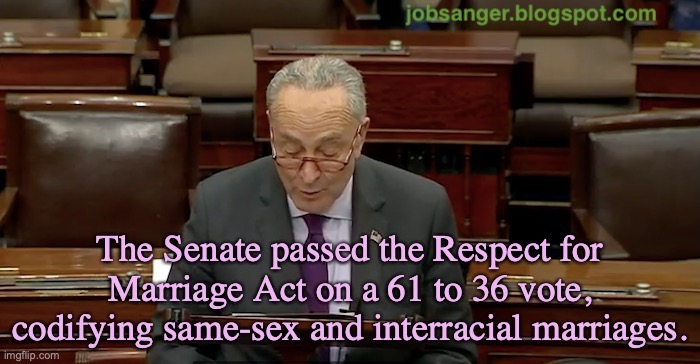
The Senate on Tuesday passed the Respect for Marriage Act, which would enshrine marriage equality in federal law, granting protections to same-sex and interracial couples.
The bill passed in a 61-36 vote, with 12 Republicans joining Democrats to vote for it. Three senators did not vote. The bill includes a bipartisan amendment that clarifies protections for religious liberties, and it will now return to the House for another vote before it can go to President Biden to sign into law.
The 12 Republican senators who voted “yes” were Roy Blunt (Mo.), Richard Burr (N.C.), Shelley Moore Capito (W.Va.), Susan Collins (Maine), Joni Ernst (Iowa), Cynthia M. Lummis (Wyo.), Lisa Murkowski (Alaska), Rob Portman (Ohio), Mitt Romney (Utah), Dan Sullivan (Alaska), Thom Tillis (N.C.) and Todd C. Young (Ind.).
Before the final vote, Collins stood to “thank all of the Republicans who have supported this. I know that it’s not been easy, but they’ve done the right thing.”
Biden celebrated the passage shortly after the tally was announced.
“With today’s bipartisan Senate passage of the Respect for Marriage Act, the United States is on the brink of reaffirming a fundamental truth: love is love, and Americans should have the right to marry the person they love,” the president said in a statement. “For millions of Americans, this legislation will safeguard the rights and protections to which LGBTQI+ and interracial couples and their children are entitled.”
The Respect for Marriage Act would not force states to issue marriage licenses to same-sex couples but would require that people be considered married in any state as long as the marriage was valid in the state where it was performed. The bill also would repeal the 1996 Defense of Marriage Act, which defined marriage as the union of one man and one woman and allowed states to decline to recognize same-sex marriages performed in other states. That law has remained on the books despite being declared unconstitutional by the Supreme Court’s 2013 ruling in United States vs. Windsor and its 2015 ruling in Obergefell v. Hodges, which guaranteed same-sex couples the fundamental right to marry.

The chart above reflects the results of the latest Economist / YouGov Poll -- done between May 15th and 17th of a nationwide sample of 1,500 adults (including 1,342 registered voters). The margin of error for adults is 2.9 points, and for registered voters is 3.0 points.


The election in Virginia last Tuesday was disastrous for Democrats. There are probably many reasons why it happened. But one big reason is revealed in exit polling that asked voters what issue was most important for them. That issue, especially for white voters was EDUCATION.
Now this is not education as it has been in the past, with educational issues like class size, testing, charter schools, or school funding. No, this time it was about race and ethnicity.
Youngkin (the GOP candidate) made that clear in the final days of the campaign, when he told voters that he would ban teaching Critical Race Theory in Virginia schools on his first day in office. That will be an easy task, because Critical Race Theory is not being taught in Virginia K-12 schools and there is no plan to have it taught. The same is true in every other state -- it is not taught and never will be.
Republican candidates across the country are lying about Critical Race Theory. They have turned it into some kind of monstrous program to embarrass white children and make them ashamed. It is NOT!
What is Critical Race Theory? It is a college level course that is discussed and taught mainly in law schools. To put it simply, it is the recognition that U.S. laws and society has racism built into it, and focuses on how to legally make those laws (and society) fairer to all Americans.
Do you want laws and societal structures that are fair to everyone? Republicans don't. They have demonized Critical Race Theory to get what they want -- a whitewashed version of history. They don't want students to learn about the evils of slavery. They don't want students taught the real reason for the Civil War -- slavery. They don't want students to learn about Jim Crow laws, the Ku Klux Klan, lynchings, or the white rioters that wiped out Black communities (like in Tulsa).
In short, they don't want real history taught. They want a white racist version of history taught.
If a Republican tells you he/she will prevent the teaching of Critical Race Theory in K-12 schools, he/she is lying, and is furthering racism.
If a voter believes that Critical Race Theory is being taught in K-12 schools, that voter is stupid or racist -- probably both.
American history has many bright moments, but it also has many dark moments. Both must be taught. Failure to do that means racism will continue, and we will be doomed to repeat many of those darker moments in our history.


It shows the racial views of groups of Americans. Note that the widest difference in views is between Democrats and Republicans.

The following is part of an excellent op-ed by the editorial board of The Washington Post:
Narrowing the U.S. wealth gap in general is important; narrowing the racial wealth gap is urgent. It is not the outcome of impersonal market forces but the legacy of oppressive policy. As a country we have already wasted too many opportunities to tackle it head-on.
It won’t be easy, in part because Supreme Court rulings have limited government’s authority to use overtly race-conscious remedies to address Black economic disadvantage. The court has held, essentially, that such measures can amount to racial discrimination against people who are not Black. This is a bitter irony given that many race-conscious policies that disadvantaged Black people were either not challenged or deemed consistent with the U.S. Constitution over the decades. Still, it is a reality that could preclude measures explicitly for the benefit of Black people.
That includes reparations, which nevertheless merit a study such as the one called for in a pending bill, H.R. 40. Even if general compensation for slavery and segregation could not be feasible, or pass muster under current constitutional law, financial restitution may be available for identifiable victims of specific contemporary injustices, analogous to payments the United States made to those of Japanese ancestry interned during World War II. There needs to be focused attention on such quietly devastating barriers to wealth-building as the prevalence of informal land title among rural Southern Black families, which The Post’s Hannah Dreier and Andrew Ba Tran documented in a recent report. This legacy of Jim Crow has cost many families government disaster relief, and sometimes their property itself.
Meanwhile, the racial wealth gap can and should be addressed through measures that are race-neutral but foreseeably bestow disproportionate benefits on people of color — thus flipping the script on past policies that were officially colorblind but favored Whites. We have mentioned some in previous editorials: direct support for first-time home buyers and for retirement savings, in place of current tax incentives that tilt toward the upper middle class; grants for college tuition in place of loans.
Each low-income child born in the United States could be staked to a federally funded $1,000 “baby bond,” with annual payments, varying by family income, added until age 18, as Sen. Cory Booker (D-N.J.) and others have advocated. Invested in safe government bonds, the money would accumulate tax-free. It could only be withdrawn for investment in further wealth-building purposes such as education, entrepreneurship or homebuying. An analysis by the financial research firm Morningstar suggests that “baby bonds” could cut the racial wealth gap in half in terms of resources available per child at age 18.
Reform of the country’s current equivalent of a wealth tax — state and local property taxes — could also foster racial equity. Recent research by finance professors Carlos Avenancio-Leon of Indiana University and Troup Howard of the University of Utah has shown that existing systems result in higher property assessment growth rates for homeowners of color relative to similarly situated White homeowners.
Unjustifiably wide though it still is, the Black-White wealth gap is narrower than it was three decades ago: Median Black household wealth was 12 percent of White in 2019, but an even lower 6 percent in 1989. The lesson is that the United States has proved capable of reducing racial wealth inequality — even during a time when it was not consciously trying to do so and, in some respects, was raising new obstacles. Think how much more progress can be achieved if the country actively pursues it.


Here is part of the response to Cruz's idiotic lie from Kevin M. Kruse at MSNBC.com:
At the conservative Faith and Freedom Forum this past week, Sen. Ted Cruz, R-Texas, launched an attack on critical race theory. Such rants have become a staple for Republicans lately, but Cruz set himself apart by asserting that the legal theory was “every bit as racist as the Klansmen in white sheets.”
To say this is nonsense feels painfully obvious. The Ku Klux Klan’s ideology began with the premise that racial differences were an obvious biological and scientific fact and that all human activities had to be organized around that fact; critical race theorists take as their starting point the belief that race is a fiction, that it’s an invented concept that has no basis in biology or science.
The Klan worked to put its racist beliefs into action through Jim Crow laws in the South and immigration restrictions for the nation as a whole; critical race theorists have devoted themselves to identifying the remainders of that racism in the law and rooting it out.
And, most obviously, the KKK was a terrorist organization responsible for decades of white supremacist violence that included thousands of murders, mutilations and bombings of African Americans and other minorities. The law school professors behind critical race theory are not.
Despite the vast differences between the Klan and critical race theorists, Cruz twisted himself into knots insisting they were the same by grossly misrepresenting the scholarly field. "Critical race theory says every white person is a racist," the senator asserted. "Critical race theory says America's fundamentally racist and irredeemably racist. Critical race theory seeks to turn us against each other and if someone has a different color skin, seeks to make us hate that person."
Cruz offered no evidence for these claims, because there is none. Far from arguing that individual white people are all racist, critical race theorists assert that focusing on the actions of individuals is meaningless because racism is more deeply rooted in larger structural and systemic problems.
Rather than believing America is “irredeemably racist,” critical race theorists have stated that their reckoning with the submerged role of racism in America is a path to redeem the nation and fulfill the promises of emancipation and the 13th, 14th and 15th Amendments. Critical race theorists also do not seek to turn Americans against each other, but rather to help them understand the actual history of the nation they share as citizens.
While Cruz’s claim that critical race theorists are “every bit as racist” as Klansmen is laughable, it notably fits into a larger historical pattern in which white southerners asserted that the critics of white supremacy were just as bad — or worse — than the defenders of white supremacy.
During the civil rights era, segregationist leaders across the South complained that they were being besieged by “extremists on both sides,” by which they meant white supremacist organizations like the Ku Klux Klan and its white-collar counterpart, the White Citizens’ Councils, and civil rights organizations, like the National Association for the Advancement of Colored People (NAACP). . . .
Convincing ordinary Americans that the enemies of the Klan were just as bad as the Klan itself was, of course, the entire point. It still is.
This is a tried-and-true line of attack from those who wish to preserve the status quo, but in this instance it’s especially egregious. Critical race theorists seek to expose the ways in which white supremacists — like Long, the Louisiana state legislature, or Johnson — abused the powers of their offices to embed racist principles and policies in our political and legal systems.
It’s bad enough that Cruz slanders them. But it’s even worse that he uses the exact same line of argument against them that those segregationists did.

The chart above is from the Politico / Morning Consult Poll -- done between May 21st and 24th of 2,200 adults nationwide, with a 2 point margin of error.
It's been over a year since the death of George Floyd, and most Americans think race relations in the country have-not improved (in fact, 46% say it has gotten worse). And sadly, only 30% say race relations will improve in the next 5 years.

The chart above is from a Gallup Poll -- done between May 3rd and 18th of a national sample of 1,016 adults, with a 4 point margin of error.
It shows that the percentage of Americans see racial justice as a problem in the U.S. increased substantially around the time of George Floyd's death, and is still significantly higher than before.


Donald Trump seems to be basing his campaign on two issues -- that the BLM protesters are violent and unruly, and that he is the person who can guarantee the public's safety. But he has a problem -- the voters don't believe him.
Voters prefer Biden on dealing with race relations by a 19 point margin, and think Biden is better for public safety by an 8 point margin. That's not good for Trump -- that the voters are not buying his campaign themes.
In fact, Biden is preferred over Trump on every campaign issue except one -- the economy (and Trump only leads that by a statically insignificant 1 point).
The chart above is from the Politico / Morning Consult Poll -- done between August 28th and 30th of a national sample of 1,988 registered voters, with a 2 point margin of error.


