Showing posts with label default. Show all posts

Friday, October 08, 2021

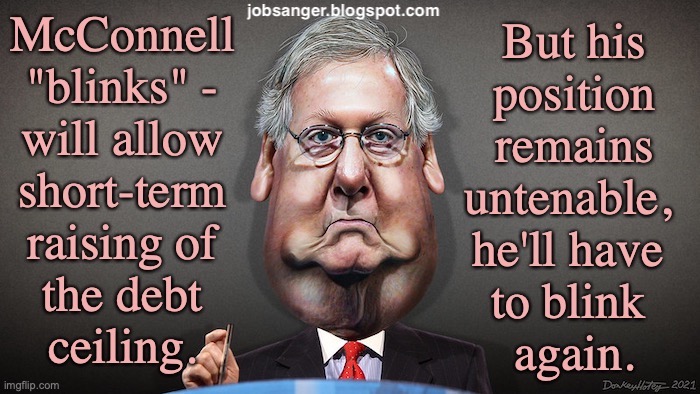
McConnell "Blinks" - But He Remains On The Hot Seat


It looks like the debt ceiling fight is over -- for now. Afraid that he and his party would be blamed for a default if they continued to filibuster raising the debt limit, Minority Leader McConnell agreed to stop the filibuster and allow Democrats to raise the debt ceiling for nearly two months. But the fight is not over. The same thing is going to be repeated near the first of December.

McConnell wants Democrats to raise the ceiling using the reconciliation process, and says the short delay will give them time to do that. He could then tell voters that Republicans tried to stop the Democrats, but failed to curb their spending. It would be a lie, but that's what he wants.

But Democrats are not interested in playing his silly game. They have no intention of using reconciliation to raise the debt ceiling. They will dare the GOP to repeat its obstruction in December.

And the position held by McConnell and the Republicans is untenable. They cannot force Democrats to use reconciliation -- and if they block raising the debt ceiling and cause a default, they will be the ones to blame. The public will see it was the Republicans who voted for default, and the Democrats who voted against it.

McConnell will have to "blink" again in December. The normally Republican business community will force him to do so.

Tuesday, October 22, 2013

Public Doesn't Like GOP Control Of House


Republicans like to talk these days about the approval rating of President Obama (which is currently 8 points under his disapproval). I don't blame them, since it is one of the few things they have to talk about that's not downright embarrassing for them. That's because the approval rating for Congress, where they have a lot of power, makes the presidential approval look exorbitantly high. Congressional disapproval is 74 points higher than their approval rating. In addition, a significant plurality of Americans (44%) think the president would do a better job of solving the nation's problems than the Congress (31%).

The congressional Republicans might like to placate themselves by thinking that the public is mad at everyone in Congress (Republicans and Democrats alike) -- and that would be partially true. But while the public is unhappy with both congressional parties, numerous polls have shown that they are a lot unhappier with Republicans than Democrats.

Now a new poll shows an even worse thing for the Republicans. For the first time since the election of 2010 (where the GOP gained control of the House), more Americans think that's a bad thing than a good thing for the Republicans to control the House of Representatives. It is the new CNN / Opinion Research Poll (taken between October 18th and 20th of 841 nationwide adults, with a 3.5 point margin of error). Currently 54% of Americans say it's a bad thing for the GOP to control the House, while only 38% think it's a good thing.

And the demographic breakdown of that poll should worry Republicans even more. Only two groups, the teabaggers and the Republicans, think it is good for the GOP to control the House (while rural voters are split on the issue, within the margin of error). All other groups show a significant preference for the GOP to NOT control the House (including all sexes, races, areas of the country, ages, and income levels). Here is the demographic chart:

This poll just verifies what several others have shown. The GOP did itself serious damage in shutting down the government (and threatening to make the government default on its loans) -- and in doing so, they have given the Democrats a good chance to flip the House in the 2014 election.

There's still a year to go before the election, and the GOP will certainly try to repair the damage they have done. But they won't be able to start seriously repairing that damage until next summer -- after the Republican primaries (where the teabaggers, who control the party in many states, will decide who wins). And waiting until after the primaries to repair the damage may not give them enough time to get it done, especially if they threaten another shutdown in January (which is what their base would like to see happen).
Wednesday, October 16, 2013

Ten Sentences On Debt Ceiling Crisis

While the government shutdown is a serious matter, and is already causing damage to our economy, it pales in comparison to the damage that could be done by failing to raise the debt ceiling -- and we are within a couple of short days of doing just that. Republicans in Congress, especially in the House of Representatives, continue to threaten to block a raising of the debt ceiling. They either don't realize, or don't care, about the damage such a move could do -- not only to the American economy, but to the economic future of many other countries.

Some of these Republicans are now trying to minimize the realities of a government default by not raising the debt ceiling, but even their compatriots on Wall Street aren't buying that. They know serious economic damage would be done by failing to raise the debt ceiling, and like most other Americans, they want to end this nonsense now.

What are the facts about our debt ceiling crisis? Perhaps the best explanation, and the most succinct, has been given by Kevin Drum of Mother Jones. He explains it in only ten sentences. Here they are:


1. On May 19, total US debt reached $16.7 trillion, the maximum currently allowed by law.
2. The Treasury Department has been playing various games since then to continue paying all our bills while still technically remaining under the debt limit, but within a few days they'll run out of tricks and the government will no longer be allowed to spend more money than it takes in.
3. These Treasury tricks are very much not business as usual, and the fact that we've been reduced to these kinds of shell games means that normal governance is already dangerously crippled.
4. The Congressional Budget Office estimates that in FY 2014 (which runs from October 2013 through September 2014), total federal income will be $3,042 billion and total spending will be $3,602 billion, a difference of $560 billion.
5. This is the amount of debt we need to issue to pay for everything in the budget, which means that if the debt limit isn't raised, we need to immediately cut spending by $560 billion, or $46 billion per month.
6. That's roughly the equivalent of wiping out the entire Defense Department; or wiping out two-thirds of Social Security; or wiping out all of Medicaid + all unemployment insurance + all food assistance + all veterans' benefits.
7. What's worse, because the government's computers are programmed to simply pay bills in the order they're received, it's not clear if the Treasury can specify which bills get paid and which don't.
8. This raises the additional risk that interest on treasury bonds might not get paid—something that would put US debt in default and could be disastrous in a global economy that depends on US bonds being rock solid.
9. So those are our choices if Congress fails to raise the debt limit: Either we suddenly stop paying for critical programs that people depend on, or we default on US treasury bonds—or both.
10. The former would immiserate millions of people and probably produce a second Great Recession, while the latter would likely devastate the global economy.

Monday, October 14, 2013

Independents Are GOP's Biggest Problem


The congressional Republicans have created a lot of problems for themselves with their shutting down of the federal government (and their threat to let the government default by refusing to raise the debt ceiling). They have unified Democrats across the country and exacerbated the split within their own party -- especially between congressional Republicans and elected GOP officials outside the Beltway (like the GOP governors).

But while those are problems, they are not as serious as what their recent actions have done to the Republican Party brand among Independents. A few months (or even weeks) ago, the Independents held an equally low opinion of both Republicans and Democrats. That is no longer the case, as Independents have been moving away from the Republican Party.

That's primarily because the Independents blame the Republicans for the shutdown (51% to 37%). And their job approval for congressional Republicans has also dropped, with 69% now disapproving of the GOP (or about 7 out of 10 Independents) while only about 25% approve of the GOP.

But the number that should scare the Republicans the most is illustrated in the bottom chart shown above -- the party they would vote for in congressional elections if the election was held today. While this number was roughly equal only weeks ago, it is no longer so. Independents prefer Democrats over Republicans by a 9 point margin now (42% to 33%) -- and that could put Republican control of the House of Representatives in danger.

The gerrymandering done by Republican state legislatures gave the Republicans a lot of safe congressional seats, but it did not make all of the seats they currently hold safe. There are at least 24 congressional seats now held by Republicans that are considered to be competitive -- and the Democrats only need 17 seats to take control of the House. The important thing to remember is that it will be Independents who decide those 24 seats (since there are not enough Republicans or Democrats in those districts to assure victory).

There is still a year before the next election, but it's going to take the GOP a while to repair the damage. And if they make the government default on its loans, or keep the government shut down for an extended time, they will make it even tougher on themselves to repair the damage they are doing before November of 2014.

The charts above were made from the recent survey done by Public Policy Polling between October 4th and 6th of 1,000 voters nationwide (with a margin of error of 3.1 points).

Thursday, October 10, 2013

Over 2/3 In The U.S. Fear A New Economic Meltdown Is Coming Soon

The Republicans in Congress haven't just hurt their own political brand by engineering the government shutdown, they are also scaring a lot of people in this country. Americans know that the current economy is weak, and could easily slip into another recession. Just last April, about 59% of Americans said the country was in danger of another financial meltdown.

Now with the GOP shutdown of government, the percentage of those expecting another meltdown has jumped another 9 points to 68% or slightly more than 2/3 of the population (nearly 7 out of 10 people). And instead of trying to work with Democrats to open the government again and start fixing the economy, the Republicans are doubling down on their threats to the government and the economy -- by saying they won't vote to raise the debt ceiling unless the Democrats give in on Obamacare and a list of other items, like cutting entitlements (Social Security, Medicare, Medicaid, etc.).

What makes it even worse is that these Republicans don't seem to understand the disaster they are courting. Several in both the House and Senate are now saying that not raising the debt ceiling wouldn't cause any problems for the economy or the government, and might even improve things. No one believes that, especially American voters. They saw the government credit status devalued after just a very short refusal to raise the debt ceiling in 2011. Now the Republicans are talking like it could be much longer this time.

The American people aren't as stupid as these GOP congresspeople seem to be. They know a crisis is looming if the GOP follows through on their attempt to blackmail the government into giving them what they couldn't get legislatively or at the ballot box. What the hell are these congressional Republicans thinking? Are they really ready to cause the government to default on its debts and throw the economy into another recession -- just to get approval of their dangerous ideology?

This is why it's crucial to vote the GOP out of power in 2014. It's the only way to get this country back on a sane economic policy footing.

The chart above was based on a recent Rasmussen Poll (taken on October 7th and 8th of 1,000 adults nationwide (with a 3 point margin of error).

Shutdown Damaging GOP (& Costing Votes)


The Republicans' ultra-right policies leading to a shutdown of the government (and a possible government default in just a few days) are hurting the Republican Party. They had hoped to come out of this mess looking like budget heroes, but just the opposite is happening. They are being blamed for the shutdown, and their reluctance to even have a vote on a continuing resolution is damaging the party's brand.

In fact, there are a couple of new polls out that agree on one thing -- that the Republicans could lose control of the House of Representatives if they continue down the road of shutdown and/or default. Just a couple of months ago, both Public Policy Polling and Democracy Corps showed that elections in congressional districts were either very close, or leaned toward the Republican Party. That is no longer true. As the two charts above show, voters are now leaning toward the Democratic Party.

The Republicans did some pretty effective gerrymandering in 2010, and that will undoubtably protect most of the House Republicans. But they do not all have safe seats. There are 24 competitive seats currently held by Republicans -- and the Democrats just need 17 of them to flip the House. And if the election was held today, there is a very good chance that would happen.

The Republicans have some fences to mend if they are going to keep control of the House, but they can't even start to mend those fences as long as the shutdown continues (or the nation goes into default). Here are some more charts showing the GOP's dilemma:


The AP-GfK Poll was conducted between October 3rd and 7th of 1,227 nationwide adults (with a 3.4 point margin of error).

The Gallup Poll was conducted between October 3rd and 6th of 1,028 nationwide adults (with a 4 point margin of error).

The survey of Public Policy Polling was conducted between October 4th and 6th of 1,000 nationwide voters (with a 3.1 point margin of error).

The Democracy Corps Poll was conducted between October 6th and 8th of 950 nationwide adults (margin of error unknown).