
Showing posts with label nuclear weapons. Show all posts
Showing posts with label nuclear weapons. Show all posts
Friday, June 27, 2025
Most Don't Trust Trump On Decision About Use Of Nuclear Weapons

Tuesday, June 10, 2025
Nuclear Weapons Haven't Gone Away - And They're More Dangerous Than Ever


The following is part of an excellent article in The Washington Post:
By Jon B. Wolfsthal
, Hans Kristensen
and Matt Korda
Jon B. Wolfsthal is the director of global risk at the Federation of American Scientists. Hans Kristensen and Matt Korda are the director and associate director of the FAS Nuclear Information Project.
Over the past 30 years, since the collapse of the Soviet Union, the prospect of nuclear war has faded from the American consciousness. With the end of the Cold War, films depicting the last days of humanity, such as 1959’s “On the Beach,” or the 1983 TV drama “The Day After,” largely disappeared from the Hollywood playbook. Schoolchildren no longer hid under their desks during practice drills to survive nuclear war.
But the weapons never went away. While thousands were scrapped and nuclear inventories were significantly reduced, many other weapons were put into storage and still thousands more remain deployed, ready for use.
Now, they and the dangers they pose are making a comeback.
The last nuclear age was defined by two superpowers — the United States and the Soviet Union — poised to destroy one another in less than an hour. They both kept nuclear weapons locked and loaded to deter the other by threatening retaliation and certain destruction.
Today’s global nuclear landscape is far more complicated and, in many ways, more precarious. More countries and more advanced technologies are involved. Weapons can fly farther, faster, from more places. Information, accurate or false, can move even more quickly. Autocrats and extremists hold positions of power in nuclear-armed countries. Nuclear threats, once taboo, are now increasingly common. And the last nuclear arms control treaty still in force between Russia and the United States expires in February.
Many of the most dangerous ideas from the Cold War are being resurrected: lower-yield weapons to fight “limited” nuclear wars; blockbuster missiles that could destroy multiple targets at once; the redeploying of a whole class of missiles once banned and destroyed by treaty. On top of this, countries are testing new ways to deliver these weapons, including nuclear-powered cruise missiles that can fly for days before hitting their targets; underwater unmanned nuclear torpedoes; fast-flying, maneuverable glide vehicles that can evade defenses; and nuclear weapons in space that can attack satellites or targets on Earth without warning. . . .
Addressing the dangers of this new nuclear reality will take more than relearning old lessons, because the ways in which these weapons are being deployed, could be delivered and the technologies they rely on are all evolving day by day. Instead of capping or limiting national missile defenses, as was done from 1972 to 2002, the U.S., Russia and China are developing more capable defenses — including the highly ambitious “golden dome” missile defense system President Donald Trump announced recently. At the same time, multiple nuclear-armed countries are developing highly maneuverable hypersonic weapons that can carry nuclear payloads and take unpredictable pathways to their targets to evade missile protection systems.
Russia and China are also both building new long-range missiles with multiple warheads that could hit multiple targets — reversing a major effort to limit such weapons during the Cold War. Both countries are also reportedly developing options to put nuclear weapons in space to attack satellites and/or targets on the ground. And the U.S. is considering building even more ways of delivering nuclear weapons, including with sea-launched cruise missiles capable of reaching Russia, China and beyond.
It is as if the lessons of the Cold War — that there is never a finish line to the arms race and that more effective nuclear weapons do not lead to stability and security — have been forgotten by the current generation of defense planners.
Finally, there is growing concern that Russia, China, the U.S. and even North Korea plan to use artificial intelligence to help manage their nuclear arsenals. Statements by the U.S. and China to keep a “human in the loop” are designed to reassure, but AI is already being used in conventional military planning and nuclear-related early warning and detection. No one knows how this new technology will ultimately affect nuclear strategy. . . .
Without renewed public pressure or political will, the world is condemned to live under the shadow of nuclear annihilation. We deserve better.
Friday, December 27, 2024
Chemical/Biological Weapons Were Banned - Nuclear Weapons Should Be Next

The following is part of a post by Beatrice Fihn in The New York Times:
It’s easy to feel overwhelmed by the growing risk of nuclear war today. Russia is making regular nuclear threats. America is undertaking a large-scale nuclear modernization program. China is increasing its nuclear arsenal. Tensions are escalating between nuclear-armed states.
But nuclear weapons are not an inevitable fact of human life. They are not impossible to get rid of, and pushing for that can be done by ordinary people like you and me.
Precedent exists for solving the problem of weapons of mass destruction. At one point, the United States and the Soviet Union, then Russia, together had over 70,000 tons of chemical weapons. But on July 7, 2023, the United States announced it had destroyed the last of its chemical weapon stockpiles, under the 1997 Chemical Weapons Convention. Russia declared it had done so a few years earlier.
When nations violate such treaties — such as when Syria, a party to the treaty, used chemical weapons in 2018 — they see little benefit but can quickly bring on international condemnation. Syria’s strategic position didn’t suddenly improve because it employed a weapon of mass destruction. The world perceives chemical and biological weapons as very dangerous but not as a source of power.
Nuclear weapons can lose their power, too. Contrary to popular belief, nuclear weapons are remarkably inefficient tools of war. They are clumsy, expensive, and lack practical military utility. Their use would result in catastrophic destruction, potentially wiping out hundreds of thousands of innocent civilians and spreading radioactive contamination across borders and generations. It is hard to envisage a scenario in which a state would be better off choosing to use a nuclear weapon over a conventional weapon, given the significant harm it would cause both to that nation and to its allies. Even nuclear-armed nations openly acknowledge that these weapons should never be used.
As opposed to conventional weapons, nuclear weapons’ main perceived benefit lies in their ability to scare and deter others. Their power lies not in their practical utility but in how they are viewed by nations and their adversaries. This concept, known as nuclear deterrence, works only as long as your adversaries allow it to work; it is a profoundly vulnerable security strategy.
That vulnerability is our greatest opportunity for change. Since no other weapon is so dependent on public perception, regular people have a unique power over the future of these weapons. Ukrainians’ refusal to be deterred by Russia’s threats of using a nuclear weapon is one example of how regular people can shift perceptions of nuclear threats and reduce the impact of a nation’s nuclear arsenal. When the threats are ignored, they lose their potency.
The anti-nuclear-weapon movement has achieved many victories in restraining nuclear proliferation and preventing nuclear war this way. Student groups, trade unions, professional organizations, scientists, artists and local governments have all played crucial roles in challenging the nuclear status quo. Thanks in part to political pressure and shifts in perception generated by such grass-roots movements, most countries in the world have signed on to a world without nuclear weapons through nuclear-weapon-free zones and the United Nations’ Treaty on the Prohibition of Nuclear Weapons. The United States and Russia have reduced their nuclear stockpiles by over 80 percent since 1985. Nuclear testing, with the exception of North Korea, has ceased. Since 1945, no country has used nuclear weapons in warfare. The number of nuclear-armed states remains small — just nine out of 193 United Nations member states. Not having nuclear weapons is the norm, not the exception. . . .
So how can individuals contribute? First, recognize your power. A key tool is to change the way we talk about nuclear weapons. Instead of thinking of them as magical tools, we should talk about them as being irrational and useless for any real life military situation. Instead of discussing nuclear weapons in terms of abstract theoretical concepts like strategic stability and mutually assured destruction, we should center conversations on the facts and scientific evidence of what happens when these weapons are used or tested. We can all start questioning common assumptions that these weapons are designed to keep us safe and expose the irrationality of a national security strategy based on threatening to commit collective global suicide.
If you’re a student, organize campus discussions. If you’re a professional, engage through your networks. If you are an artist, use your skills to address these issues.
Get in touch with your elected representatives but don’t forget to also engage with city councils, state representatives and community groups. Cities and local authorities are becoming more involved in statecraft and diplomacy. Getting your city or state on board with the growing number of local authorities that are taking action on this can help build a new generation of political leaders taking on this issue.
Finally, remember that it’s not just governments that need to change. Through our pension funds, universities and financial institutions, we can try to influence corporate behavior by withdrawing investments from companies involved with nuclear weapon manufacturing. By pressuring companies like Boeing, Lockheed Martin, Northrop Grumman and other military contractors that develop nuclear weapon technologies, we can make the production of weapons of mass destruction costly to corporate reputations. Divestment campaigns have proved effective at raising awareness in other spheres, such as tobacco and fossil fuels, and can be equally helpful in delegitimizing nuclear weapon production. . . .
We have the power to turn nuclear weapons into relics of a misguided past.
Tuesday, March 26, 2024
Most Think A New World War Will Happen In Next 5-10 Years


The charts above reflect the results of a YouGov Poll -- done between February 1st and 7th of a nationwide sample of 1,000 adults, with a 3.8 point margin of error.
Monday, November 06, 2023
Has The World Forgotten The Horror Of A Nuclear War?

At the end of World War II, the world saw nuclear weapons used for the first, and so far only time, as Hiroshima and Nagasaki were bombed. Many thousands were killed or injured, and it was horrifying. As Russia developed nuclear weapons, the world shuddered at the thought of a nuclear war.
Fortunately, both sides recognized the danger and a detente was reached. Treaties were signed to control the manufacture and use of nuclear weapons.
But the safeguards reached are now beginning to disappear. The last of the detente treaties (Start treaty) will expire in February of 2026, after which there will be no restraints on the manufacture and/or use of nuclear weapons by either Russia or the United States.
Add to this the fact that China has increased its manufacture of nuclear weapons. After being content to have only a few hundreds for decades, China is expected to have at least 1,500 nuclear weapons by 2035.
The danger doesn't stop there. At least six other countries also have nuclear weapons (United Kingdom, France, Pakistan, India, Israel, and North Korea) -- and Iran is on the way to having a nuclear arsenal.
It makes me wonder -- have today's leaders forgotten the horror a nuclear war would bring? I'm sure that have read about Hiroshima and Nagasaki in history books, but reading about something is not the same as seeing the horror of it. And the weapons used on Japan are small potatoes when compared to today's nuclear weapons.
Decades ago, these weapons were kept to keep others from using them against any nation. That no longer seems to be. It seems that some now thing a nuclear war would be winnable, and maybe even justifiable to spread their own political or religious beliefs.
That is insane, but leaders sometimes do insane things. The continued proliferation of nuclear weapons and the disappearance of treaties regulating them is making the world a much more dangerous place.
There needs to be new talks, new treaties, and new controls on nuclear weapons -- and these talks need to involve the entire world (both the current nuclear countries and those who may develop them in the future). A nuclear strike by any country could kill millions, and could be the match that ignites a world war of nuclear strikes (which could be end end of civilization).
A nuclear war is not winnable, and it's time to make sure one never happens.
Wednesday, October 12, 2022
Are We Closer To A Nuclear War Than Any Time Since 1962?

Is President Biden right? Are Putin's threats to use nuclear weapons putting the world at more risk of a nuclear armageddon than at any time since the Cuban Missile Crisis of 1962? Here's is a part of what Madison Czopek and Louis Jacobson have to say about it at PolitiFact:
It’s not every day that an American president warns of nuclear disaster and draws on Biblical imagery to do so. But President Joe Biden did just that Oct. 6 when he told Democratic donors the threat of "Armageddon" is higher than it has been in decades.
"We have not faced the prospect of Armageddon since Kennedy and the Cuban Missile Crisis," Biden said at the New York event. "We’ve got a guy I know fairly well; his name is Vladimir Putin. I spent a fair amount of time with him. He is not joking when he talks about the potential use of tactical and nuclear weapons, or biological or chemical weapons, because his military is, you might say, significantly underperforming."
The Cuban Missile Crisis in 1962 was a roughly two-week period when the Soviet Union moved nuclear missiles to Cuba, not much more than 100 miles from U.S. territory. Before President John F. Kennedy and Communist Party First Secretary Nikita Khrushchev calmed tensions, millions of American adults and children had well-founded fears that they could die in a nuclear exchange between the superpowers.
It wasn’t immediately clear whether Biden was warning that Russia might use nuclear weapons, breaking an international taboo that has held for 77 years, or whether he was saying that such a nuclear strike by Russia would spiral into a nuclear free-for-all and global destruction. Experts have said that the use of "tactical," or battlefield-based, nuclear weapons would not necessarily set off a civilization-destroying conflagration, though it would cause many more limited problems.
Either way, Biden’s willingness to broach the subject of "Armageddon" set off alarm bells. The New Testament describes Armageddon as the place of final battle between good and evil. The word is often used to describe a final conflict that would end the world.
Russian President Vladimir Putin has made several statements about the amount of force he is willing to use and has suggested that nuclear weapons are not off the table.
"If the territorial integrity of our country is threatened, we will without doubt use all available means to protect Russia and our people — this is not a bluff," Putin said Sept. 21.
During a Sept. 30 ceremony in which Putin moved to annex four regions of Ukraine into Russia, Putin said Russia would "protect our land using all our forces and means at our disposal." The annexations followed elections that international observers widely derided as shams.
Experts in nuclear policy told PolitiFact that they thought Biden had a point about the nuclear risk level as it pertains to U.S.-Russia relations. Although the Cuban Missile Crisis is the best-known potential nuclear faceoff in the two countries’ Cold War history, experts added that a number of other conflicts have created heightened global nuclear risk, not all of which were publicly known in real time.
The White House did not respond to PolitiFact’s request to elaborate on Biden’s comments.
Sebastien Philippe, an associate research scholar with the Program on Science and Global Security at Princeton University, said that "the world is closest to the prospect of nuclear use, escalation and war that it has been in decades." He said Russia could use nuclear weapons in a variety of ways in the conflict, but even the most modest option "would likely broaden the conflict and increase the prospects of further nuclear escalation."
Even before Russia invaded Ukraine, relations between the U.S. and Russia had soured, potentially putting the two nations on a collision course, said Lynn Rusten, vice president of the Nuclear Threat Initiative’s Global Nuclear Policy Program. During the Obama administration, Rusten served as the senior director for arms control and nonproliferation on the White House National Security Council.
Putin’s move toward "nuclear saber-rattling" suggests that Russia’s current leadership is dangerous, making a nuclear exchange at least conceivable, Rusten said.
Richard Betts, a war and peace studies professor at Columbia University, said there hasn’t been such a significant near-war crisis with Moscow since 1962.
"Lack of such crises reflected the stabilization of the cold war and the recognition by all sensible policymakers on both sides that it’s in neither side’s interest to raise the risk of mutual annihilation," Betts said.
Betts added that Putin’s recent threats may be only a bluff, seeking to leverage what tools he has when his military is struggling on the battlefield and when Russia is relatively isolated diplomatically. Still, Betts said, the certainty that Putin is only bluffing "is not high enough to be grounds for confidence."
Shannon Bugos, a senior policy analyst at the Arms Control Association, said that although she might have used different words to describe the situation than Biden did, the president’s words "certainly convey the U.S. assessment that the threat is very serious — and I would very much agree with that assessment."
Tuesday, March 22, 2022
WWIII Has Started (Though Most Don't Want To Admit It)

In the 1930's, nations tried to appease Hitler by allowing him to annex the Sudentenland. They mistakenly thought this would satisfy Hitler and prevent war. They were wrong. He went on to invade Poland and many other countries.
History is now repeating itself. The U.S. and NATO did nothing as Putin seized Crimea. They thought that allowing him to do that would prevent a wider war. They were wrong. He has now invaded Ukraine, and there is no reason to believe he will stop there. He wants to restore the old Soviet empire, and if allowed to do that, will go even further.
Still leaders of the U.S. and NATO refuse to believe what is actually happening. The truth is that World War III has already started. This is not just a war between two countries -- Ukraine and Russia. At least 30 other countries are already involved (the members of NATO). They are sending supplies and weapons to Ukraine. That makes them involved, even though they are too cowardly to actually fight.
The West is acting like it is afraid of Putin. Many think if they become involved in the war with troops, Putin will respond with nuclear power. I doubt that though. Even if Putin was crazy enough to do that, his generals are likely to stop him (even if they had to depose him). They know that Russia would be devastated in a nuclear war.
Besides, if Putin is likely to use nukes now, wouldn't he do the same after invading a NATO country? He is likely to do that if he gets away with bullying the West now with his nuclear threats. Why shouldn't he believe the West will continue to back down as long as he makes nuclear threats? The refusal to intervene in Ukraine just makes Putin bolder.
Until the West acts to stop Putin, the war will grow and soon grow beyond Ukrainian borders. Putin is already threatening to attack convoys sending military help to Ukraine. Is the West going to let him get away with that?
World War III has started. The U.S. and NATO has the military power to end it now -- before it becomes a worldwide conflict. They should do it! Cowering in fear every time Putin threatens to use his nukes is the road to disaster, and a much wider war.
Monday, January 24, 2022
The Biggest Foreign Policy Mistake Made By Trump
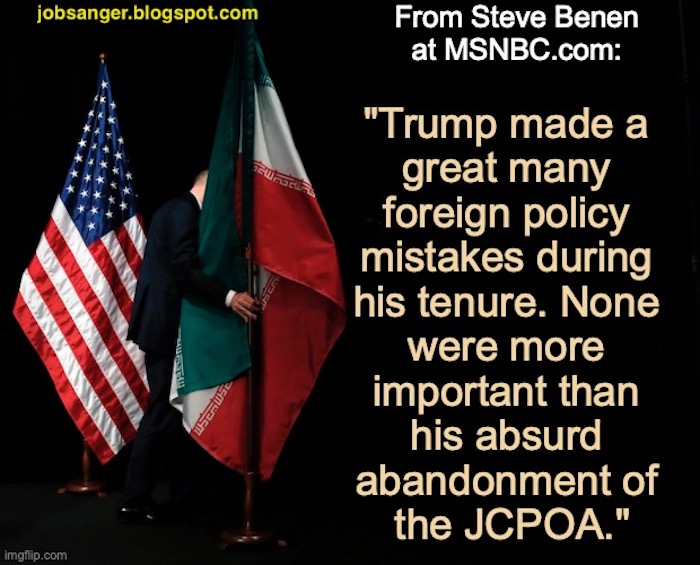
The Iran deal did exactly what it set out to do: The agreement dramatically curtailed Tehran's nuclear ambitions and established a rigorous system of monitoring and verification. Once the policy took effect, each of the parties agreed that the participants were holding up their end of the bargain, and Iran's nuclear program was, at the time, on indefinite hold.
And then Trump took office.
One of my favorite stories about the Iran deal came a few months into Trump's term, when the then-president held a lengthy White House meeting with top members of his national security team. Each of the officials told Trump the same thing: It was in the United States' interest to preserve the existing JCPOA policy.
The Republican expected his team to tell him how to get out of the international agreement, not how to stick with it. When his own foreign policy and national security advisers told him the policy was working, Trump "had a bit of a meltdown."
Soon after, he abandoned the deal anyway, not because it was failing, but because Trump was indifferent to its success. The effective policy was soon replaced by a new strategy known as the "maximum pressure" campaign.
Iran almost immediately became more dangerous, not less.
Among the results is a new perspective among former JCPOA critics. It's no secret that Israeli officials were among the fiercest opponents of the Iran deal, but Axios reported two weeks ago that the head of Israeli military intelligence told ministers during a Security Cabinet meeting "that Israel will be better off if the Iran nuclear talks lead to a deal rather than collapsing without one."
There are plenty of other notable voices in Jerusalem delivering the same message.
In Republican circles, it's simply assumed that the Obama-era Iran deal "failed." That gets reality backwards: The real failure is the policy Trump tried to implement, not the policy he replaced.
Restoring what worked may prove impossible, but there should be no question as to who's responsible for our current predicament. Trump made a great many foreign policy mistakes during his tenure, many of them driven by little more than petty ignorance. None were more important than his absurd abandonment of the JCPOA.
Saturday, May 25, 2019
The Public Doesn't Trust Trump With Nuclear Weapons

This chart is from a survey of 2,264 adults between January 7th and February 1st of this year. It was done by the University of Maryland School of Public Policy, and has a margin of error of 2.1 points.
It shows that the American people do not trust Donald Trump with nuclear weapons. It was once thought that this country being the first to strike another country with nuclear weapons was unthinkable. But Trump has refused to take a nuclear weapons first strike off the table. He believes it should be an option for him to do at his own discretion.
The problem is that Trump has no discretion (or competence).
That has most Americans (68%) thinking Congress should pass a law that would not allow any president to use nuclear weapons without congressional approval (unless as a response to a nuclear attack launched against this country). They don't want Trump (or any president) to have the right to launch a first strike with nuclear weapons.
And this view crosses political lines. It includes a majority of Democrats (74%), Independents (73%), and Republicans (59%). No one is comfortable with Trump's finger on the nuclear button.
Tuesday, February 26, 2019
Will Trump Accomplish Anything In Vietnam? - Probably Not!

Donald Trump is in Vietnam for a second meeting with North Korea's Kim Jong-Un. The last time they met (in Singapore), Trump got nothing except an agreement that didn't oblige North Korea to do anything.
In spite of that, Trump claimed that he had made the world safe, and North Korea had agreed to give up their nuclear weapons. It was not true. North Korea continues to make nuclear bombs and missiles capable of carrying them -- and the world knows that. Note in the chart below (from the Pew Research Center) that both Americans and people in other countries are still concerned about the danger of North Korea having nuclear weapons.
Since then, he has scaled his claims back, since his own intelligence agencies have said the North Koreans have done nothing to disarm. Now Trump claims that his visit caused North Korea to stop testing nuclear bombs and missiles. That's another disingenuous claim. They have tested both enough to know they work.
Will Trump be played for a fool again this time? It's likely. No one believes that North Korea will give up their nuclear weapons. Even many in the White House are nervous that Trump will give up too much for spurious promises from North Korea -- promises they have no intention of keeping.
The meetings start Wednesday, and the world holds its breath -- hoping that Trump doesn't blow it too bad this time. Sadly, that's probably a vain hope.

Wednesday, November 14, 2018
N. Korea Pegged Trump As A Fool And They Played Him

That was Donald Trump's tweet as he returned from meeting with Kim Jong-Un in Singapore. He was convinced (or at least tried to convince us) that he had saved the United States (and the world) from the threat of North Korean nuclear missiles.
But only a fool could believe that. Although an "agreement" was signed, it was not binding. And North Korea continues to do just what it always intended to do -- keep building missiles and nuclear weapons. The U.S. got nothing out of the Singapore summit. North Korea got a lot. They got the U.S. off their backs while they continue to arm themselves with nuclear missiles. In short, they played Trump for a fool -- appealing to his narcissism and taking advantage of his ignorance.
This is how Paul Waldman puts it in The Washington Post:
About six months ago, attendees at a Trump rally were so giddy about the president’s masterly diplomatic maneuvering in supposedly convincing North Korea to suspend testing of nuclear weapons that they began to chant “Nobel! Nobel!,” taking even President Trump by surprise (though he later claimed that “everyone thinks” he deserved one). Not long after, Trump met with Kim Jong Un and returned to declare that he had achieved what presidents had tried and failed to do for decades.
Well, about that …
North Korea is moving ahead with its ballistic missile program at 16 hidden bases that have been identified in new commercial satellite images, a network long known to American intelligence agencies but left undiscussed as President Trump claims to have neutralized the North’s nuclear threat.The satellite images suggest that the North has been engaged in a great deception: It has offered to dismantle a major launching site — a step it began, then halted — while continuing to make improvements at more than a dozen others that would bolster launches of conventional and nuclear warheads.The existence of the ballistic missile bases, which North Korea has never acknowledged, contradicts Mr. Trump’s assertion that his landmark diplomacy is leading to the elimination of a nuclear and missile program that the North had warned could devastate the United States.
Who could have predicted something like this would happen? Pretty much everyone. Except, apparently, the president of the United States. In fact, it’s precisely Trump’s naive view of foreign policy that brought us to this point.
Let’s recall what happened at that summit in June, when the two leaders signed an agreement under which the North Koreans promised to “work toward” denuclearizing the Korean Peninsula. That pledge was almost completely meaningless; as Sen. Chris Murphy (D-Conn.) told me at the time, “It’s important to note that that is a weaker commitment to denuclearization than the regime has made in the past.”
But the president naturally declared victory. “He’s de-nuking, I mean he’s de-nuking the whole place,” Trump said, an assertion that was obviously false. One can only hope Trump was lying and didn’t actually believe that was what was happening.
So that summit, which seemed so dramatic at the time, turned out to be a failure. Why? Because Trump is gripped by a fundamental misconception about foreign policy.
For Trump, everything is personal and everything is about him. He doesn’t need to understand the history of our relationships with other nations, the forces acting on an an adversary or the incentives its leadership faces. He’s the world’s greatest dealmaker! He’ll get in a room with the guy, employ the same skills he uses to drive down the price on gold-leaf wallpaper for one of his buildings and, bada boom bada bing, we’ve got ourselves a historic bilateral agreement.
You can see it in the way Trump talks about foreign relations. He never tries to understand where other countries are coming from or what they are seeking; it’s all about whether they’re screwing us over and whether he’ll “get along” with another country’s leader, as though a friendly personal relationship will make anything possible. “I hope we get along well. I think we get along well,” he said about Russian President Vladimir Putin. “We had a great chemistry, not good, but great,” he said about Chinese President Xi Jinping. “I liked him and he liked me a lot.” A few weeks ago he described his relationship with Kim this way: “I was really being tough, and so was he, and we’d go back and forth. And then we fell in love. Okay? No, really. He wrote me beautiful letters, and they’re great letters. We fell in love.”
But alas, love can be fleeting. The problem is that no matter how many beautiful letters Kim sends to Trump, the North Korean leader still sees nuclear weapons as the key to his survival. As far as he’s concerned, his weapons mean that no great power would dare to invade his country and destroy his regime; without them, he could wind up like Saddam Hussein or Moammar Gaddafi, i.e., deposed and dead.
It’s vital to understand that while Kim is a brutal dictator, that’s an absolutely rational position for him to take. Which means that getting him to give up those nuclear weapons is difficult and complicated. In fact, it’s possible that there’s nothing we can offer him in exchange that would be sufficiently enticing.
Trump is hardly the first U.S. president to struggle with North Korea’s willingness to deceive and break its promises, nor is he the first who failed to find something compelling enough to offer North Korea in exchange for denuclearization. But no president before him was so naive as to proclaim victory after having accomplished so little. I suppose that makes Trump’s foreign policy just the same as everything else he does.
Tuesday, September 11, 2018
Trump's Singapore Summit Was A Colossal Policy Blunder

After meeting with North Korean leader Kim Jong-Un a few months ago, Donald Trump claimed he had convinced him to give up his nuclear weapons, and the American people (and the world) had nothing more to fear from North Korea. That was far from the truth.
After the meeting was over, North Korea continued to produce nuclear material capable of being turned into a bomb, and they actually increased their production of missiles capable of carrying a nuclear warhead for thousands of miles. Now we learn from NBC News that they have continued making those nuclear bombs, and taking action to hide the storage of those nuclear weapons. Not only has North Korea not taken any steps to denuclearize, they have not even slowed production of the nuclear weapons.
The Trump administration press secretary tried to put a good face on the failure by saying it's good that talks continue between the two nations. That is not true either. The North Koreans have been so uncooperative in those talks, that Trump has, at least for now, discontinued them.
The Singapore Summit was not just an epic failure, but it was also a colossal foreign policy blunder. And it has put the United States in a worse position than it was before the summit. By cutting out our allies and China, Trump painted himself into a corner, and left himself with no real options.
He cannot now take military action against North Korea. None of our allies would support that now, or take part in it. And the economic sanctions are now looser than ever. That's because China, worried about being left out of the summit and angered by Trump's trade war against them, are no longer taking those sanctions seriously. They have increased trade with North Korea, and the North Korean economy is doing better because of that.
The Singapore Summit only accomplished one thing for the U.S. -- it highlighted Donald Trump's incompetence and complete lack of understanding of diplomacy and foreign policy.
Wednesday, July 04, 2018
Evidence Emerges That Trump Got Played By Kim

That's the tweet Trump published after his meeting with Kim Jong-Un in Singapore. He claimed that there is no longer a nuclear threat from North Korea, because Kim Jong-Un had agreed to give up his nuclear weapons. He repeated that claim to journalists in the days following the summit.
Unfortunately, his bold claims were premature. The agreement he signed with the North Korea leader was not a binding agreement for North Korea to give up its nuclear weapons, and provided for no kind of verification that they would do so. It was just a feel-good moment for both leaders that meant nothing.
Has North Korea taken steps to give up those weapons? Have they even stopped production of nuclear weapons and missiles? NO! In fact, they have done just the opposite. Our intelligence agencies have now verified that North Korea has taken steps to increase their ability to produce nuclear weapons and the missiles to carry those weapons.
Consider this from military.com:
U.S. intelligence officials believe North Korea has been "deceiving" the U.S., saying the Hermit Kingdom was bolstering production for nuclear weapons at "multiple secret sites" in the past few months, a report stated.
Officials from the CIA and other intelligence agencies told NBC News the regime has increased its production of enriched uranium for the weapons despite the historic summit earlier this month between North Korean leader Kim Jong Un and President Trump. Kim and Trump both signed a document on June 12 stating that Pyongyang would work toward "complete denuclearization of the Korean Peninsula.". . .
However, the officials believed North Korea was "positioning itself to extract every concession it can from the Trump administration -- while clinging to nuclear weapons it believes are essential to survival."
And this from time.com:The Middlebury Institute of International Studies report found that North Korea has recently expanded a factory complex in the eastern city of Hamhung that produces key engines for solid-fuel ballistic missiles. The factory also makes other missile components, including re-entry vehicles for warheads that could be used on longer-range missiles capable of reaching the U.S.
“The expansion suggests that, despite hopes for denuclearization, Kim Jong Un is committed to increasing North Korea’s stockpile of nuclear-armed missiles,” the report’s authors David Schmerler and Jeffrey Lewis wrote.
Donald Trump got played by the North Korean leader. Kim just wanted his moment on the world stage, and Trump was dumb enough to give it to him. Nothing has changed about the North Korean nuclear threat.Americans didn't really believe Trump's bragging anyway. Only 24% of Americans said in a recent poll that they believed North Korea had agreed to give up nuclear weapons, and that included less than half of Republicans (49%). It seems that the U.S. public was smarter than Trump
The chart below is from the latest Economist / YouGov Poll -- done between June 24th and 26th of a national sample of 1,500 adults, with a margin of error of 3.1 points.

Sunday, June 24, 2018
The Trump/Kim Bromance Didn't Last Very Long

Less that two weeks ago Trump was singing the praises of Kim Jong-Un, the dictator of North Korea. He called him a good leader, talented, and trustworthy -- and told Americans that they had nothing more to worry about from North Korea. He said the threat of a nuclear North Korea was over, and it was all due to the marvelous negotiating powers of Donald Trump.
Well, it seems the bromance didn't last very long. Trump is finally starting to realize he got played by the North Korean leader. Trump sent a letter to Congress last Friday. He told them that North Korea's "provocative, destabilizing, and repressive actions . . . continue to constitute an unusual and extraordinary threat", and that country continues it's "pursuit of nuclear and missile programs".
I'm glad that Trump is finally realizing what most Americans already knew -- that Kim Jong-Un is a vicious and brutal dictator, and cannot be trusted any more that his father or grandfather.
Sunday, June 10, 2018
Most Say North Korea Will NOT Give Up Nuclear Weapons

Donald Trump will be meeting with Kim Jong-Un of North Korea very soon. Trump says he will settle for nothing less than the complete denuclearization of North Korea, I think he return empty-handed, because I don't think they will denuclearize. It looks like a huge majority of Americans agree with me. A new poll has 70% of Americans saying it is not likely that North Korea will give up those weapons,
This chart reflects the results of a new Economist / YouGov Poll -- done between June 3rd and 5th of a national sample of 1,500 adults. The margin of error is 3.2 points.
Tuesday, May 15, 2018
Could Half Of All Americans Really Be This Clueless ?

The chart above reflects the results of a new Rasmussen Poll -- done on May 10th and 13th of a random national sample of 1,000 likely voters, with a 3 point margin of error.
I understand that the Rasmussen Poll is usually kind to the Republican point of view, but I was still rather shocked to see these results. The poll says that 51% of the public is at least somewhat confident that the meeting between Donald Trump and Kim Jong-Un next month will result in the denuclearization of North Korea (or at least the slowing of their program). Only 39% don't believe the meeting will accomplish that (and 10% are unsure whether anything will be accomplished).
I know that Trump has a dream of North Korean denuclearization, and believes the economic sanctions on that country has forced them to the bargaining table. I believe he is wrong.
North Korea has wanted a one-to-one meeting with the President of the United States for many years now -- and they would happily have done such a meeting with George W. Bush or Barack Obama. But Bush and Obama both were smart enough to understand that such a meeting would only benefit North Korea, and would not result in the termination of their nuclear weapons program.They understood that the North Korean leader only wanted such a meeting to enhance his own standing in the eyes of the world -- and meeting one-on-one with the most powerful leader in the world would make him look like a true world leader.
Trump is not that smart, and he fell for the ploy by Kim Jong-Un. He doesn't understand that this was just a public relations ploy by North Korea, and the fact that the meeting will be held means North Korea has already gotten what they want (and the meeting's photo ops will just be icing on the cake for them).
Trump claims that North Korea stopping their nuclear testing was because of his threats and sanctions, and represented a concession by the North Korean leader. It wasn't. As experts have noted, the nuclear test site that North Korea used has collapsed. It is unusable. North Korea couldn't test a nuclear device right now if it wanted to do so. Trump was conned.
North Korea has no intention of giving up their nuclear weapons.
Wednesday, May 09, 2018
Trump Ignores Public's Wishes - Violates Iran Agreement

On Tuesday, Trump did it. He showed the world they cannot trust the United States to abide by any treaty or agreement. He did it by announcing to the world that the United States would not abide by the Iran Agreement. Instead, the United States would immediately restore its own economic sanctions against Iran. This is the second time Trump has trashed an agreement made by the United States. The first was the Paris Accords on global climate change.
Trump also talked about the coming North Korean talks, and assured everyone that he could be trusted to keep his word. How is that trust possible when he has already trashed two agreements made by this country?
Trump tried to justify his idiotic decision by telling a series of lies. He said the Iranians were cheating on the agreement. But the IAEA inspectors, our European allies, and our own intelligence agencies say Iran was not cheating -- but was abiding by the terms of the agreement.
Trump said our European allies had agreed with him that Iran must not have nuclear weapons. This is true, but his inference was that they agreed with his decision to violate the terms of the agreement, and that is outrageously false.
Trump said the agreement was bad because it did not include a curb to other activities by Iran (missile development, support of terrorists, etc.), and an agreement could have easily been reached that included those things. The truth is it took many years just to get an agreement on curbing Iran's nuclear activities, and that was the primary purpose of the agreement.
Trump said Iran had supported al-Queda -- a ridiculous lie. The al-Queda terrorists were SUNNI muslims, while Iran is SHIITE muslim. They have supported some Shiite groups, but never al-Queda (which got most of its support from our ally, Saudi Arabia (a Sunni state).
Trump said the inspections were not adequate. Our allies and the IAEA inspectors disagreed. The inspections are the strictest ever imposed on a country, and would have discovered any Iranian attempt to cheat.
The truth is that Trump just went against the wishes of the American public (see chart above) to please his ignorant base of deplorables. He was hoping the lies would cover for his stupid action. I don't think it will.
The chart above is from a new CNN / SSRS Poll -- done between May 2nd and 5th of a random national sample of 1,015 adults, with a margin of error of 3.6 points.
Sunday, May 06, 2018
Support For Withdrawing From Iran Agreement Is Weak

Donald Trump has said many times that the U.S. should withdraw from the nuclear agreement with Iran. Other leaders don't agree. They point out that Iran has abided by the agreement, and inspections have shown they are not currently working on getting a nuclear weapon. Macron (France) and Merkel (Germany) recently came to this country to try and talk Trump out of withdrawing from the agreement, and they left believing they had failed.
It now looks like that Trump will actually withdraw the U.S. from that agreement. Iran has said if he does, then they will consider the agreement to be null and void. They could well resume their nuclear weapons program.
That's not the only bad thing that could come from withdrawal. It would also show the world that Trump has no respect for agreements with other countries -- and this (along with withdrawal from the Paris Accords on global climate change) would discourage other countries from entering into an agreement with the United States. And with the North Korean talks coming up soon, it would show Kim Jong-Un that Trump cannot be trusted (and destroy the slim likelihood that those talks could be productive).
Then we have the wishes of the American public. Trump may think he has convinced Americans that we should withdraw, but that is simply not true. A new poll shows support for withdrawing is very weak. Only 25% of the public (and only 30% of registered voters) support withdrawing from the Iran nuclear agreement. And all groups have far less than majority support from withdrawing. Support is highest among Republicans, but it is only 48% even there.
The chart reflects results of a new Economist / YouGov Poll -- done between April 29th and May 1st of a random national sample of 1,500 adults (including 1,273 registered voters). The margin of error for adults is 3.1 points, and for registered voters is 2.9 points.
Saturday, March 10, 2018
Did North Korea Say It Was Willing To "Denuclearize" ?

 The new media is full of stories about a possible face-to-face meeting between Kim Jong-Un of North Korea and Donald Trump -- which would be to negotiate the differences between the two countries.
The stories spring from a meeting Trump had with South Korean officials. They told Trump that the North Korean leader would like to have a face-to-face meeting with Donald Trump, and that the North Korean leader said he would be willing to discuss denuclearization.
Trump, impulsive as ever, went off half-cocked and announced to the press that he would be willing to have such a meeting. He then told the press that the North Koreans were willing to give up their nuclear weapons. He even had his press spokesman, Sarah Sanders, repeat that in a press conference -- although she seemed to walk back Trump's willingness to meet by saying certain "concrete" steps would have to occur before a meeting could take place.
Did North Korea really say it would be willing to unilaterally give up its nuclear weapons? No! They said they would be willing to discuss denuclearization. Isn't that the same thing that every nuclear power has said (including the United States)? They have all talked about a dream of a world without nuclear weapons -- but none of them have said they would unilaterally give up their nuclear weapons. And neither has North Korea.
No nation that has acquired nuclear weapons has been willing to give them up -- and anyone who believes North Korea will be the first to do so is living in a dream world. North Korea is NOT going to give up its nuclear weapons.
They did say they would be willing to stop testing for a while to have a one-to-one meeting between Kim Jong-Un and Donald Trump. This is not surprising, since they already have the bomb and the missile delivery systems. Why would they want this meeting (since they are not doing to give up their nuclear weapons)? For propaganda purposes. It would allow them to pose as an equal to the United States, and in their eyes, would enhance their importance.
I don't believe this meeting will take place. Cooler heads seem to have talked with Trump, and he's now saying things must happen before that meeting could happen (and those things are unlikely to happen).
This could be a good thing. A meeting between the two narcissists would be doomed to failure (with North Korea refusing to unilaterally disarm and the U.S. refusing to lift any sanctions). Such a public failure could give Trump the excuse he has been searching for to laugh a military attack on North Korea. He has been wanting to do that, but so far cooler heads have talked him out of it. They might no longer be able to do that if he is embarrassed by a face-to-face negotiating failure.
Subscribe to:
Posts (Atom)