Showing posts with label Canada. Show all posts

Tuesday, September 15, 2026

U.S. Voters Don't Like Trump's Actions Toward Canada


The charts above are from the Quinnipiac University Poll -- done between September 3rd and 6th of a nationwide sample of 970 registered voters, with a 3.9 point margin of error.

Friday, September 11, 2026

Message To Canada: Most Of Us Support You Standing Up To The Bully!


I think Robert Reich speaks for most in the U.S. in this post:

Canadian Prime Minister Mark Carney will gather his cabinet in Banff, Alberta, today to consider whether Canada should continue to respond to Trump’s trade war and Canada’s former retaliation for his tariffs against Canada with more tariffs against U.S. goods. 


The answer is yes. 


On Tuesday, Canada retaliated against 50 percent American tariffs on $20 billion worth of Canadian goods with 15, 25 and 50 percent tariffs, depending on the product. Trump responded that evening by adding more products to his 50 percent tariff list and banning the imports of several Canadian goods outright, including beer, wine and liquor.


I obviously cannot tell Carney or Canada what to do. But I can say that, based on my experience, the only way to stop bullies is to hit them back. And the only way to deal with Trump is to make it impossible for him to bully worse. Otherwise, he will continue to bully. 


Most Canadians appear to feel the same way. Polls released in recent days show unusually widespread support across Canada’s fractious regions to fight back. Many Canadians want the Canadian government to go further, with measures like an export tax on electricity.


Carney is a former central banker with a doctorate in economics, but this is not an economic issue. It is a matter of political bullying.


To our friends in Canada, I say: We here in the United States are embarrassed and outraged by the ignorant ego maniac now occupying the White House. Most of us do not support him. Many of us have tried — and will continue — to fight back against his war against Iran, which the United States is losing; his war against immigrants in our communities, many of whom are terrified; and his extraordinarily stupid tariffs.


I’m sure I speak for many here in the United States when I say that whatever you do we will be your friends and allies, but that we hope you continue to fight Trump. The more of us — here in the U.S. and around the world — who take him on, the more likely it is that his bullying will stop. 


We are now in the final weeks of a midterm election where control of Congress is at stake. You should know that we’re doing everything we can to take back Congress, so we can limit his ignorant megalomania. 


Our best wishes to our Canadian neighbors, friends, and allies.

Wednesday, September 02, 2026

Most People In The U.S. Oppose Trump's Renaming Of Lake Ontario


The chart above reflects the results of the Economist / YouGov Poll -- done between August 28th and 31st of a nationwide sample of 1,592 adults (including 1,437 registered voters). The margin of error is 3.5 points for adults and 3.3 points for registered voters. 

Monday, August 31, 2026

Canadians Overwhelmingly Approve Of PM Carney Standing Up To Trump


The charts above are from the Abacus Data Poll -- done between August 21st and 26th of a nationwide sample of 2,022 Canadian adults, with a 2.2 point margin of error.

Thursday, August 13, 2026

Most See Trump As A Force For Bad And Untrustworthy


These charts are from a YouGov Poll -- done between July 1st and 17th of adults in the U.K. (2340), Australia (2003), Canada (2057), France (2109), Germany (2079), Poland (2098), and the U.S. (2039).

Sunday, February 22, 2026

Canadians No Longer Trust (Or Even Like) The United States


The charts above are from the Politico / Public First Poll -- done between February 6th and 9th of a nationwide sample of 2,000 Canadians, with a 2 point margin of error.

Friday, August 15, 2025

Only 15% Of Canadians Approve Of U.S. Leadership


The chart above is from the Gallup Poll -- done 2007 and 2025 of 1,000 Canadian adults, with a 3.6 point margin of error. 

Monday, July 28, 2025

A Record Percentage Of Canadians Have An Unfavorable Opinion of U.S.


The charts above are from a Pew Research Center survey done between February 19th and April 15th of a country-wide sample of 1,024 Canadian adults.

Wednesday, March 12, 2025

Trump Tariffs Are Damaging Relations Between Canada And The U.S.

The chat above is from the YouGov Poll. The U.S. poll was done between February 12th and 14 of 1,104 adults, with a 4 point margin of error. The Canadian poll was done between February 14th and 19th of 985 adults, with a 3 point margin of error.
 

Thursday, February 27, 2025

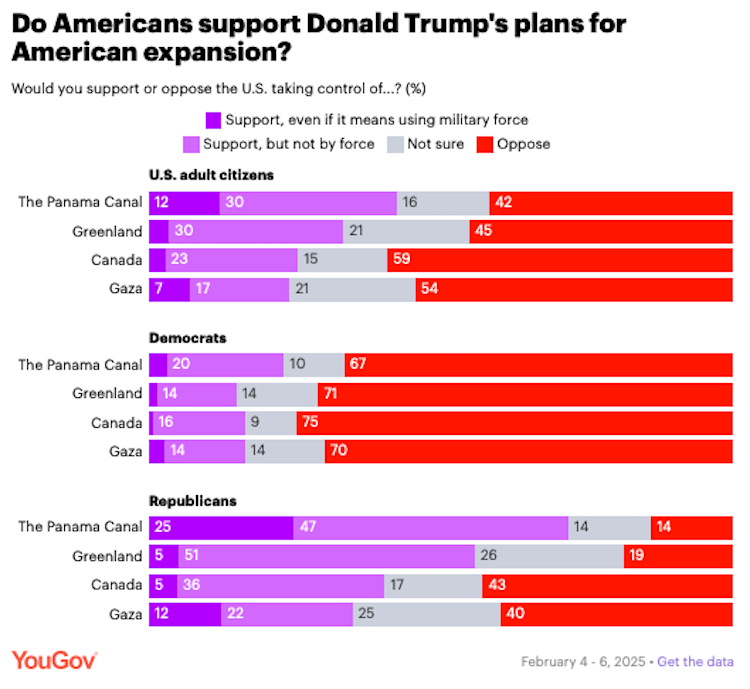
Most Oppose Trump's Plan For U.S. Expansion (Especially By Force)

The chart above is from a YouGov Poll -- done between February 4th and 6th of a nationwide sample of 1,142 U.S. citizens, with a 4 point margin of error.
 

Tuesday, December 31, 2024

A Bit Of Humor(?) From Robert Reich


 Robert Reich says there's a better idea than the U.S. making Canada the 51st state:

Trump wants to buy Greenland and annex Canada as the 51st American state. 

When I first heard these ideas I thought he was joking, but as with all things Trump, he’s not … quite.


Last week, while naming a new ambassador to Denmark (which controls Greenland’s foreign and defense affairs), Trump made clear that his first-term offer to buy Greenland could, in the coming term, become a deal the Danes cannot refuse.


He seems to want Greenland because of its strategic location at a time when the melting of Arctic ice is opening new commercial and naval competition. He’s also interested in Greenland’s reserves of rare earth minerals needed for advanced technology.


But Trump isn’t stopping there. He also wants to annex Canada. This proposal appears more a public needling of Canadian Prime Minister Justin Trudeau than a serious plan. 

Yet Trump has continued to tease the idea of annexing Canada on social media. “I think it’s a great idea,” he wrote in a recent post.


This is all bonkers, of course.


But as long as we’re considering changing national borders, why not do it in a more sensible way? 


How about the West Coast states of Washington, Oregon, and California becoming the 11th province of Canada? After all, the politics of these blue states would fit much better with Canada’s than with Trump’s America. 


Meanwhile, the New England states (Maine, Vermont, New Hampshire, Massachusetts, Rhode Island, and Connecticut) and New York could become the 12th Canadian province, for much the same reason. 


While Trump is toying with the idea of annexing Canada, these blue American states should bid him goodbye and be annexed by Canada. 


Hell, Trump might just go along. He doesn’t like these blue states anyway. They all voted against him in 2016, 2020, and again in 2024. He’s been looking for ways of getting even. Why not simply disown them? 


Letting Canada annex these blue states would also simplify Trump’s war on undocumented immigrants, since many of them reside in these states. 


America First Legal, a nonprofit run by Trump’s incoming deputy chief of staff for policy, Stephen Miller, has already written to local elected officials in California and New York warning them not to try to become sanctuaries — threatening that the officials could be personally “criminally liable” if they refuse to support federal government efforts to detain and deport illegal immigrants.


But if California, New York, and other blue states were annexed by Canada, the problem disappears.


Of course, this leaves the pesky question of whether Canada would accept America’s West Coast as its 11th province and New York and New England as its 12th? I’ll leave that question to Canadians. 

Friday, November 29, 2024

These Products Will Be Affected By Trump's Tariffs On Mexico/Canada


 The following is from Newsweek:

If the tariffs are imposed, they could cost Americans an estimated $78 billion annually, NBC News reported, with everyday goods costing more.

Below are the seven major product categories that would be most affected.

Automobiles and Automotive Parts


Canada and Mexico are major suppliers of vehicles and parts, and many cars sold in the U.S. are assembled in those countries or use components sourced from them. Analysts have estimated that a tariff could add $1,000 to $5,000 to the price of a new car, with parts such as engines, transmissions and tires becoming more expensive. Replacement parts would also become more expensive because of the tariffs.

Agricultural Products


Canada and Mexico are also significant exporters of agricultural goods to the U.S., including fruits, vegetables, meat and dairy. A 25 percent tariff would make everyday staples such as avocados, tomatoes, beef and cheese more expensive for U.S. consumers.

Canadian beef exports across all markets are projected to total 595,000 tons this year, with about 80 percent destined for U.S. customers. Last year, the U.S. imported $2.7 billion worth of avocados from Mexico, the U.S. Department of Agriculture reported.

Electronics


Many electronics—including smartphones—are assembled in Mexico or rely on components manufactured there. Tariffs on electronics could lead to higher prices for consumer goods, especially devices such as TVs, laptops and home appliances that rely on Mexican manufacturing.

Mineral Fuels and Oils


Canada is the largest exporter of crude oil and refined petroleum to the U.S. A 25 percent tariff would increase fuel costs, affecting gas prices and heating oil. This means consumers would likely see higher prices at the pump, with several cents per gallon being added to gasoline and diesel prices.

Plastics and Plastic Products


Canada and Mexico supply a significant amount of plastic materials and products used in packaging, construction and consumer goods. Tariffs would raise costs for businesses and consumers across industries that rely on plastic.

Machinery and Industrial Equipment


Canada and Mexico also export heavy machinery, engines and industrial tools used in manufacturing and construction.

If Trump's tariffs are imposed, U.S. industries will face higher costs for equipment, such as industrial machinery, boilers and electrical equipment. The higher costs could slow down construction and manufacturing projects, which in turn could hit companies in those industries.

"If you voted for Trump because you thought he was going to bring down the cost of housing, a lot of our lumber, cement and other materials comes from Canada, which means that construction costs are going to go up," commentator Catherine Rampell said on CNN on Monday.

Aluminum and Steel Products


Canada is a top supplier of aluminum and steel, which are essential for construction, automotive manufacturing and packaging. Tariffs would raise the cost of raw materials, affecting industries that use these metals and even products such as soda cans.

Tuesday, November 08, 2022

Republican Care About Immigrant Crime Is Only Skin Deep


It turns out that the attacker of Mr. Pelosi was an undocumented immigrant, but we're hearing nothing about that from Republicans. Could it be that they only care about immigrant crime when the perp is not white?

Here's Nayyera Haq's take on this at MSNBC.com:

After years of anti-immigrant, “Build the Wall” rhetoric, we have seen one of the highest-profile examples of someone who was in the United States illegally committing an act of shocking violence. We learned this week that the man who took a hammer to the head of House Speaker Nancy Pelosi’s 82-year-old husband was undocumented, here on an expired temporary visitor visa, and radicalized online. And the attacker is part of one of the largest populations in the United States illegally: Canadians. 

The Republican Party has used anti-immigrant rhetoric against Latinos and Hispanics for years, making sure it remains a potent topic for voters in the midterm elections. Arizona Senate candidate Blake Masters has made so-called illegal immigration a centerpiece of his campaign but has been silent on the attack on Paul Pelosi. New Hampshire Senate candidate Don Bolduc, who wants to continue Title 42 public health restrictions at the southern border despite President Joe Biden declaring the pandemic over, did issue prayers to the Pelosi family saying “violence is never the answer.” But neither of them, nor any other political leader, is seizing on this crime committed by a supposed “illegal immigrant” to start deporting Canadians.

This is not a Blame Canada shtick. This is the reality: In the past 10 years, visa overstays in the United States outnumbered illegal border crossings by a 2:1 ratio. It’s a trend that’s been growing since 2004, with more than 600,000 people on average living illegally in the United States each year after their visas expired, according to the Department of Homeland Security. After former President Donald Trump’s first year in office, DHS released a report showing that the largest group of people who overstay their official welcome in the United States come from across the northern border. . . .

The difference in perception Americans have between Canadians and Mexicans has significant policy and political implications. American cultural demonization of Canadians is limited to comedians cracking jokes about Justin Bieber and saying “eh?” repeatedly. The trope for Canadians is that they’re too nice while our neighbors to the south have been the target of rape and drug cartel jokes for years. Trump launched his campaign on the back of these stereotypes, saying,“When Mexico sends its people, they’re not sending their best. ... They’re bringing drugs. They’re bringing crime. They’re rapists.”

When Trump called for the creation of a deportation forceand promised to expel 2 million to 3 million undocumented people, there was little surprise that law enforcement targeted people from Central and South America. The disparity in enforcement was still dramatic: In 2017, DHS reported 350 Canadians were deported compared with nearly 130,000 Mexican nationals. . . .

Despite the use of law-and-order rhetoric when it comes to immigration, the political right is specific about which undocumented people get labeled as criminals. Overstaying a visa is currently punishable with up to four years of jail time and a 10 year ban from the United States. But even after this week’s revelations that an egregious act of political violence was committed by someone conservatives would normally term an “illegal immigrant,” there will be no new constituency for deporting Canadians or political railing against Canadians as a criminal monolith.

The constituency that votes based on curbing illegal immigration is not really worried about making sure people don’t take advantage of American laws and generosity. If they were, the policy solutions would be entirely different. We’d see calls for Canadians to enter with visas and for greater data sharing with Canadian authorities for cross-border prosecutions. Both of which are part of the many immigration-related policies DHS has in place with Mexico and countries south of the border. 

Voters that Republicans are courting with their immigration rhetoric are really worried about American identity looking and feeling a certain way. For these voters, their identity cannot be shared with brown day laborers or families willing to risk death to come to the United States. This is the real promise of Trumpism and why immigration holds such a key place in its ideology. That its adherents would mock Pelosi as the latest liberal avatar to be torn down, rather than a near martyr in their crusade, shows that concern about immigrant crime is only skin deep.

Saturday, May 02, 2020

Canada Does What U.S. Refuses - Bans Assault Weapons

In spite of many mass shootings in this country where the primary weapon used was a military-style assault weapon, the federal government (primarily Republicans) has absolutely refused to ban them.

Many of those Republicans will say that they don't want to violate the Constitution with such a ban. But that argument is a lie. The Supreme Court has ruled that it is constitutional for the government to ban military-style weapons -- and when the assault weapons were banned in the past, they specifically said that ban was constitutional. The truth is that those GOP congressmen have been bought and paid for by the NRA and the gun manufacturers through campaign donations -- and they consider those donations more important than saving American lives (which aa assault weapons ban would do).

But Canada does not have the same disingenuous stance. After a recent mass shooting spree in that country, the Canadian government has acted. They are banning all military-style assault weapons in their country.

Here is how Amanda Coletta reports it in The Washington Post:

The Canadian government on Friday announced an immediate ban on some 1,500 makes and models of “military-grade” assault weapons, including two weapons used by the gunman who killed 22 people in rural Nova Scotia during the country’s deadliest mass shooting last month.

Prime Minister Justin Trudeau said there will be a two-year amnesty period for current gun owners to comply with the prohibition. He said legislation will be drafted in the coming months to provide “fair compensation” to them.

“There is no use and no place for such weapons in Canada,” Trudeau said in a news conference in Ottawa on Friday that began with him listing several mass shootings in the country’s history.

He said that while most firearms owners are law-abiding citizens, “you don’t need an AR-15 to bring down a deer.”

Monday, January 20, 2020

U.S. Wastes Billions Of Healthcare Dollars Every Year

 Americans like to think that the money they spend each year for health insurance goes to actually pay for health care. It doesn't. The truth is that the U.S. spends hundreds of billions of dollars each year that doesn't contribute to the health of any American.

The money goes to pay the overhead for private insurance companies -- profits, executive and employee compensation, stockholder compensation, et cetera. The people receiving this money provide no health care. They simply suck dollars out of the health care system.

No matter what kind of health care system a country has, some money will be spent on overhead (managing the system), but Americans spend far more on overhead than other countries do -- and that is largely why health care costs so much more in the U.S. than in most other countries. For instance, Canada spends only about $1 on this compared to $4 in U.S. for each person.

Consider this excellent article by Melissa Healy of the Los Angeles Times:


In the United States, a legion of administrative health care workers and health insurance employees who play no direct role in providing patient care costs every American man, woman and child an average of $2,497 per year.
Across the border in Canada, where a single-payer system has been in place since 1962, the cost of administering health care is just $551 per person — less than a quarter as much.
That spending mismatch, tallied in a study published this week in the Annals of Internal Medicine, could challenge some assumptions about the relative efficiency of public and private health care programs. It could also become a hot political talking point on the American campaign trail as presidential candidates debate the pros and cons of government-funded universal health insurance.
Progressive contenders for the Democratic nomination, including Sen. Bernie Sanders of Vermont and Sen. Elizabeth Warren of Massachusetts, are calling for a “Medicare for All” system. More centrist candidates, including former Vice President Joe Biden and former South Bend, Ind., Mayor Pete Buttigieg, have questioned the wisdom of turning the government into the nation’s sole health insurer.
It’s been decades since Canada transitioned from a U.S.-style system of private health care insurance to a government-run single-payer system. Canadians today do not gnash their teeth about co-payments or deductibles. They do not struggle to make sense of hospital bills. And they do not fear losing their health care coverage.
To be sure, wait times for specialist care and some diagnostic imaging are often criticized as too long. But a 2007 study by Canada’s health authority and the U.S. Centers for Disease Control and Prevention found the overall health of Americans and Canadians to be roughly similar.
Some Canadians purchase private supplemental insurance, whose cost is regulated. Outpatient medications are not included in the government plan, but aside from that, coverage of “medically necessary services” is assured from cradle to grave.
The cost of administering this system amounts to 17% of Canada’s national expenditures on health.
In the United States, twice as much — 34% — goes to the salaries, marketing budgets and computers of health care administrators in hospitals, nursing homes and private practices. It goes to executive pay packages which, for five major health care insurers, reach close to $20 million or more a year. And it goes to the rising profits demanded by shareholders.
Administering the U.S. network of public and private health care programs costs $812 billion each year. And in 2018, 27.9 million Americans remained uninsured, mostly because they could not afford to enroll in the programs available to them.
“The U.S.-Canada disparity in administration is clearly large and growing,” the study authors wrote. “Discussions of health reform in the United States should consider whether $812 billion devoted annually to health administration is money well spent.”
The new figures are based on an analysis of public documents filed by U.S. insurance companies, hospitals, nursing homes, home-care and hospice agencies, and physicians’ offices. Researchers from Hunter College, Harvard Medical School and the University of Ottawa compared those to administrative costs across the Canadian health care sector, as detailed by the Canadian Institute for Health Information and a trade association that represents Canada’s private insurers.
Compared to 1999, when the researchers last compared U.S. and Canadian health care spending, the costs of administering health care insurance have grown in both countries. But the increase has been much steeper in the United States, where a growing number of public insurance programs have increased their reliance on commercial insurers to manage government programs such as Medicare and Medicaid.
As a result, overhead charges by private insurers surged more than any other category of expenditure, the researchers found.
In U.S. states that have retained full control over their Medicaid programs, the growth of administrative costs was negligible, they reported. (The same was true for Canada’s health insurance program.) But in states that shifted most of their Medicaid recipients into private managed care, administrative costs were twice as high.
America’s Health Insurance Plans, a group representing private health insurance companies, said administrative practices shouldn’t be blamed for escalating the cost of care in the United States.
“Study after study continues to demonstrate the value of innovative solutions brought by the free market,” AHIP said in a statement. “In head-to-head comparisons, the free market continues to be more efficient than government-run systems.”
AHIP cited a recent report by the Medicare Payment Advisory Commission, an independent body that advises Congress. The report showed that Medicare Advantage plans — which are privately administered — deliver benefits at 88% of the cost of traditional Medicare.
Even so, the study authors concluded that if the U.S. health care system could trim its administrative bloat to bring it in line with Canada’s, Americans could save $628 billion a year while getting the same health care.
“The United States is currently wasting at least $600 billion on health care paperwork — money that could be saved by going to a simple ‘Medicare for All’ system,” said senior author Dr. Stephanie Woolhandler, a health policy researcher at Hunter College and longtime advocate of single-payer systems.
That sum would be more than enough to extend coverage to the nation’s uninsured, she said.

Monday, January 07, 2019

Percentage In U.S. Who Would Like To Migrate To Another Country Rose Significantly Under Trump Administration


Each year, the Gallup Poll asks about 1,000 people in many countries if they would like to migrate to another country. The chart above shows the results of the survey in the United States.

Under the administrations of George W. Bush and Barack Obama the percentage was about the same -- 11% in the Bush administration and 10% in the Obama administration. But there was a statistically significant change after Donald Trump assumed office. Under Trump, the percentage rose to 16% (a climb of about 60%). And that rise was apparent in all age groups and both genders.

The country that most of that 16% would like to move to is Canada. About one in four said Canada would be their preference.

Thursday, June 14, 2018

Trump Treating G-6 Members As Enemies Strengthens Them


Donald Trump seems to have declared war on our best allies. While embracing dictators such as Vladimir Putin, Recep Erdogan, and Kim Jong-Un, he has tried to bully and threaten allies like France, Canada, United Kingdom, Germany, Japan, and Italy. He has put a tariff on their steel and aluminum, and threatened to apply other tariffs if they retaliate. And his bullying tactics at the recent G-7 meeting has just driven them further away -- and made them question whether the U.S. can be trusted with Trump as president.

The chart above shows what the people of those six nations thought of U.S. leadership before the G-7 meeting. Note that all of those nations had a very high opinion of Barack Obama as president. But their opinion of Trump is very low. The percentage saying they have at least some confidence in U.S. leadership under Trump is only 25% or lower in all six countries -- France (14%), Canada (22%), United Kingdom (22%), Germany (11%), Japan (24%), and Italy (25%).

Those are terrible numbers, and Trump's atrocious performance at the G-7 meeting is not going to improve them. I expect it will have the opposite effect -- making these leaders (who stood up to Trump) stronger among their own citizens, and giving them the support they need to fight Trump's ridiculous trade war.

The G-7 meeting just proved once again that Trump's foreign policy moves have been a disaster -- and have seriously damaged the reputation of the United States.

The chart above is from the Pew Research Center.

Wednesday, June 13, 2018

The Biggest Export/Import Trading Partners Of Each State


The charts above are from the Business Insider. They used data from the U.S. Census Bureau to determine the biggest trading partners, both export and import, of each of the 50 states.

Donald Trump has recently initiated a trade war by placing tariffs on products from Canada, Mexico, China, and the European Union -- and those entities has said they will retaliate. Trump administration officials have said if they do, then further tariffs will be imposed (which of course will result in more retaliation). In other words, we are seeing the beginning of an increasingly devastating trade war.

Trump has said a trade war will be easy to win. After viewing the charts above, do you believe that. Isn't it obvious that Trump's trade war will hurt every state?

Saturday, June 09, 2018

Trump Is Attacking Our Allies And Helping Our Enemies

(Cartoon image is by Bob Englehart at cagle.com.)

France, Canada, and Great Britain are the oldest allies the United States had. And following World War II, Germany, Japan, and Italy joined the other three in being reliable and important allies of the United States. These six countries, along with the United States, make up the members of the G-7 economic group, and in the past, their unified goals have helped to stabilize the world economy and help all countries to flourish.

But then Donald Trump was elected. He seems to have no respect for our six best allies. They have all tried to reason with Trump, and failing that, they have tried to flatter him in an attempt to maintain their alliance. Trump has snubbed all their efforts. Against their wishes, he has pulled out of the Paris Accords (endangering the climate of the whole world), denigrated NATO (even suggesting the U.S. might pull out), and violated the Iran Agreement and re-instated sections against that country (sanctions that would seriously affect our allies). Now he has gone further. He has placed tariffs on Canada and the European Union, and threatened tariffs against Japan (cars).

Trump seems not to value having allies. He thinks the United States can go it alone in the world -- and threaten all other nations to fallen line with U.S. wishes through our military and economic power. He is wrong, and he's fixing to find that out. The other 6 nations of the G-7 are tired of Trump's behavior and attacks on their economies, and they are ready to fight back. They are ready to impose their own tariffs on U.S. products -- tariffs that will hurt American farmers, industries, and consumers. And they will have the support of their people in this retaliation against Trump (who is very unpopular around the world).

I worry about what is going to happen in the future -- when we need those allies and find they are no longer willing to come to our aid.

But it's worse than just attacking our allies. Trump seems determined to help our enemies. He will be leaving the G-7 summit early to fly to Singapore to meet with North Korean dictator, Kim Jong-Un. Trump is bragging about the meeting like it was some kind of accomplishment. It isn't!

Any past U.S. president (Clinton, Bush, Obama) could have easily had such a meeting. They didn't because they knew it would accomplish nothing except a public relations victory for the North Korean dictator -- making it seem like they were on an equal footing with the United States (one of the world's most powerful nations). Sadly, Trump has given them that PR victory without receiving anything in return.

Trump thinks he can talk Kim Jong-Un into giving up his nuclear weapons, even though he did no preparation before the meeting with North Korea. Trump is a fool, and he's being played by North Korea. They are NOT going to give up their nuclear weapons. Trump has threatened "massive sanctions" if they don't give up those weapons.

He think they only have two choices -- give up the nuclear weapons or starve. That is not true. They have a third option if they get desperate enough -- attack South Korea to get what they need. China and Russia are not going to let that happen. They don't want a war threatening their part of the world, and they will see that North Korea gets just enough to stave off that kind of desperation.

Trump will return from Singapore either empty-handed, or with a really bad deal (that doesn't involve North Korean denuclearization).

North Korea is not the only enemy Trump wants to help. He has done his best to help Russia. Shortly after being sworn in, Trump tried to remove sanctions against Russia, and was stopped by Congress. When Congress passed new sanctions against Russia, Trump refused to impose them. Trump also supported the Russian annexation of the Crimea, and has basically allowed Russia to take control in Syria. Just yesterday, he announced that Russia should be re-admitted to the G-7 (which used to be the G-8 until Russia was kicked out for invading the Ukraine and annexing the Crimea). What has he gotten from Russia for all this help? NOTHING!

Russia is also the nation that benefits from Trump's attacks on our traditional allies. Putin has to be thrilled that the Western nations are no longer a solid bloc.

Why is Trump attacking our allies and helping our enemies? Is it just stupidity and incompetence, or is it something more nefarious? Is it payback for Russia helping him win the 2016 election? Do the Russians have some nasty secret on Trump they are using to control him?

Sunday, June 03, 2018

Donald Trump's Trade War Will Hurt All Americans


Donald Trump has said a trade war is good, and can easily be won by the United States. He is wrong, and his new tariffs, that have kicked off a trade war will wide up hurting all Americans.

Let's be clear about one thing to start -- the tariffs are a new tax on American consumers. They may be levied on the products coming from other countries, but those countries won't be paying the higher tariffs (taxes) -- American consumers will be paying them.

Some of you may be thinking that consumers can avoid paying those new taxes by just buying American products instead. That's wrong. Why did Trump impose the tariffs to begin with? It was because those foreign products (aluminum and steel) were cheaper that the aluminum and steel produced in the United States. Whether you buy the foreign products or the American products, you will be paying more -- and that excess payment amounts to a new tax (a tax NOT approved by Congress). And the higher prices won't just be in aluminum and steel, but will be seen in every American industry that uses aluminum and steel.

In other words, there is no way an American consumer can avoid paying Trump's new tax -- and that new tax will hurt ordinary Americans far more than it will hurt the rich (since the rich pay a much smaller percentage of their income for consumer goods than most Americans must pay).


And it won't just be higher taxes that will affect Americans. The entities that had a tariff placed on their products are responding with tariffs on American products. Those tariffs will negatively affect American farmers and industries -- and could cost workers their jobs.

The chart above is from Business Insider. It shows the effect the new tariffs levied by Canada will have on the individual states. The states in the darker colors will suffer the biggest hit, but all states will be affected. And that chart just shows Canada's reaction. Don't forget that Mexico, the European Union, and China are also responding with tariffs on American products. This could get real ugly really fast.

And we may not be seeing the worst. The White House advisors have said there may be more tariffs to counter the tariffs put on American products. This could be just the start of an escalating trade war.

-------------------------------------------------------

This would be a good time to look at a bit of American history. In the late 1920's, the gap in wealth and income between the rich and the rest of America was enormous. And Republicans decided that they needed large tariffs to help American industries (especially after the stock market crash of 1929), so they passed a huge tariff bill (Smoot-Hawley Act) in 1930. The result was the Great Depression.

We now have a wealth and income gap as large as that of the 1920's, and a new tax law that will make that gap much larger. And we have the start of a trade war with new tariffs -- a trade war that could easily get out of hand. Are we setting ourselves up for a repeat economic disaster? It's certainly not beyond the realm of possibility.

if there is a saving grace in all this, it is that most Americans don't think tariffs are good economic policy (see chart below). Even Republicans are opposed. Maybe public opposition can compel Congress to stop the trade war.

The chart below shows results from a recent Politico / Morning Consult Poll -- done between May 23rd and 29th of a national sample of 1,995 registered voters, with a 2 point margin of error.