These charts represent the 2026 election forecast from G. Elliott Morris at FiftyPlusOne. When he was making these forecasts in the past for fivethirtyeight.com, he was among the most accurate forecasters.


In 2022, many polls were predicting a "red wave" with voters preferring Republicans because of President Biden's unpopularity. But the "red wave" fizzled as a massive number of Democrats and Independents voted.
In both cases, the media was full of headlines saying the polls were wrong! Were they?
I don't think they were wrong. They fairly accurately told us what the American public was thinking. So why didn't the elections turn out as predicted by the polls?
Because there is one thing the polls (or anyone else) can't know - who and how many will vote. Some polls try to account for that by differentiating "likely voters" from all registered voters. But it's still a guessing game. Someone that claims they will defnitely vote might not, and someone who normally doesn't vote may decide to vote.
And if the polls show one candidate with a large lead, some of their supporters may decide their vote is not needed. And supporters of the candidate losing in the polls may decide it's hopeless and not vote. Both of those can skew the results, and make us think the polls were wrong (even though they accurately told us the mood of the public).
I like polls. Polls can tell us the mood of the country. But polls cannot actually predict the winner all the time. So, disregard whether your candidate is ahead or behind in the polls - and VOTE. Voting is the only thing that decides an election. Make sure your's counts.

Here is part of how Sophia A McLennen reports Moore's latest prediction at Salon.com:
Remember when everyone thought Hillary Clinton would win the 2016 election? No, I don't just mean win the popular vote: Win it all and win big. FiveThirtyEight, Nate Silver's political projection site, had Clinton's chances of winning at 71.4 percent. Frank Luntz tweeted on Nov. 8, 2016, "Hillary Clinton will be the next President of the United States." One GOP insider declared that for Trump to win, "it would take video evidence of a smiling Hillary drowning a litter of puppies while terrorists surrounded her with chants of 'Death to America.'" Pundit after pundit, on the left and the right, joined the chorus of mainstream news outlets to declare that the election was Clinton's.
There was, however, one lone voice of dissent: Michael Moore. In July 2016, Moore wrote "Five Reasons Trump Will Be President." That article mostly went unnoticed by mainstream media after the election, when everyone finally realized Moore was right but it was way too late to make a difference.
Fast forward to the 2022 midterms and we find ourselves in a similar scenario, but turned upside down. Now the media is basically repeating again and again that Democrats will lose in November, while Moore is suggesting the opposite. Moore isn't just echoing the widespread notion that Democrats could hold the Senate while losing the House. He is suggesting that voters "are going to descend upon the polls en masse — a literal overwhelming, unprecedented tsunami of voters — and nonviolently, legally, and without mercy remove every last stinking traitor to our Democracy."
That prediction is likely to cause hyperventilation at all points of the political spectrum. Could he really be right? . . .
There is reason to believe that the combination of Trump fascist nutters on the ballot, the revelations from the Jan. 6 committee hearings, the various investigations into Trump and, last but definitely not least, the fact that the Supreme Court put abortion back on the ballot could lead to the type of voting tsunami Moore is predicting.
Which leads us to wonder why the media isn't covering that story, but is still offering the same stale script about Biden's low favorability and Republican chances of taking back both the House and the Senate. Even Jen Psaki, Biden's former White House press secretary turned MSNBC commentator, offered the downer view that the president wasn't helping his party win.
Media coverage matters. And the fact that the media is largely sticking to pre-established coverage patterns doesn't just mean that it's missing the story, as Moore claims, it also means it's likely influencing the outcome of the election — and not in a good way. . . .
Moore has a long history of questioning the status quo and bucking conventional thought patterns. Whether getting booed off the Academy Awards stage for opposing the war in Iraq or being the lone voice predicting that Trump would win, Moore has never shied away from disagreeing with the pundit class and political elites. But he doesn't just do it for shock value; he does it because he's paying attention to the political climate in ways the mainstream media tends not to.
Is Moore right that there will be a tsunami of voters determined to defeat the enemies of democracy? The only way to learn the answer is to stop trying to read the tea leaves and focus on making it happen.

E.J. Dionne Jr. seems to agree. Here is part of what he writes in The Washington Post:
The conventional wisdom, well-rooted in history and data, suggests the Democrats should be toast this fall. But beware, say the dissenters, because 2022 is not a normal year, and it will not play out in a normal way.
The dissenters may be onto something, even if the case for a Republican sweep is strong. . . .
The public view of the economy is gloomy — and voters expect even worse. In a comprehensive study this month, Pew Research Center found that just 13 percent of Americans rated the economy as excellent or good — and since you’re probably wondering, only 1 percent actually picked “excellent.” Opinion is also moving quickly in a negative direction. As recently as January, 28 percent rated the economy positively.
Pew also found 47 percent saying the economy would be worse a year from now. Back in March 2021, only 31 percent thought the economy would deteriorate.
If the polling seems lethal for Democrats, so does history. In midterms, voters often toss out vulnerable members of the incumbent party who swept in on earlier tides. Turnout for the party in power also typically drops off. Opposition voters tend to be more eager to cast ballots by way of sending a message of protest. . . .
After the wild presidency of Donald Trump and the radicalization of the Republican Party, there’s reason to believe 2022 does not fit neatly into the old paradigms.
Trump has not gone away. The Jan. 6 committee has brought his transgressions back to the center of discussion. One of his most important legacies is a very right-wing Supreme Court that has begun a radical demolition of long-standing conceptions of the law on abortion, guns, environmental regulation and voting rights — with more to come. . . .
If the public isn’t wild about Democrats, they like Republicans even less. That Pew survey found that 57 percent of Americans had an unfavorable view of the Democratic Party, but 61 percent had an unfavorable view of Republicans. . . .
When it comes to issues, the Pew study suggests the decisive question for 2022 is whether Democrats can push the campaign dialogue away from economic performance and toward concerns on which Republicans are at a decided disadvantage.
Yes, on economic policy, voters say they agree more with Republicans than Democrats by 40 percent to 33 percent. Still, this seven-point margin is surprisingly small, given the broader economic mood. Republicans have a five-point advantage on crime, and immigration is a wash, with the GOP holding a one-point lead.
The list of problems on which Democrats have the advantage, according to Pew, is much longer.
Voters prefer Democrats over the GOP by 20 points on both climate policy and issues affecting LGBTQ people; by 14 points on abortion and covid policy; by 13 points on health care and policies affecting race; and by four points on gun policy.
There is also this: While 37 percent of Americans have a very unfavorable view of Biden, 46 percent have a very unfavorable view of Trump. The more Trump is at the center of the conversation, the worse it is for Republicans — and there has been a lot of Trump news lately.
When it comes to the substance of the matter, you can count me as believing that until Republicans break openly and decisively with Trump, putting them in power is profoundly dangerous. But the numbers — especially when it comes to holding their slim House majority — are still daunting for Democrats.
The bottom line: An unhappy country that might otherwise punish the incumbent party really doesn’t like the alternative. That’s why the campaign ahead will matter.
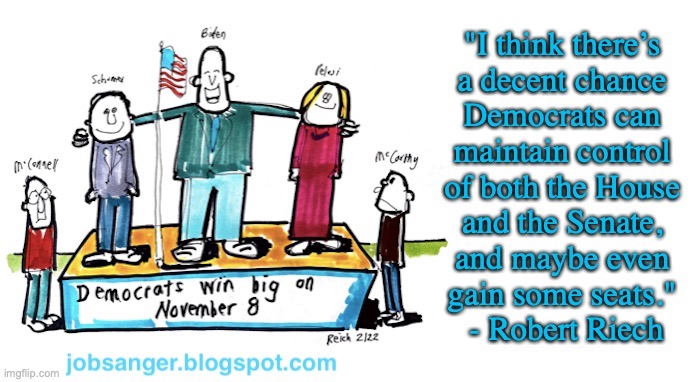
It’s a good day to contemplate whether Joe Biden has a prayer of keeping a Democratic House and Senate next year. Call me a hopeless optimist, but I think he does.
Yes, I know: Republicans are suppressing votes, Democrats are hopeless at messaging, Biden’s poll numbers are in the basement. But let me give you ten reasons why I think there’s a decent chance Democrats can maintain control of both the House and the Senate, and maybe even gain some seats.
First: It’s likely that job growth between now and November will remain strong (if the Fed doesn’t ruin everything by raising interest rates too high, too soon). We’re still 3.5 million jobs short of where we were in February 2020 — giving the economy lots of room to grow. Biden and the Democrats can take credit for putting the economy back on track.
Second: Inflation will begin edging downward, as supplies of goods increase and demand shifts back to services — removing the one big economic negative. If Omicron infections continue to drop, the decline in inflation could start as early as April.
Third: When the pandemic seems to be over — and there’s a good chance it will feel over by the spring — the nation will breathe a huge collective sigh of relief, and Biden can take credit for getting shots into the arms of 80 percent of Americans.
Fourth: If tensions continue or escalate with Russia over Ukraine – or, lord help us, Russia invades Ukraine – America will unite behind its Commander-in-Chief.Republicans and Democrats in Congress are already demonstrating a remarkable degree of unity over Russia. War is horrific, of course, but it tends to garner support for those in power (at least in its months).
Fifth: Democrats will almost certainly pass Build Back Better in some form this spring. It won’t be nearly as ambitious as the original, but probably enough to generate some visible benefits for families. Republicans will, of course, oppose it, which means even more help for Democrats in November. To pay for Build Back Better, Democrats will increase taxes on corporations and the super-rich (even Joe Manchin is in favor of doing this). Republicans will surely fight these measures to protect rich corporations. Another big plus for Democrats.
Sixth: The courts are pushing back against Republican gerrymandering, giving Democrats better opportunities to hold on to or gain seats.
Seventh: In late spring, Republican appointees on the Supreme Court are likely to overturn Roe v. Wade. Evangelicals will be delighted, but most Americans will be horrified – adding to their motivation to back Democrats in November.
Eighth: The findings of the January 6 Committee will be reported. It won’t be a pretty picture for Trump or the Republican Party. If Democrats are wise, they’ll let Republican Liz Cheney, vice-chair of the committee, lead the charge – presenting the findings and blasting traitorous Trump and seditionist Republicans on every TV network, radio outlet, and whistle-stop around the country. Reminded of the sedition, more voters will swing toward Democrats.
Ninth: In light of this report – and desperate to keep the 2024 Republican nomination for himself – Trump will increase the volume and intensity of his wacko conspiracy theories and other lies. This will motivate even more Democrats as well as Independents and moderate Republicans to vote for Democrats in November.
Tenth and finally: If they’re smart, Joe Biden and the Democrats will center their midterm campaign message on the vulnerability of average working Americans to big corporations and Wall Street, which continue to siphon off most economic gains while the typical American is barely holding on. Biden and other Democrats will show that the GOP is still the party of trickle-down economics, corporate welfare, and crony capitalism – a party that’s been blocking a slew of common-sense Democratic measures to help working Americans — which, they’ll argue, is why we need more Democrats in the House and Senate.
Presto. A huge turnout in favor of Democrats this November, which results in Democrats retaining or even increasing their margins in the House and Senate.
Is this really possible? Democrats have snatched defeat out of the jaws of victory too many times for me to feel confident. But the scenario I’ve sketched is far from being out of the question.

The following is just part of a great op-ed by Dana Millbank in The Washington Post:
In September, I wrote that the United States faced a situation akin to the 1933 burning of Weimar Germany’s parliament, which Hitler used to seize power.
“America, this is our Reichstag moment,” the column said, citing the eminent Yale historian Timothy Snyder on the lessons of 20th-century authoritarianism. Snyder argued that President Donald Trump had “an authoritarian’s instinct” and was surrounding the election in “the authoritarian language of a coup d’etat.” Predicted Snyder: “It’s going to be messy.”. . .
American democracy survived that coup attempt on Jan. 6. But the danger has not subsided. I called Snyder, who accurately predicted the insurrection, to ask how the history of European authoritarianism informs our current state.
“We’re looking almost certainly at an attempt in 2024 to take power without winning election,” he told me Thursday. Recent moves in Republican-controlled state legislatures to suppress the votes of people of color and to give the legislatures control over casting electoral votes “are all working toward the scenario in 2024 where they lose by 10 million votes but they still appoint their guy.”
History also warns of greater violence. “If people are excluded from voting rights, then naturally they’re going to start to think about other options, on the one side,” Snyder said. “But, on the other side, the people who are benefiting because their vote counts for more think of themselves as entitled — and when things don’t go their way, they’re also more likely to be violent.”
The extinguishing of our Reichstag fire on Jan. 6 made Trump’s failed coup less like 1933 Germany than 1923 Germany, when Hitler’s clownish Beer Hall Putsch failed. Historically, most coup attempts fail. “But a failed coup is practice for a successful coup,” Snyder said. This is what’s ominous about the Republicans’ determination to sabotage investigations that could help us learn from the Jan. 6 insurrection. Also ominous is the move in many Republican-controlled states to ban schools from teaching about systemic racism — “memory laws,” Snyder calls them — which “feeds into this authoritarian turn” by providing cover for the new attempts to disenfranchise more non-White voters. “They’re trying to ban the discussion of things like voter suppression, and it’s precisely the history of voter suppression which allows us to see it for what it is,” Snyder said.
It all boils down to this: “One of our two political parties is currently on an undemocratic track. That’s just the way it is, I think, for the 2022 and 2024 cycles.”
Many others are sounding similar alarms. A survey of 327 political scientists released this week by Bright Line Watch, a project by scholars at Dartmouth College, the University of Chicago and the University of Rochester, found widespread concern: The experts collectively estimated a 55 percent likelihood that at least some local officials will refuse to certify vote counts in 2024, a 46 percent likelihood that one or more state legislatures will pick electors contrary to the popular vote, and a 39 percent likelihood that Congress will refuse to certify the election.


This electoral college map is from The Cook Political Report.
It has Joe Biden with 290 electoral college vote and Donald Trump with 125. It has 123 electoral votes in the toss-up states.


The two charts above reflect the chances of winning the presidential election by Joe Biden and Donald Trump.
The top chart is from FiveThirtyEight.com. It has Biden with an 87% chance of winning and Trump with a 13% chance.
The bottom chart is from The Economist. It has Biden with a 91% chance of winning and Trump with an 8% chance.

The chart above is from FiveThirtyEight.com. It shows the various outcomes of the presidential election in November, and lists the chance of each outcome happening.


Both The Economist and the website fivethirtyeight.com have issued new predictions for the outcome of the 2020 presidential election.
The two charts above are from The Economist. They say Joe Biden has an 83% chance of winning in November. They give Trump only a 17% chance of winning.
The two charts below are from FiveThirtyEight.com. They give Biden a 75% chance of winning. Trump has only a 24% chance of winning.